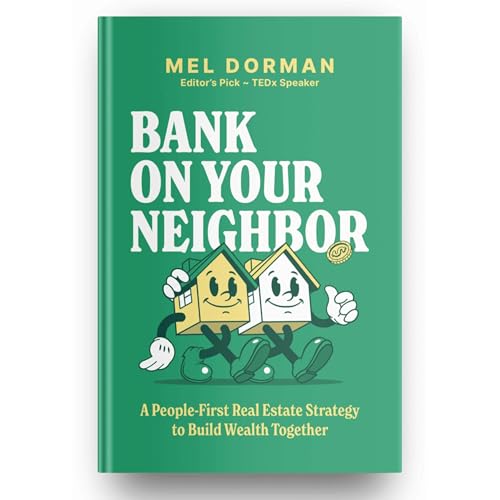
Seller financing sits in a corner of property investing that most beginner material skips entirely, which makes an audiobook devoted to it worth a closer look than its self-help framing suggests. Bank on Your Neighbor runs six hours and fifty-one minutes and arrived in August 2025 with Mel Dorman in both the author and narrator slots. The pitch is right in the title: the money comes from a person rather than an institution, and the opening line of the description promises that building wealth does not have to mean Wall Street.
Exclusive audio series is what the description calls this, rather than a book, and the word choice is worth pausing on. Nothing else on the record supports it: one file, one runtime, no episode count, no season, no indication of whether more installments exist or are planned. A buyer reading series might reasonably expect a subscription or a course with modules. What is on offer is a single continuous recording of roughly the length of an audiobook, which is fine, but the mismatch between the language and the product is worth sorting out before you spend anything.
Straight after that, the description runs into the author's own web address, with no space before it and no explanation of what sits at the other end. That is unusual on a retail listing, and it tells you something about how this product is positioned: as one piece of a practice rather than as a standalone publication. No publisher is named anywhere on the record either, so this is a self-released title with no house standing behind the editorial choices. Neither fact is disqualifying. Both change what a buyer should expect.
Dorman Sounds Like Someone Who's Done This
Seller financing genuinely deserves a dedicated treatment. Most property education is built around bank lending, which means the moment a deal falls outside conventional underwriting the standard playbooks stop being useful. A recording that spends nearly seven hours inside one financing structure can go deeper than a chapter in a general investing book ever will, and the depth is the argument for buying it. Ethical and win-win are the words the description reaches for, and the whole premise turns on making the arrangement work for the person on the other side.
Author narration counts for more here than it would on a narrative title. Method books sold by practitioners live on whether the person sounds like they have actually done the thing, and putting the author in the reader slot lets a listener judge that within a few minutes. Dorman is describing an approach rather than reporting a story, and the delivery of a technique by the person who uses it carries information that a hired reader cannot supply. Sample the opening before committing; on a book like this the first ten minutes are genuinely diagnostic.
Community framing is the other thing worth taking seriously. The description talks about deals rooted in relationships and strategy, and about building financial freedom inside your own neighborhood. That is a meaningfully different proposition from anonymous transactions at scale, and it changes the risk profile in both directions: better information about the counterparty, and considerably more at stake socially if a deal goes wrong. A listener who takes that seriously will find the ethical framing is doing real work rather than decorating the pitch.
Every State Left Unnamed on This Listing
Rules for owner-financed transactions vary by jurisdiction, and the record names none. No state, no country, no regulatory framework, and no note about licensing or disclosure obligations appears anywhere in the description. That absence matters more on this subject than on most, because the difference between a legal arrangement and an unenforceable one can come down to local requirements that no general recording can cover. Treat the content as a way of thinking about deals and verify the mechanics with somebody qualified where you actually live.
Format imposes a second limitation. Deal structures involve terms, schedules, and numbers, and no worksheet, template, or companion document is named on the listing. Anyone planning to build an actual offer from this material will be transcribing by hand or pausing repeatedly to write things down. That is manageable across seven hours, but it argues for listening at a desk for at least one pass rather than treating the whole thing as commute material, and for keeping a notebook nearby from the first chapter.
Aimed at Sellers Ready to Skip the Bank
Small-scale investors who keep getting stopped by lending criteria are the obvious audience, along with sellers weighing whether to carry paper on a property they own outright and want to move without a bank in the middle. People drawn to the community aspect, who would rather do business with someone they can find on a local street than with an underwriting department, will connect with the framing immediately. So will listeners who have been through a conventional purchase and come out convinced the process is more complicated than it needs to be.
Buyers who want citations, case studies with named numbers, or a legal review will not find those promised anywhere in the description, and should treat this as one practitioner's method rather than as a survey of the field. The same goes for anyone hoping to hear from more than one voice: this is a single point of view, delivered by the person who holds it, sold on a page that offers nothing beyond that person's own account of what works.
Common Questions
What does the audiobook actually teach about seller financing?
The description promises a people-first approach to creating ethical deals that work for both sides, rooted in relationships and strategy rather than institutional lending. It stays at the level of method and mindset in its own summary, and no chapter list or curriculum outline appears on the record to narrow that down further.
Is the audiobook part of a larger program or course?
The description calls it an exclusive audio series and ends on the author's own web address, but the record shows a single six hour fifty-one minute file with no episode numbering, module list, or companion material named. Anything beyond the recording itself would have to be confirmed elsewhere before buying.
Does it cover the legal side of owner-financed deals?
Nothing on the listing says so. No jurisdiction, licensing requirement, or disclosure obligation is mentioned anywhere in the description, and rules for these transactions differ from place to place. Use the material for strategy and have the paperwork checked locally by somebody qualified before signing anything.
Is this a self-released title?
It looks that way. No publisher is credited anywhere on the record, and one name sits in both credit slots, so the method arrives in the voice of the person selling it. The listing carries no biography or track record, which leaves sampling the recording as the only way to judge the experience behind it.