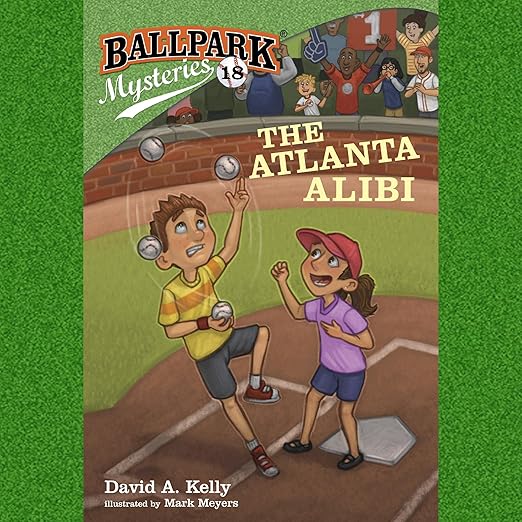
- Narration: Marc Cashman reads alone, moving between the mystery itself and the factual Dugout Notes appended to it.
- Themes: Junior detection, alibis and red herrings, baseball history, cousins working as a team
- Mood: Bright, brisk, fact-flecked
- Verdict: A well-judged seventy-five minutes for young sports fans, built on a real piece of baseball history.
Hank Aaron's 715th home run is real, and so is the record it broke. What David A. Kelly invents for this audiobook is the theft: the historic bat and ball from that night have gone missing in Atlanta, and cousins Mike and Kate are in town to work out who took them. Anchoring an invented mystery to a genuine piece of baseball history is the trick this whole series runs on, and it is a good one, because a seventy-five-minute chapter book ends up delivering a fact a child will keep long after the culprit is forgotten.
Where Alibis and Red Herrings Get Named
The most useful assessment on the page comes from an adult who read it as an adult and calibrated accordingly. That account notes that working out the solution is easy enough from a grown-up vantage point, then argues that this remains one of the stronger mystery series for the upper elementary audience, describing it as intelligent without carrying the heavier material that tends to arrive with middle-grade mysteries. That is the correct frame. A puzzle transparent to a forty-year-old can be genuinely challenging to an eight-year-old encountering the machinery for the first time.
Machinery is what the series is actually teaching. Alibis and red herrings are named as such, in the text, where a young reader can watch them working. That approach is close to how the classic children's detective series operate, and it treats a mystery as a form with rules rather than a story with a surprise at the end. A child who finishes several of these has absorbed the vocabulary of deduction, which is a more durable acquisition than any individual plot.
Worth crediting how carefully the sleuthing is bounded. Mike and Kate do enough investigating on their own to be the heroes while staying broadly sensible, and adults and the police remain involved to a degree. Getting that balance right is harder than it looks, since a mystery needs children to act independently while a parent buying it would rather not supply a model for wandering off alone. Kelly threads it without draining the adventure out of the story.
Cashman's Single Voice Shifts Register
Seventy-five minutes is an unusually well-judged length for the target reader. It fits a car journey, an afternoon, or two bedtimes, and it delivers a complete mystery with a real resolution inside that window rather than a fragment of something longer. One parent describes an eight-year-old who loves sports breezing through these while still finding them interesting and engaging, and calls it a great early chapter book. Momentum matters enormously at that age, and a story that ends before attention runs out is doing something valuable.
Marc Cashman voices it alone, and the assignment carries a wrinkle beyond the two young cousins and the adults around them. Each entry includes Dugout Notes, a section of genuine baseball facts appended to the fiction, which means a single voice has to move between a story register and a factual one inside one short file. Print marks that shift visually with a heading a child can see coming. Audio has to signal it some other way, and how cleanly that transition reads is worth checking in the preview.
A Ballpark Tour Filed as Geography
Entry eighteen sounds forbidding and is not. Each book takes Mike and Kate to a different ballpark with a self-contained case, so the series number indicates how many exist rather than how many a child needs first. Starting in Atlanta is perfectly reasonable, particularly for a family with a local connection to the city or an interest in the Aaron story specifically. The one practical consequence of the numbering is that tracking which entries a child has already heard becomes its own small administrative task.
The category tag on this listing reads Geography and Cultures, which looks like a filing error and turns out to be an accurate description of what the series does. Every volume is organized around a real city and its ballpark, so the books function as a tour of American places with a mystery attached to each stop. Parents browsing under sports or mysteries may miss them entirely, which is the real cost of the shelving. Search by series name rather than by category.
Value deserves an honest word. A seventy-five-minute recording priced as a standalone purchase asks a good deal per hour compared with a full-length children's novel, and families working through a long series will feel that quickly. Library borrowing and subscription catalogs are the sensible routes for a series consumed at this pace. The counterargument is that a book a child actually finishes and asks to repeat is worth more than a longer one abandoned at chapter three, which is the trade these short entries are built around.
Halfway Between A to Z Mysteries and Lupica
Sports-loving children roughly six to nine are the target, especially newer readers building confidence, and one reader sums the appeal up as a perfect summer series for elementary-aged kids. Families who take road trips to ballparks have an obvious use for it. The description points toward readers of Ron Roy's A to Z Mysteries and Matt Christopher's sports books, and toward younger siblings of Mike Lupica readers, all of which are accurate signposts for a parent trying to place the reading level.
Adult mystery readers hoping for a puzzle that resists them will be disappointed, and should treat this as a book to share rather than to consume. Children who have moved on to longer middle-grade fiction will find the plotting thin and the vocabulary undemanding, since neither is aimed at them. And anyone hoping the baseball is incidental should know it is not; the sport saturates the series, and a child indifferent to it will not be converted by the mystery alone.
Do I need to listen to the earlier Ballpark Mysteries books first?
No. Each case resolves inside its own volume, and nothing carries over that a newcomer would need to catch up on. The cousins and their dynamic are re-established early every time, so the eighteenth entry opens as easily as the first, especially for a family drawn to the Atlanta setting.
How long is The Atlanta Alibi audiobook?
One hour and fifteen minutes, which suits a car journey or a couple of bedtimes and delivers a complete mystery inside that time. The brevity is deliberate for the age group, prioritizing a finished story over length, though families listening through the series will find the per-hour cost adds up.
Does this audiobook work as a shared family listen?
It suits that use well. Seventy-five minutes covers a car journey or a couple of bedtimes, the plotting is easy for an adult to follow while only half-attending, and the baseball history gives a parent and child something to talk about once the case has closed.