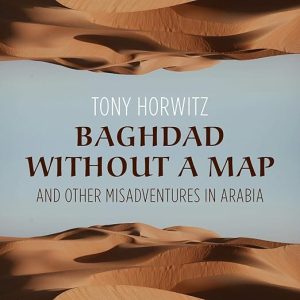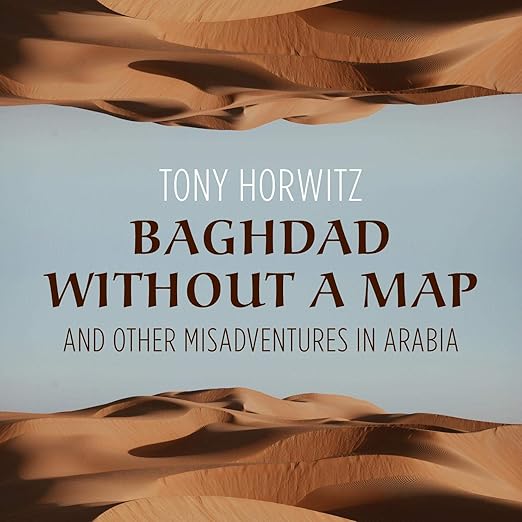
I first encountered Tony Horwitz through Confederates in the Attic, the way most American readers do, and spent a Sunday afternoon entirely derailed when I discovered that Baghdad Without a Map predated it by nearly a decade. This is where Horwitz was developing the voice that would later produce Blue Latitudes and his Pulitzer Prize-winning journalism: the comic self-awareness, the eye for the telling incongruity, the willingness to absorb discomfort and report it without self-pity. It is a younger book, with rougher edges, but those edges are part of what makes it interesting.
The book grew out of Horwitz's years as a correspondent in the Middle East, during which his wife Geraldine Brooks, herself a Pulitzer Prize-winning author, was also reporting in the region. That spousal deployment context, which one reviewer correctly notes is the origin point of the whole enterprise, shapes the book's tone in interesting ways. Horwitz is not the lone romantic adventurer of the classic travel narrative tradition. He is a journalist doing a job in places that do not especially want journalists, trying to find stories and largely finding chaos instead. The comedy is the coping mechanism of a man who knows he is out of his depth and decides to be honest about it.
Is Baghdad without a Map and Other Misadventures in Arabia Worth Your Time?
Fourteen countries including Yemen, Lebanon, Sudan, Iraq, Israel, and Afghanistan appear in this account, and Horwitz moves through them with a characteristic combination of journalistic persistence and spectacular situational helplessness. The scene in which he chews qat with Yemeni men, plays soccer with Dinka refugees in southern Sudan, and travels with press corps journalists to view corpses from the Iran-Iraq war, described by one longtime reader, captures the book's emotional range well. Some of it is genuinely funny. Some of it is disturbing. The mixture is the point.
What separates Horwitz from the broader category of American journalists writing about the Arab world is his refusal to subordinate his experience to a thesis. He is not trying to explain the Middle East to you. He is trying to show you what it felt like to be a young American reporter dropped into it at a specific historical moment, 1990-1991, just before the Gulf War changed everything. The region he describes is recognizable in many ways because the structural tensions he observed have not resolved. That persistent relevance is both the book's strength as a historical document and its most uncomfortable quality.
The Best Parts of Baghdad without a Map and Other Misadventures in Arabia
The narration by Nathaniel Brooks Horwitz, the author's son, is one of the more affecting casting choices I have encountered in travel audiobooks. Horwitz died in 2019, and his son reading this early work carries an emotional dimension that a professional narrator simply could not replicate. Nathaniel reads with the kind of restrained familiarity you would expect from someone who grew up knowing these stories, and his delivery honors the comic timing without performing it. A reviewer noted the book is humorous, heartbreaking, educational, and honestly reported, and Nathaniel's reading captures all four registers without forcing any of them.
The audio format also suits the episodic, anecdote-driven structure of the book particularly well. Baghdad Without a Map is not a continuous narrative building toward a single conclusion. It is a collection of reported encounters organized by geography and escalating in political intensity as Horwitz gets closer to Iraq and the outbreak of war. Each chapter works as a self-contained listening session, which makes this a strong choice for commute listening or any context where you cannot guarantee an extended block of uninterrupted time.
Before You Commit to Baghdad without a Map and Other Misadventures in Arabia
This book was written in 1991 and reflects the knowledge and attitudes of its time. Horwitz's perspective on the region is that of a liberal American journalist of his generation, and some of his framing of Arab societies and Islamic culture reads as a product of its era. His humor is generally pointed at himself and at Western geopolitical hubris rather than at the people he meets, which distinguishes it from the uglier tradition of Western exoticism in travel writing, but readers attuned to postcolonial critique will find moments worth examining critically.
One reviewer noted that this book is not quite as insightful as Horwitz's later works like Confederates in the Attic or Blue Latitudes, which were driven by specific historical obsessions rather than the accumulation of reporter experience. That is a fair observation. Baghdad Without a Map is a first major book, and it shows in a looseness of structure that the later work does not have. For readers who love Horwitz's mature voice, this is a fascinating origin document. For readers coming to him fresh, either work is a valid entry point, but the later books are tighter.
Should You Listen to Baghdad without a Map and Other Misadventures in Arabia?
This is for listeners who want travel writing that takes political complexity seriously without sacrificing readability, who are interested in the Middle East as it was in the years just before the Gulf War transformed the Western relationship to the region, or who came to this book through Horwitz's later journalism and want to see where his voice began. The Nathaniel Horwitz narration adds a dimension that makes this particular audio production worth seeking out over the text.
Skip it if you are looking for deep, thesis-driven analysis of Middle Eastern politics, if the comic-misadventure frame of classic American travel writing leaves you cold, or if the 1991 context feels too historically distant to engage with. The book rewards listeners who are comfortable sitting with ambiguity and willing to take humor and grief in the same chapter.
Before You Press Play
- Narration: Nathaniel Brooks Horwitz, the author's son, reads with a quality of intimate familiarity that suits the material; his delivery captures Horwitz's wit without overplaying it, and the familial connection gives the reading an understated emotional resonance.
- Themes: Outsider journalism in hostile territory, the collision of ancient and modern worlds, the absurdity of geopolitical violence
- Mood: Darkly comic, observant, and occasionally unsettling in ways the humor cannot quite contain
- Verdict: A classic of American travel journalism that remains startlingly relevant to anyone trying to understand the Middle East outside the frame of crisis coverage, narrated with uncommon personal investment.
Frequently Asked Questions
Why is Tony Horwitz's son narrating this book, and does it affect the listening experience?
Nathaniel Brooks Horwitz narrates in place of his father, who died in 2019. His delivery combines genuine familiarity with the material with a narrator's earned restraint. The emotional resonance of a son reading his father's early work is present throughout but never overplayed. It adds a layer to the listening experience that simply cannot be separated from the audiobook version of this particular title.
Is this book primarily about Iraq and the Gulf War, or does it cover the broader Middle East?
Despite its title, the book covers fourteen countries across the Middle East and Arabian Peninsula, including Yemen, Lebanon, Sudan, Egypt, Israel, and Afghanistan. Iraq and the approaching Gulf War form the book's dramatic endpoint rather than its primary subject. Readers expecting an Iraq war book will find a much wider and more episodic account of the whole region in the year before the conflict began.
How does Baghdad Without a Map compare to Horwitz's later books like Confederates in the Attic?
Most readers who know Horwitz's later work find this earlier. It is looser in structure and more dependent on accumulated incident than on the organizing historical obsession that drives his mature books. His wit and eye are already fully present. The craft difference is in compression and thematic coherence. Baghdad Without a Map rewards readers who enjoy the texture of accumulation; Confederates in the Attic rewards those who want a single sustained argument.
The book was originally published in 1991. Has it aged well, and is the regional portrait it offers still relevant?
The structural tensions Horwitz observed, the collision of tribal, religious, and modern political forces, the gap between Western geopolitical assumptions and regional realities, have not resolved in the decades since. The specific political landscape has changed dramatically, and Horwitz's framing reflects 1991 assumptions. But as a document of what the region felt like before the Gulf War, and as an argument against simplistic Western narratives about it, the book remains productively unsettling.