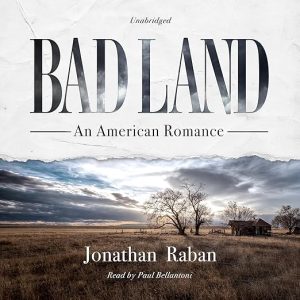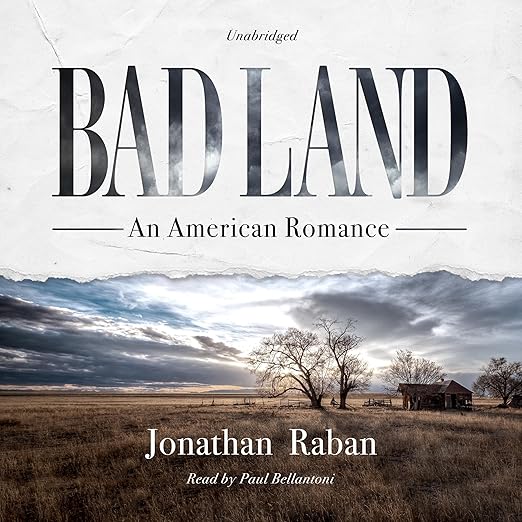
I came to Jonathan Raban through his later travel writing, and somewhere along the way Bad Land fell off my to-listen list. I finally got to it on a long drive through flat agricultural country in early spring, when the fields were still bare and the sky was the color of old pewter. The timing was uncanny. Raban writes about the eastern Montana plains the way you feel them when you are actually in them: as a landscape that dares you to find it beautiful and then slowly breaks your resistance down.
This audiobook had been sitting on my wishlist for months, but I had no idea it would hit this hard. Raban is British, Seattle-based by the time he wrote this, and the outsider perspective is precisely what gives the book its unsettling clarity. He sees what Americans have been trained not to see: that the homesteading dream was a confidence trick dressed up in grid paper and railroad brochures. That observation, stated plainly, sounds polemical. In Raban's hands, it is something more difficult: a grief-saturated reckoning with the distance between what a nation promises and what it delivers.
What We Made of It
The heart of the book is Raban's forensic examination of the Enlarged Homestead Act of 1909, which promised 320 acres of non-irrigable Montana land to anyone willing to work it. The key word, of course, is non-irrigable. Raban digs into the promotional materials, the brightly colored railroad pamphlets, the government literature, and shows how scientific language was weaponized to sell settlers on land that had already defeated the buffalo. He quotes actual texts and traces actual families, and the effect is a slow-building fury at the gap between official optimism and meteorological fact. The annual rainfall numbers alone should have told anyone that this was not wheat country. Nobody was telling.
One reviewer called this "masterly creative nonfiction" centered on Euro-American settlement of the Great Plains, and that framing is exactly right. Raban isn't simply recounting disaster; he's performing a kind of structural archaeology, showing how the myth was constructed layer by layer so that he can then dismantle it layer by layer. What remains is something harder and more honest: the actual human cost of a national fantasy that was never tested against the land it described.
What Makes Bad Land Worth Hearing
What lifts Bad Land above mere historical analysis is Raban's gift for the intimate portrait. He drives through the region decades after the homesteading collapse and finds the descendants, now elderly, of those first arrivals. The dignity he extends to these conversations is remarkable. One reviewer noted that when Raban sticks to the settlers and their experiences, "the writing fairly hums along, painting pictures of this indescribable land." That observation is accurate, and the reverse is also true: there are moments where Raban inserts himself and his own literary preoccupations more heavily, and the writing loses some of its forward momentum. It is a minor drift but an honest one worth noting for listeners who value documentary restraint.
The families he traces, including Norwegian immigrants, Scottish farmers, and people who answered the brochures with genuine hope, are rendered as full human beings rather than historical footnotes. Their letters survive. Their fence posts survive. Their dried-out irrigation channels survive. Raban reads these remnants like a detective and writes about them like a novelist, and the combination is what earns this book its reputation. He gives the descendants the same careful attention he gives to the historical record, and their voices enrich the book's moral texture considerably.
What Might Not Land
Bellantoni's narration is calibrated to the landscape itself. He doesn't rush. He allows Raban's longer sentences to unfurl at their own pace, and he treats the silences between ideas with the same respect a good reader gives to white space on a page. There are passages here, descriptions of the light over the high plains or of a particular family's final autumn before abandonment, where Bellantoni's restraint is exactly the right artistic choice. He could have leaned into the pathos, and he doesn't. The result is that the pathos arrives on its own, without announcement, which is the only way it should. This is one of those narrations where the voice and the text seem to have reached an agreement about what the material needs, and it holds throughout the twelve hours.
Running just over twelve hours, the audiobook is long enough to feel immersive without becoming exhausting. It demands genuine attention. This is not a book you can half-listen to while doing something else. But it rewards that attention generously, and the cumulative effect of Raban's method, moving between history and portrait and landscape description, is something you carry around after you finish listening.
Who Should Listen to Bad Land
If your mental map of Montana runs to fly-fishing and big-sky vistas, this book will complicate it permanently, and that's a gift. Bad Land is ideal for listeners who love narrative nonfiction that doesn't flatten its subjects into symbols; who are drawn to American history through the lens of ordinary lives rather than great men; or who have a taste for writers like Ian Frazier or Timothy Egan, both of whom have worked similar ground with similar seriousness. Raban's literary sensibility is more European, more novelistic, and occasionally more self-conscious, but his appetite for this particular American story is genuine and the scholarship underneath the prose is solid.
Listeners looking for straight history, clean timelines, and a neat thesis should know they're getting something more essayistic. Listeners looking for a beautiful, difficult, deeply researched piece of creative nonfiction about what this country did to people who believed its promises will find exactly that here. It is available as a free audiobook on Audible, which removes every barrier to beginning it.
Good to Know
Do you need prior knowledge of Montana history to follow Bad Land?
No. Raban is writing for a general audience and builds in enough historical context that newcomers to the subject will be fully oriented. Familiarity with the broader westward expansion narrative helps but isn't required.
Is this audiobook suitable for listeners who don't usually enjoy travel writing?
Yes, more than you might expect. Bad Land is as much social history and character study as it is travelogue. Raban drives the region in the present day but the book's real subject is the past, and his method is closer to literary journalism than conventional travel writing.