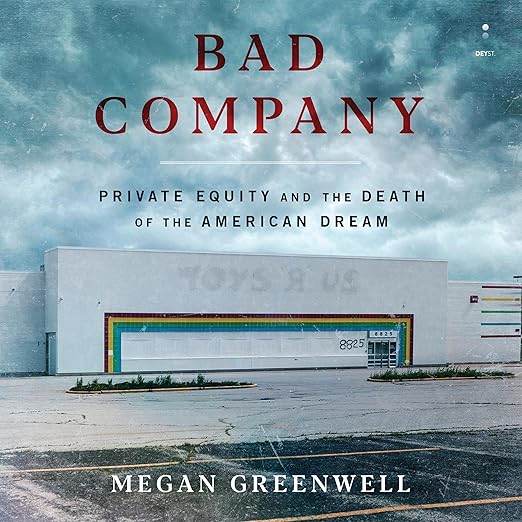
Bad Company
Audiobook & Ebook

Bad Company by Megan Greenwell | Free Audiobook

By Megan Greenwell

Narrated by Dan Bittner

🎧 8 hours and 51 minutes 📘 Dey Street Books 📅 June 10, 2025 🌐 English
🎧 Listen Free on Audible 📖 Read on Kindle

Free 30-day trial · Cancel anytime

About This Audiobook

*VANITY FAIR’S BEST BOOKS OF 2025*ONE OF NEW REPUBLIC’S BOOKS OF THE YEAR*KIRKUS’ BEST NONFICTION BOOKS OF THE YEAR 2025*ONE OF AV CLUB’S BEST BOOKS OF 2025*

“[An] indictment of an industry that has cannily tilted the playing field in its favor. Bad Company details how clichéd abstractions like ‘consolidation’ and ‘efficiency’ have given cover to real betrayals.” – The New York Times

A timely work of singular reportage and a damning indictment of the private equity industry told through the stories of four American workers whose lives and communities were upended by the ruinous effects of private equity takeovers.

Private equity runs our country, yet few Americans have any idea how ingrained it is in their lives. Private equity controls our hospitals, daycare centers, supermarket chains, voting machine manufacturers, local newspapers, nursing home operators, fertility clinics, and prisons. The industry even manages highways, municipal water systems, fire departments, emergency medical services, and owns a growing swath of commercial and residential real estate.

Private equity executives, meanwhile, are not only among the wealthiest people in American society, but have grown to become modern-day barons with outsized influence on our politics and legislation. CEOs of firms like Blackstone, Carlyle, KKR, and Apollo are rewarded with seats in the Senate and on the boards of the country’s most august institutions; meanwhile, entire communities are hollowed out as a result of their buyouts. Workers lose their jobs. Communities lose their institutions. Only private equity wins.

Acclaimed journalist Megan Greenwell’s Bad Company unearths the hidden story of private equity by examining the lives of four American workers that were devastated as private equity upended their employers and communities: a Toys R Us floor supervisor, a rural doctor, a local newspaper journalist, and an affordable housing organizer. Taken together, their individual experiences also pull back the curtain on a much larger project: how private equity reshaped the American economy to serve its own interests, creating a new class of billionaires while stripping ordinary people of their livelihoods, their health care, their homes, and their sense of security.

In the tradition of deeply human reportage like Matthew Desmond’s Evicted, Megan Greenwell pulls back the curtain on shadowy multibillion dollar private equity firms, telling a larger story about how private equity is reshaping the economy, disrupting communities, and hollowing out the very idea of the American dream itself. Timely and masterfully told, Bad Company is a forceful rebuke of America’s most consequential, yet least understood economic forces.

🎧 Listen Free on Audible

Free 30-day trial · Cancel anytime

Quick Take

  • Narration: Dan Bittner delivers Greenwell’s investigative prose with clear authority, a narration that serves the reportage rather than embellishing it.
  • Themes: Private equity and its human cost, economic inequality, community destruction, American capitalism’s accountability deficit
  • Mood: Maddening and necessary, the kind of book that makes you want to put it down and then immediately pick it back up
  • Verdict: One of the more important pieces of economic journalism published in 2025, built on four individual stories that make an abstract machine legible and infuriating.
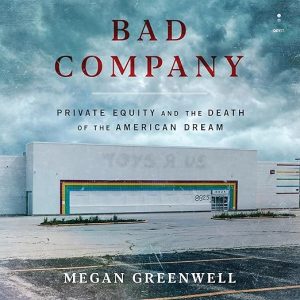

I started Bad Company during a week when I was already feeling generally exhausted by economic news. That was probably not optimal timing. By the end of the first section, the Toys R Us floor supervisor whose livelihood was dismantled by a firm that loaded the company with debt it could never service, I had paused the playback twice just to process. By the end of the week I had both listened to the whole book and decided to make changes to where I spend my money. Not everyone will have that response, but the book is designed to produce something close to it.

Megan Greenwell is a journalist with a track record of covering media industry collapses and the structural forces behind them. Bad Company expands that investigative instinct to cover private equity’s reach across an extraordinary range of American institutions: hospitals, daycare centers, supermarket chains, voting machine manufacturers, local newspapers, nursing home operators, fertility clinics, prisons, highways, water systems, fire departments, emergency services, and commercial real estate. The book’s central argument is that private equity has become so embedded in ordinary American life that most people encounter it daily without knowing it, and the executives of firms like Blackstone, Carlyle, KKR, and Apollo have acquired political influence commensurate with their economic power, while entire communities bear the costs of their decisions.

Our Take on Bad Company

What Greenwell does that distinguishes this from other private equity critiques is the structure. Rather than moving directly to argument and evidence, she grounds the entire book in four individual human stories: a Toys R Us floor supervisor, a rural doctor, a local newspaper journalist, and an affordable housing organizer. This is the Matthew Desmond method, the comparison Greenwell’s publishers make to Evicted is apt and not merely promotional, and it works here for the same reason it works in Desmond’s book. Abstract economic machinery becomes comprehensible and emotionally real when you are watching it grind through a specific person’s specific life.

One reviewer named the book maddening but well-written, which is the accurate and efficient summary. Another described having to regularly put the book down to process the dreadful stories before picking it back up. A third, the most critical of the substantive reviews, argued that the book doesn’t grapple adequately with whether private equity is the problem or capitalism more broadly, and that the four stories don’t represent the full range of private equity outcomes. These are fair criticisms of a work with genuine argumentative limits. But they don’t undermine the core achievement: making a system that benefits from opacity genuinely legible to a general audience.

Why Listen to Bad Company

Dan Bittner’s narration is clean and authoritative without being theatrical. Investigative nonfiction in audio format lives or dies by the narrator’s ability to maintain momentum across dense explanatory passages without losing the human texture of the individual stories at the center. Bittner manages both registers well, he reads the economic mechanics sections with appropriate clarity and the personal narrative sections with genuine warmth, without overcooking either. The transition between Greenwell’s analytical mode and her storytelling mode is handled smoothly enough that the listener rarely notices the gear shift.

At just under nine hours, the book is the right length for its structure. The four individual stories and the contextual analysis that surrounds them don’t feel padded or rushed. One reviewer who both read the book and listened to the audiobook found both versions held their full attention, that’s a meaningful endorsement of the audio production specifically. The material is dense enough that some listeners may benefit from treating individual sections as discrete listening sessions rather than attempting the whole book in a single stretch.

What to Watch For in Bad Company

The critical review’s point about the book’s argumentative limits is worth taking seriously. Bad Company tells the story of private equity’s destructive potential through cases that demonstrate that destructiveness clearly. It does not engage systematically with cases where private equity intervention produced better outcomes than the alternative, nor does it develop a fully theorized account of what a better system would look like. This is a journalistic indictment, not an economic treatise, and some readers will find that the book’s emotional power comes partly at the expense of its analytical completeness.

It’s also worth noting that the book’s subject is ongoing. The private equity landscape described in Bad Company is not static, and some of the specific cases Greenwell follows have developed since publication. For listeners who want to understand the structural dynamics rather than just the current situation, this is a feature of any journalism that addresses live issues rather than settled history.

Who Should Listen to Bad Company

Anyone with a professional or personal stake in any of the industries Greenwell covers, healthcare, journalism, retail, housing, will find the book clarifying in ways that may also be alarming. General readers interested in how American economic institutions actually function, as opposed to how they present themselves, will find it both accessible and genuinely illuminating. The structural choice of four individual human stories makes this book workable for listeners who aren’t already steeped in economic journalism, you don’t need a background in finance to follow the argument. If you found Matthew Desmond’s Evicted or Bethany McLean and Peter Elkind’s The Smartest Guys in the Room useful and affecting, this belongs on a similar shelf. Listeners who are skeptical of structural critiques of capitalism and want a book that steelmans private equity’s positive potential will find Bad Company a deliberately one-sided account.

Frequently Asked Questions

Does Bad Company explain private equity clearly enough for readers with no financial background?

Yes, deliberately so. Greenwell structures the book around four individual human stories precisely to make the mechanisms of private equity legible to a general audience rather than a finance-specialist one. By the time the analytical sections arrive, the reader already has concrete human context for what concepts like ‘leveraged buyout’ and ‘fee extraction’ actually mean in practice. One reviewer described reading it and listening to it twice, both times with full attention, not a typical pattern for technically demanding nonfiction.

Is the book’s focus on private equity as purely destructive? Does it acknowledge any cases where private equity improved a business or community?

The book is an investigative indictment rather than a balanced survey. Greenwell selects cases that demonstrate private equity’s harmful effects because her argument is that those effects are systematically produced by the structure of the industry rather than idiosyncratic. One critical reviewer identified this as a genuine limitation, the book doesn’t engage with counterexamples or develop a full systemic alternative. That criticism is fair, and listeners expecting analytical balance should know the book’s orientation upfront.

Dan Bittner narrates a wide range of nonfiction. How does his voice suit the combination of investigative journalism and personal storytelling in Bad Company?

Well, actually. Bittner’s delivery is authoritative and clear without being cold, which is the right calibration for a book that needs to sustain both intellectual argument and emotional engagement across its running time. He doesn’t reach for drama in the personal narrative sections, which would be the wrong move, the human stories Greenwell tells are affecting on their own terms and don’t need narration performance added. One reviewer who both read and listened to the book found both versions equally engaging, which is a meaningful data point.

Does Bad Company tell the full story of what happened to the four people at its center, or does it leave their situations unresolved?

Greenwell follows each person’s story to a meaningful stopping point that reflects where their situation stood when the book went to press. The individual outcomes are not uniformly bleak, but they are honest about the limits of what is recoverable once private equity has restructured a community or industry. The book’s emotional precision comes partly from not forcing resolution, it acknowledges that some of what has been lost doesn’t come back.

Ready to listen?

🎧 Listen to Bad Company for free

Free 30-day trial · Cancel anytime

What Listeners Are Saying

★★★★★

If you loved Toys”R”Us, this book will captivate and infuriate you

Megan’s narration style is excellent. I read the book once and then listened to the audiobook, and both versions held my full attention. There’s a lot to absorb if you’re not already familiar with private equity and its destructive “leveraged buyouts,” but it’s an important and eye-opening read. A horrible…

– Amazon Customer
★★★★☆

Maddening book we all need to read

Interesting look into the rise of private equity and its terrible effects across multiple industries. Maddening but well-written.

– Beth
★★★★★

Awesome book

Great reading material

– Miriam Abreu
★★★★★

Read It and Weep – And Change Your Buying Habits

This book was eye -opening. Hard to get through – I had to regularly put it down to process the dreadful stories about how private equity has destroyed and continues to destroy businesses and communities. Really well done in terms of how the author structured it – using the individual…

– A. Gjeny
★★★☆☆

A missed opportunity

The author is at her best when telling the stories of the four people and the life they live. After that, the book is a let down. I guess the point of the book is that private equity firms create poor quality businesses, including the book's focus on toy stores,…

– Joshua
Alexandra Reed

Written by Alexandra Reed

Founder & Literary Critic