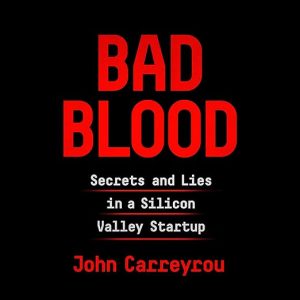
John Carreyrou's Bad Blood begins with a company valued at more than nine billion dollars on the basis of a technology that did not work, and it ends with criminal convictions. The eleven hours and thirty-seven minutes between those two points, narrated by Will Damron, constitute one of the most compulsively listenable pieces of reported nonfiction produced in this decade. Carreyrou was the Wall Street Journal investigative reporter who broke the original Theranos story; the audiobook that resulted from his reporting is not a summary of the scandal but a reconstruction of how it was possible, and that distinction is what makes it essential rather than merely timely.
Where This One Lands
Theranos founder and CEO Elizabeth Holmes was in 2014 widely seen as the next Steve Jobs: a brilliant Stanford dropout whose startup "unicorn" promised to revolutionize the medical industry with its breakthrough device, which performed hundreds of laboratory tests from a single drop of blood. Backed by investors including Larry Ellison and Tim Draper, Theranos sold shares in a fundraising round that valued the company at more than nine billion dollars, putting Holmes's worth at an estimated 4.5 billion. The problem was fundamental: the technology did not work. Erroneous results put patients in danger, leading to misdiagnoses and unnecessary treatments. All the while, Holmes and her partner Sunny Balwani worked methodically to silence anyone who voiced misgivings, from journalists to their own employees.
Damron's narration serves the material by maintaining clinical authority without losing narrative momentum. The Wall Street Journal's house style leans analytical, and Carreyrou's prose follows that discipline: he does not reach for emotional language when the facts themselves are sufficiently alarming. Damron honors this register precisely. When the text describes a board of directors containing Henry Kissinger, George Shultz, and James Mattis being systematically deceived by a twenty-something CEO, Damron reads it without editorial emphasis, which is exactly right. The absurdity is already in the facts. Editorial emphasis would diminish it.
The book's construction is investigative rather than narrative, and this distinction matters for the listening experience. Carreyrou reconstructed events primarily through interviews with former Theranos employees who risked significant legal exposure to speak with him, and each chapter follows a different person's experience inside the company: engineers who raised technical concerns and were dismissed or threatened, laboratory scientists who discovered the test inaccuracies and were silenced, patients who received wrong results and were not informed. The cumulative portrait that emerges is more disturbing than any single dramatized account of the fraud could be, because it shows the institutional system that allowed the deception to persist.
What Makes Bad Blood Worth Hearing
Multiple reviewers have described Bad Blood as reading like a thriller, and Damron's pacing honors that quality without manufacturing it. The escalating pressure as Carreyrou's journalism closed in on Holmes, the legal threats designed to stop publication, and the internal panic inside Theranos as the company struggled to maintain its deception across multiple regulatory and journalistic fronts all receive full narrative attention. The book does not treat the Silicon Valley cultural dynamics that made Theranos possible as background noise; it builds a detailed account of exactly how the "fake it till you make it" ethos scaled from acceptable startup mythology to systematic patient endangerment.
One reviewer described the book as "one of the best I've ever read," specifically noting its emotional power alongside its factual density. Another came to Bad Blood from outside their usual reading habits, typically self-help and leadership books, and found themselves unable to stop listening. A third noted the ongoing relevance of the story, pointing out that legal proceedings were still unfolding when they listened. Carreyrou's new Afterword in the later edition addresses those proceedings and brings the legal aftermath into view for listeners who want the complete arc of the story.
The science of Theranos's technology is explained accessibly but not superficially. Carreyrou provides enough technical detail for a listener without laboratory science background to understand specifically what the device was supposed to do, what it actually did, and why the gap between those two things endangered real patients. This is harder to achieve than it looks in long-form science journalism, and the audiobook format suits it well. Damron's delivery keeps the technical passages from feeling like lectures while ensuring that non-specialist listeners arrive at the same factual understanding as specialist ones.
What Gives Us Pause
The cast of characters is large, and listeners who are not taking notes may occasionally need to backtrack to place a source. Carreyrou introduces each person with enough identifying information to orient within the chapter, but the number of former employees, board members, investors, and regulatory figures who pass through the account is substantial. Audiobook listening benefits here from the chapter structure, which tends to follow individual threads; losing one name rarely causes you to lose the thread of the chapter you are in, and each chapter's central figure is reintroduced clearly enough to reorient.
Holmes declined to participate in the book, so her perspective is absent except as reconstructed from documents and other sources, which Carreyrou notes transparently. The reporting is rigorous, but listeners who want Holmes's account of her own intentions and beliefs will not find it here. That absence is itself informative about the legal and strategic position she maintained throughout the period the book covers.
The Right Listener for Bad Blood
Anyone interested in how major fraud persists inside institutional systems designed to prevent it will find Bad Blood essential. Listeners who follow startup culture, medical technology regulation, or investigative journalism as a practice will each find different angles of the story particularly illuminating. Readers who have already followed the Theranos story through documentary coverage will find Carreyrou's sourced, granular account considerably more detailed and more disquieting than any summary of the scandal can convey. The audiobook rewards listeners who want to understand the mechanics of the deception, not just its scale, and Damron delivers those mechanics with the authority they require across nearly twelve hours of carefully constructed audio.
Key Details
- Voice: Will Damron controls the tone with precision, keeping the investigative report authoritative while letting the absurdity of the Theranos deception build naturally.
- Big ideas: Silicon Valley hubris, regulatory failure, the mechanics of long-term fraud
- Atmosphere: Clinical and increasingly disturbing
- Worth it?: Carreyrou's investigative audiobook on Theranos is a model of reported nonfiction: rigorous, fast-moving, and as unsettling as any thriller in the current catalog.
How does Will Damron's narration handle the large cast of sources and former Theranos employees?
With consistent clarity. Damron maintains authoritative delivery without differentiating characters through exaggerated vocal performance, which suits the investigative journalism format and keeps the factual account primary throughout.
Is this audiobook appropriate for listeners without a background in biotech or startup culture?
Fully. Carreyrou explains the technology, the investment structures, and the regulatory environment with enough clarity that no specialist background is required. The human dimensions of the story are accessible to any engaged listener.
Does the Bad Blood audiobook feel balanced, or does it read as prosecutorial?
Rigorously reported rather than prosecutorial in tone. Holmes declined to participate, so her perspective is absent except as reconstructed from documents. Carreyrou notes this transparently and the sourcing throughout is specific and verifiable.