In Brief
- Performance: Dave Ramsey self-narrates with the conviction of a three-decade practitioner; his Tennessee directness is the whole point of listening rather than reading.
- What it covers: Debt elimination, wealth building through consistent investing, financial discipline as moral practice
- Feel: Earnest and motivational, with the occasional edge of financial preacher
- Our call: A focused, honest audiobook for Baby Steps adherents ready to get serious about the investing phase.
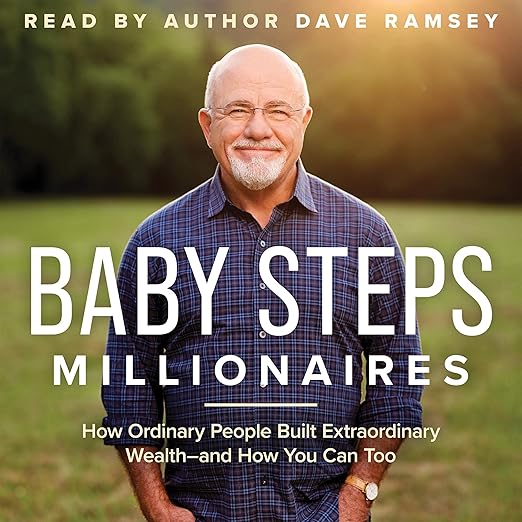
Ramsey's voice fills the room even before he says a word. I picked up this audiobook on a weeknight after sorting through a stack of personal finance titles that all seemed to promise the same painless path to wealth. Baby Steps Millionaires is different in one specific way: Dave Ramsey narrates it himself, and that decision shapes every minute of the listening experience. This is not a polished studio performance from a hired voice actor. It is a man who has spent three decades telling people to stop buying things they cannot afford, and he sounds exactly like that person.
Ramsey's Bankruptcy Story Grounds the Seven Steps
The central argument of Baby Steps Millionaires is disarmingly simple: follow the seven Baby Steps, stay the course, and becoming a millionaire is not a matter of luck or inheritance. Ramsey opens by revisiting his own story, making his first million in his twenties through leveraged real estate, losing everything in bankruptcy, and rebuilding by learning what the Bible says about money. That personal foundation runs through the entire audiobook and gives it a moral weight that purely tactical finance books often lack.
The bulk of the content is devoted to Baby Step 4, which covers investing fifteen percent of household income into retirement accounts. Ramsey walks through growth stock mutual funds, Roth IRAs, and the mathematics of compound interest with the patience of someone who has explained these concepts to millions of people who were terrified of money. He is not teaching hedge fund strategies. He is teaching ordinary households how to stop being broke, and the clarity of that focus is the book's real strength.
One reviewer described it as practical and motivating, noting that Dave does not talk down to his readers. That matches the listening experience. Ramsey's explanations are direct, occasionally blunt, and never wrapped in jargon. When he says this information is straightforward, practical, and maybe even a little boring, he means it as a badge of honor.
Ramsey's Tennessee Cadence Makes It Personal
Listening to Ramsey narrate his own material produces a specific kind of intimacy that a third-party narrator cannot replicate. His Tennessee cadence, his pauses before a point he wants to land, his mild exasperation when describing financial behavior he considers foolish: all of it signals that you are hearing a man who believes what he is saying with complete conviction. Whether or not you share his religious framework or his views on debt, that conviction is persuasive in audio form in a way that it might not be on the page.
The audiobook also integrates real stories from ordinary people who paid off debt and built wealth following the plan. These sections are not celebrity testimonials. They are accounts from teachers, nurses, and retail workers who started with nothing and ended up with retirement accounts they never imagined. Ramsey presents these stories with evident pride, and they function as the emotional backbone of an argument that is otherwise built on math and repetition.
At just under five hours, this is a lean production. It does not meander into personal anecdotes unrelated to wealth building, and it does not pad its runtime with filler content. The chapter structure is clean, making it equally effective for a single long listening session or broken across several commutes.
Actively Managed Funds Over the Index Approach
Listeners coming to Ramsey for the first time should know that his system has firm edges. He is deeply opposed to debt of almost any kind, skeptical of whole life insurance, and dismissive of investing strategies that involve significant complexity. If you are already familiar with index fund investing or the FIRE movement, some of his recommendations will feel conservative. His preference for actively managed mutual funds over index funds, in particular, runs against mainstream financial advice and is worth examining critically alongside other sources.
The religious framing, while sincere and never aggressive, is a consistent presence. Ramsey's approach to money is explicitly grounded in biblical principles, and listeners who prefer purely secular financial instruction may find this texture distracting. It is never preachy, but it is persistent.
The book also presupposes some familiarity with the Ramsey method. Listeners who have not encountered the Baby Steps before will benefit from the overview this audiobook provides, but the deeper treatment in Total Money Makeover remains the cleaner entry point to the full system. Baby Steps Millionaires reads more naturally as a companion volume than a standalone introduction.
The testimonial structure also rewards audio consumption over silent reading. Hearing Ramsey describe a family who started with negative net worth and reached millionaire status within fifteen years lands differently when delivered in his voice rather than processed through a reader's interior voice. The emotional contract between narrator and listener tightens with each story, which is why this book works most effectively as an audiobook rather than as a print experience.
Made for Listeners Already Working the Steps
This audiobook is well suited for people already working through the Baby Steps who want motivation and technical depth on the investing phase. It is also a strong choice for anyone who learns best from a conversational, story-driven format rather than charts and formulas. Listeners who have bounced off more cerebral personal finance titles because the tone felt cold or elitist will likely respond well to Ramsey's plainspoken approach.
Those who want a comprehensive breakdown of investment vehicles, tax optimization strategies, or nuanced retirement planning may need additional resources alongside this one. And listeners who actively disagree with Ramsey's stance on debt instruments or his theological framing will find this a frustrating rather than illuminating experience. The system works for the people it works for, and Ramsey makes no apologies for the boundaries of the plan.
Before You Listen
Does Ramsey cover specific investment fund recommendations in this audiobook?
He recommends growth stock mutual funds across four categories and mentions Roth IRAs and 401(k)s specifically. He does not name specific funds by ticker. His preference for actively managed funds over index funds is consistent with his broader teaching.
How does this audiobook handle the real-world stories of people who became millionaires?
The testimonials are woven throughout and cover a range of professions and starting points. Ramsey presents them as proof of concept rather than extraordinary exceptions. They are brief, emotionally effective, and grounded in specific numbers and timelines.
Is the audiobook format significantly better than the print version of Baby Steps Millionaires?
For Ramsey's material specifically, audio adds measurable value. His conversational register and delivery patterns are calibrated for speaking rather than reading. The self-narrated format removes the translation layer that occurs when a hired narrator interprets someone else's personality.