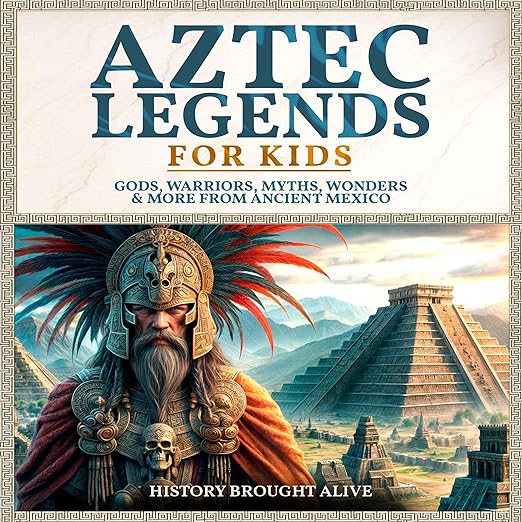
A time machine, a floating city, and a world that had to be made five separate times before it held: that is the itinerary this two-hour audiobook lays out for a listener young enough to want all three at once. Aztec Legends for Kids promises creation stories, sacred prophecies, towering temples and underworld journeys, and Guy Barnes reads all of it in two hours and six minutes. Short enough for a car trip, wide enough to cover an empire, and priced like a paperback.
Very Little Room to Sit Still
Six areas divide the running time, and the description lists them without coyness. The Creation of the Five Suns, in which the world is made, destroyed and reborn repeatedly. Quetzalcoatl, the Feathered Serpent, who brings knowledge, corn and civilization. Aztec warriors and Eagle Knights. The Great Temple and the Calendar Stone. Festivals, rituals and daily life in the floating city of Tenochtitlán. Then Montezuma and the arrival of the Spanish. Two hours split six ways gives each roughly twenty minutes, which is a survey rather than a study, and the pitch never claims otherwise.
Quetzalcoatl gets the fullest billing, and the ordering of that last section is the more interesting editorial decision. A children's mythology collection could stop at the gods and the temples and send everybody home pleased. This one ends where the empire does, with an arrival that changed everything, and it calls that chapter a dramatic turning point instead of dressing it as another legend. Families should know the ending is historical, not mythic, because a young listener who has spent ninety minutes with gods and eagle warriors will feel the gear change.
What the copy refuses is as telling as what it promises. This is not slow, dusty history, the description insists, which is a claim aimed squarely at an adult buyer who remembers being bored by a textbook. The risk in defining a book against that stereotype is that it commits the writing to constant momentum, and momentum through creation myths, calendar mathematics and imperial collapse leaves very little room to sit still. Twenty minutes per subject is a real constraint, and no amount of energy in the delivery changes it.
Barnes Simply Says the Hard Names Out Loud
Here is the case for choosing audio over print, and it is unusually concrete. JJ, writing from Canada, praises the print text for supplying phonetic spellings of the harder words, noting that many Aztec words run long and give an English speaker trouble. In an audio edition that entire problem dissolves. Guy Barnes simply says Tenochtitlán, Quetzalcoatl and ōllamalitzli out loud, and a child hears the shape of the language instead of decoding a bracketed respelling. The description promises clear pronunciation guidance for names and places; in this format that guidance is the narration itself.
JJ is otherwise measured in a way that helps a buyer. The collection provides a good overview of Aztec folklore, the review says, while noting it is not a particularly long book. Chapter seven, the legend of the eagle and the cactus, gets singled out as the standout, with the ending deliberately left unspoiled. That is a review doing its job: naming what the book is for, marking its size honestly, and pointing at one specific story where a vaguer response would praise the whole. Anyone deciding between mythology collections should weigh that phrasing carefully, because a good overview is a real compliment and a limited one.
An Amazon Customer takes a different approach and effectively reprints the contents as a list of questions. Do you know how humans were created from corn? How the world was formed, and that it took five tries to get right? How the sun and the moon came to be? What ōllamalitzli is? Then the review names the payload underneath: these legends teach bravery and determination, kindness and generosity, the same way they taught the Aztec themselves. For a parent scanning quickly, that question list is a more useful preview than the marketing copy above it.
The Rating, Unusually, Checks Out Exactly
Both responses on file were posted before this edition's stated release date. The dates read March 3 and March 8 against a release of March 16, 2026, so both are advance reactions, not listener reports, and both describe reading instead of hearing. Nobody on this page has yet described what Guy Barnes does with two hours of Nahuatl names and creation cycles, which is worth knowing given that the narration carries the exact feature the print reviewers singled out for praise.
The rating, unusually, checks out. The badge shows five stars, the tally beneath it admits to a pair of votes, and two five-star responses sit visible underneath, so those counted votes total ten of a possible ten and the score matches the column exactly. That alignment is rarer on these listings than it ought to be. It is also, plainly, two people. A perfect score assembled from two votes tells you nobody disliked it and nothing more, and a title this new has not had time to collect a dissent. Come back in six months and the decimal will almost certainly have moved.
History Brought Alive appears in both the author field and the publisher field, which means the byline is an imprint rather than a person. The Amazon Customer review treats it that way too, greeting the book as another great selection from a familiar producer. Nothing is wrong with that arrangement, but it changes what you are buying. A listener who likes this will be following a house style and a format across a catalog, not a writer whose next book will sound like this one.
Look Elsewhere for Scholarly Depth or Primary Sources
Curious children who already like myth, families looking for something substantial to fill a short drive, and homeschoolers who want a mythology unit that comes with its own pronunciation built in. The description names those groups itself, and for once the targeting is accurate. A child who has worked through Greek or Norse collections will find a pantheon that operates on different rules, and the daily-life section in Tenochtitlán gives the gods somewhere to live.
Parents wanting scholarly depth, primary sources or a sustained account of the conquest should look elsewhere, since twenty minutes a topic cannot deliver any of that. The same goes for anyone who wants the Spanish arrival handled at length instead of as a closing turn. Listeners who want the myths themselves, said aloud by a voice that has to get the names right, are exactly who this two hours was built for.
Common Questions
Can young listeners follow the Aztec names in this audiobook?
That is the format's biggest advantage. JJ praises the print edition for supplying phonetic spellings because Aztec words run long for an English speaker. In audio those respellings become unnecessary: Guy Barnes says Tenochtitlan, Quetzalcoatl and the rest out loud, and a child absorbs the sounds without stopping to decode anything.
How much ground do two hours actually cover?
Six areas: the Five Suns creation cycle, Quetzalcoatl, warriors and Eagle Knights, the Great Temple and Calendar Stone, festivals and daily life in Tenochtitlan, then Montezuma and the Spanish arrival. That works out to roughly twenty minutes each, so expect a confident survey, not depth on any single subject.
Why do the reviews describe reading instead of listening to the audiobook?
Both responses were posted in early March 2026, before the March 16 release date on this edition, and both discuss the text as a book on the page. They are advance reactions to the writing itself. Nothing on the listing yet describes what the narration does with the material.