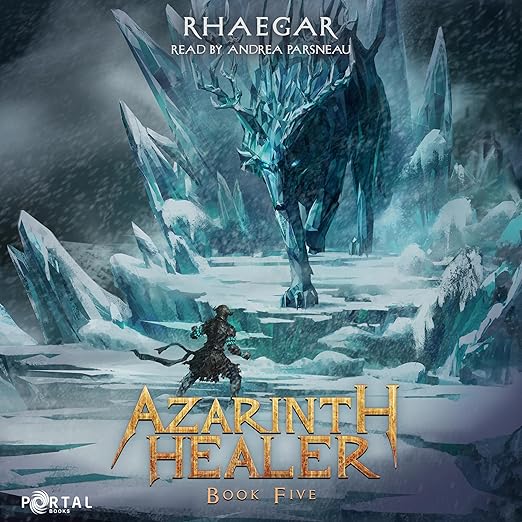
Rhaegar's Ilea Spears returns in Azarinth Healer, Book Five with the same core appeal that has sustained this LitRPG series through its preceding volumes: the protagonist remains relentlessly curious, physically powerful in increasingly specific ways, and pleasingly immune to the genre convention that trauma must hollow out a character before they are allowed to grow. This audiobook, narrated by Andrea Parsneau and running twenty hours and eighteen minutes, takes Ilea from the immediate aftermath of the Descent arc into a structure divided between teaching, grinding, and an unexpected military deployment that complicates what initially looks like a quieter, more reflective setup.
Book Five opens with Ilea returning south to check on her allies and begin laying groundwork for her elusive third Class. Trian has launched the Medic Sentinels training program, and Ilea's role as a reluctant instructor, teaching her battle-healer approach to a first generation of recruits, gives Rhaegar space to develop supporting characters who have been present but backgrounded in earlier volumes. For fans of the series, this quieter character-rich phase is exactly the kind of earned breathing room that makes the eventual return to brutal conflict feel meaningful rather than relentless.
What We Made of It
The LitRPG mechanics in the Azarinth Healer series are among the more thoughtfully calibrated in the genre. Rhaegar's dual-class system, where Ilea's evolution as both a damage dealer and a healer is governed by skill trees that require active engagement rather than passive leveling, avoids the number-inflation problem that makes some LitRPG progressions feel arbitrary and eventually hollow. Book Five continues this with the resistance-training framework: Ilea's preparation for her third Class involves deliberate self-exposure to dangerous magic and dungeon traps, a progression philosophy that rewards the reader's understanding of how her abilities interact and accumulate rather than simply watching a single number climb.
Reviewer Maria Richter places the Azarinth series alongside Drizzt Do'Urden, Jason Asano's work, and The Spellmonger, which is a comparison worth unpacking. What those series share is a protagonist whose power growth feels genuinely earned across volumes rather than handed out by authorial convenience, and whose personality remains an active source of reading pleasure across hundreds of hours of accumulated text. That last point is specifically relevant to Andrea Parsneau's narration, which has carried this series from the beginning: her understanding of Ilea's internal voice, and her instinct for where the character's humor is dry rather than broad, has become one of the series' primary assets.
The Medic Sentinel teaching arc is one of Book Five's genuine novelties. Watching Ilea attempt to pass on her resistance-grinding philosophy to recruits who have not yet internalized the core conviction that acceptable risk is whatever you can heal from gives Rhaegar a natural context for articulating what actually drives Ilea's approach rather than simply dramatizing it. One reviewer specifically calls out this story beat as something they want to see expanded in subsequent volumes, and that enthusiasm is understandable: the teaching arc develops Ilea's relationships with a new set of characters in a way that the dungeon-running structure alone cannot achieve.
The Best Parts of Azarinth Healer, Book Five
Parsneau's performance in the Azarinth series has developed into something quite specific and quite valuable: she renders Ilea's humor as dry and observational rather than performed, which suits a character who has survived more existential threats than most fantasy protagonists but maintains a fundamental equanimity about violence that the books play as comedy rather than desensitization. The reviewer who notes that characters are not voiced annoyingly, and that this has kept them engaged with the series across multiple volumes, is identifying something real. In LitRPG audio, narrators who over-differentiate monster voices or lean into squeaky sidekick registers can undermine the tonal consistency that makes a protagonist's perspective cohere across long runtimes. Parsneau does not make that mistake.
The structure of Book Five provides genuine genre variety within the series' established frame. The teaching sequences, dungeon runs, and eventual military deployment to a kingdom losing a war each offer a different kind of stakes and a different relationship between Ilea's power and the world around her. The transition from the first half's relatively peaceful grinding arc to the second half's active military deployment shifts tone considerably, and listeners who prefer the quieter sections should be prepared for that gear change around the midpoint.
What Might Not Land
Rhaegar is transparent about the tonal range of the series. The author's own description, equal parts comfy slice-of-life wanderings, goofy jokes, and brutal blood-pumping battles with nightmarish monsters, is accurate for Book Five as for any earlier volume. The cozy elements, Ilea hoarding snacks, making sarcastic observations about increasingly powerful monsters, building the Sentinel organization with the pragmatic logic of someone who has simply stopped being afraid of dying, coexist with genuine brutality in the combat sequences. Readers who want unrelenting grimness or unrelenting lightness will find the blend disorienting. Readers who enjoy that tonal flexibility will find it one of the series' most distinctive pleasures.
The series is firmly isekai in its foundational structure, beginning with Ilea's transport to a world governed by classes, levels, and skill progression, and Book Five does nothing to step outside that framework or interrogate it. Newcomers to LitRPG or isekai will find the system logically presented and Rhaegar's version of it coherently designed, but entering at volume five will deprive them of the accumulated investment that makes skill progression in this specific system satisfying. This is a series to start from Book One, full stop.
The Right Listener for Azarinth Healer, Book Five
This audiobook is for established fans of the Azarinth Healer series and LitRPG listeners who want a protagonist with genuine personality alongside competent mechanical system design. Andrea Parsneau's consistent narration across five volumes is a significant draw for listeners who track narrator performance in long fantasy series. Listeners new to LitRPG or to this series specifically should begin at Book One rather than sampling here. Those who find the grind-and-grow structure of progression fantasy fundamentally repetitive should start with a different series rather than expecting this volume to change what the genre is about.
In Brief
- Read by: Andrea Parsneau has made this series her own across five volumes; her instinct for Ilea's dry equanimity in the face of escalating violence is one of the production's defining assets.
- At its heart: Power progression through deliberate exposure, teaching what you have mastered, the logistics of founding something new
- Vibe: Comfortably propulsive, goofy in precisely the right places, occasionally brutal and entirely unapologetic about it
- Short version: Rhaegar's fifth Azarinth Healer volume delivers what the series has always promised: satisfying progression, genuine character warmth, and Parsneau narrating all of it with unerring tonal judgment across twenty hours.
Common Questions
Does Azarinth Healer, Book Five work as a standalone audiobook, or do I need the earlier volumes?
It requires prior investment. The skill progression, character relationships, and world context that make this volume satisfying are built across four preceding books. Multiple reviewers specifically recommend starting from Book One to get the accumulated payoff that makes the progression meaningful.
How does Andrea Parsneau's narration hold up across twenty hours of a fifth-series audiobook?
Parsneau has voiced the series from the start, and that continuity shows. Her rendering of Ilea's dry humor is consistent and earned, and reviewers specifically cite her characterization as a reason they continue with the series rather than a compromise they accept to access the story.
Is Book Five more focused on dungeon grinding or on character and world development?
Both, in roughly even measure. The first half centers on the Medic Sentinel training arc and Ilea's resistance-building dungeon work, offering a quieter character-rich mode. The second half deploys her into a military conflict that shifts the tone and raises the stakes considerably.