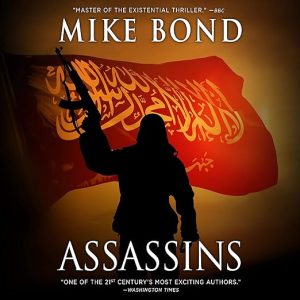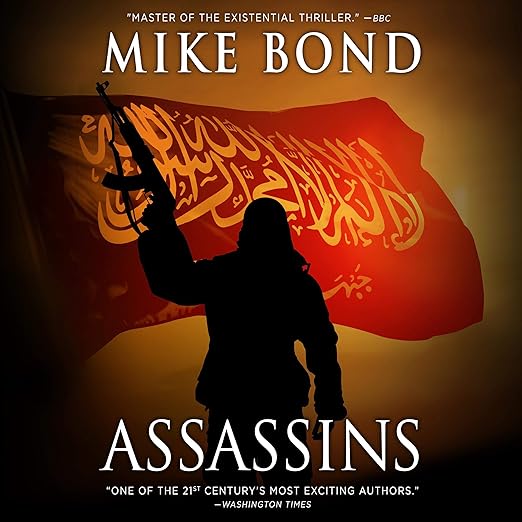
Nobody appears to have told the credit line on this audiobook what the book underneath it actually is. The author slot reads Tim LaHaye. The description that follows is a novel covering thirty years of war between Islam and the West, and one four-star reader, writing in January 2026, opens by attributing that exact title to Mike Bond. Below both of them, the genre classification says science fiction and fantasy, on a story that moves through Afghanistan, Iraq, Syria, the Sinai and Paris. Three slots on one page, three incompatible books.
Is Assassins Worth Your Time?
Everything except the credit points the same way. The January response lays out the opening: a CIA agent named Jack parachutes into the mountains of Afghanistan to help the mujahideen fight the Soviet Union, and several viewpoint characters carry the story from there. That is precisely what the product description promises, right down to the parachute drop and the roster of perspectives, so whatever went wrong on this listing, it went wrong in the byline rather than in the copy.
The structure is genuinely ambitious. Five viewpoints, deliberately spread across the sides of the same wars: an American commando, a French doctor, an Afghan warlord, a Russian major, a British journalist. The route runs from the night skies over Afghanistan to attacks in Paris, and the span is thirty years compressed into thirteen hours and thirty-seven minutes. Almost nothing in that arrangement is decorative. Each perspective exists to make the same conflict look different depending on which side of it you are standing on.
What deserves a flag before you buy is the register of the sales copy, because it does something unusual for fiction. It asks whether the Saudi government financed the September 11 attacks, whether one administration let bin Laden escape and then lied about weapons of mass destruction, whether a 2011 withdrawal produced ISIS. Then it answers each one with a variation on the phrase that it is all there, all real. A novel is being sold as an argument about recent history, and you should decide how you feel about that before hour one.
The Best Parts of Assassins
The most compact endorsement on the page comes from a five-star written in March 2026, which values the book for its angle rather than its action: the wars of the Middle East seen through the manipulations of the governments that caused them, from inside the working life of a secret operative. That single sustained vantage point across conflicts usually narrated separately is the real selling proposition here, more than any individual set piece.
Andy McKinney's five-star goes further and locates the payoff in the protagonist. That response describes a book that begins as a conventional thriller and turns into something considerably darker, and argues that what separates it from better-known work in the genre is the depth of the character study: a patriot doing the work from conviction, carrying a toll that only enormous moral strength could absorb. If you want tradecraft and gadgets, this will disappoint. If you want the slow accounting of what the job costs, that is the book.
Tim Campbell is the only voice Brilliance Audio credits, which makes the casting question unusually concrete. One reader delivers a French doctor, a Russian officer, an Afghan commander and a British journalist, in a novel whose entire method is switching heads. None of the five written responses says anything at all about how that turns out. On a book built this way, that is the gap I would most want closed before committing, and the sample is the only place to close it.
Before You Commit to Assassins
Start at the beginning, because that is exactly where the one dissenting response gets stuck. A three-star from November 2017 reports finding the opening hard to enter: it was not clear who had jumped from the plane, or whom they had come to support once they landed. The same response suspects the constant jumping between places is deliberate, an attempt to convey how chaotic the region is, and still finishes unsatisfied by the ending. In print you can flip back two pages to work out who is speaking. Listening, you cannot.
The rating headline needs the same skepticism. This page reports an average built from two ratings, while five signed responses sit underneath it carrying grades that range from three stars to five. Whatever that headline number is summarizing, it is not summarizing the written record you can actually read, and a book with this much political freight is precisely the kind where you want the written record rather than a rounded figure.
Dave's four-star lands the sharpest critique available anywhere here: one individual is placed at an implausible number of pivotal moments in the history of terrorism, the author has a very dark take on human nature, and the only thing missing is footnotes and sources. A novel that keeps insisting it is all real has drawn a reader asking, reasonably, to see the citations. That same response closes by warning off anybody who wants a good night's sleep, which is a fair summary of the tone from the first chapter onward.
Should You Listen to Assassins?
This suits listeners who want one fictional through-line connecting Afghanistan, Iraq, Syria and Europe rather than four separate books, who can take a strong political thesis without needing to agree with it, and who prefer character erosion to procedural detail. Anyone who has read a shelf of post-2001 war reporting and wants the same events arranged as a single life will find that framing worth the hours. It also rewards listeners with an appetite for the losing side of an argument, since the Russian officer and the Afghan commander are given room to be people rather than obstacles, and that even-handedness at the character level survives even where the sales copy is at its most partisan.
Avoid it if you arrived from the science fiction and fantasy shelf, because that classification is simply wrong and nothing here is speculative. Avoid it if you want sourced history, since the copy claims documentary weight the form cannot deliver. And avoid it if the credited author's name is what sold you, which brings us back to where this started.
Check the byline against the description before you buy, because on this page the two do not agree, and every other verifiable detail sides with the novel the responses are describing.
- Narration: Tim Campbell takes five nationalities solo for Brilliance Audio, and nothing on the page reports how that turns out.
- Themes: Three decades of war seen from inside covert work, government manipulation, moral cost accumulating across a career.
- Mood: Bleak, restless, argumentative.
- Verdict: A serious war novel wearing the wrong author credit and the wrong genre label; worth the time if you want the polemic as well as the plot.
Questions Listeners Ask
The byline on this audiobook does not match the book being described, so what should a buyer do?
Shop by the description rather than the name. Every checkable element, the plot summary, the roster of perspectives and the written responses, agrees with the others and disagrees with the credit. If you are buying a specific author's work, confirm from a second source before spending money, because this listing cannot be trusted to tell you whose novel it is.
Does the audiobook take a clear political position?
Yes, and it does not hide it. The sales copy poses direct questions about Saudi involvement in the September 11 attacks, weapons of mass destruction, and the withdrawal from Iraq, then insists the answers are in the book. If you want fiction that leaves the politics ambiguous, this is not it.