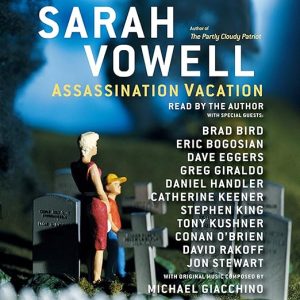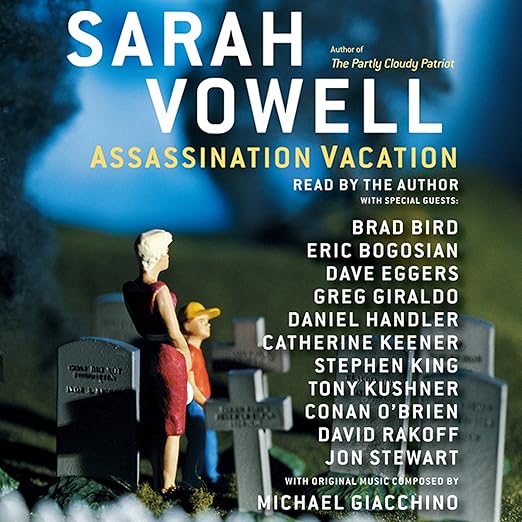
I came to Assassination Vacation the way I suspect many people do: someone recommended it on a day when I had complained about history being boring, and I was skeptical that a book about three presidential assassinations narrated by Jon Stewart was going to resolve that complaint in any meaningful way. It resolved it within the first fifteen minutes. The chapter about Robert Todd Lincoln, present at the assassinations of Lincoln, Garfield, and McKinley, apparently cursed to be adjacent to American tragedy, had me laughing out loud in a parking lot, which is not the typical response to a book about political murder.
Sarah Vowell is a contributor to NPR's This American Life and the author of several American history books that operate in the same register: genuinely researched, rigorously argued, and written with an irreverence that makes the material accessible without cheapening it. Assassination Vacation is her most focused effort in this mode.
The conceit is elegant: Vowell takes a road trip to the sites associated with the assassinations of Lincoln, Garfield, and McKinley, not just the famous monuments but the less-visited locations, the overlooked museums, the historically significant spots that tourism has neglected or misrepresented. From Washington to Buffalo to Alaska, she reports on how these deaths have been used: for political advantage, for cultural mythology, for commercial tourism, for the satisfaction of a specific American appetite for narrative of martyrdom.
The Robert Todd Lincoln thread is the book's most sustained joke, the man was present at three separate assassinations and eventually refused public invitations out of what can only be described as self-preservation, but it is also its most pointed argument: American political history has a way of folding the same figures into multiple tragedies, and the coincidences say something about the smallness of the world in which these events occurred.
What Sarah Vowell Gets Right
Jon Stewart narrating Sarah Vowell is one of the more inspired casting choices in audiobook history. Their sensibilities, the same blend of genuine patriotism and sharp-edged critique, the same impatience with pieties that do not hold up to examination, produce a listening experience that feels collaborative even though Stewart is simply reading her words. His comedic timing in the funnier passages is precise, and his register in the more sobering sections shifts without the jarring transitions a less skilled narrator produces.
One reviewer who described themselves as an art historian found the book's treatment of American museum culture and historical tourism particularly resonant, Vowell takes seriously the question of what a monument says about the people who built it rather than about the person it memorializes. This kind of critical attention applied to popular destinations (the Lincoln Memorial gets an extended treatment) is rare in accessible history writing.
Where Sarah Vowell Loses Some Ground
The book was published in 2005, and some of its political asides have dated. Vowell's politics are legible throughout, she is no political neutral, and readers who find her particular brand of liberal civic engagement grating may find those sections more work than the history rewards. The book is not a polemic, but it has a point of view, and that point of view is consistent enough to occasionally interrupt the more purely historical passages.
The three assassinations receive unequal treatment. Lincoln gets the most space, as he inevitably must; Garfield and McKinley's sections are shorter and feel somewhat compressed by comparison. Listeners who come primarily for the Garfield material may feel slightly shortchanged.
Who Should Pick Up Assassination Vacation
History readers who find conventional narrative history dry will find this a revelation. Comedy listeners who are also curious about American political history will find it a productive gateway. The seven-hour runtime makes it an ideal single-weekend listen. Skip it if you need your history delivered with solemnity; Vowell's mode is seriousness-through-wit, and readers who experience humor as a sign of superficiality will be frustrated.
Why is Jon Stewart narrating a Sarah Vowell book?
Stewart has narrated Vowell's work before, the two have a long professional relationship through their shared media world. The match works because their comedic and political sensibilities are closely aligned.
Do I need prior knowledge of the Garfield or McKinley assassinations to follow the book?
No. Vowell provides sufficient context, and part of her project is recovering these less-remembered assassinations from historical obscurity. The Lincoln sections assume more baseline knowledge.
Is this appropriate for younger listeners interested in American history?
Generally yes, with parental awareness, the content involves political violence and some adult-oriented historical material, but Vowell's approach is thoughtful rather than graphic.
How does the audiobook compare to reading the print version?
One reviewer noted they bought the print version after listening specifically to highlight the interesting sections, the audio is the more entertaining format, but the density of historical detail rewards having the physical text as a reference.