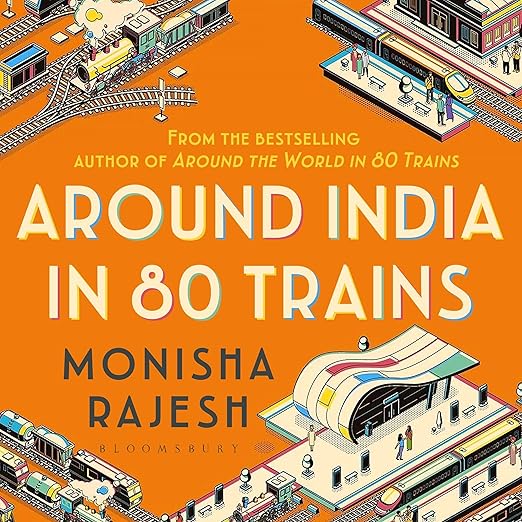
Covering 40,000 kilometers across 80 separate train journeys is, as a premise, almost absurd in its ambition. Monisha Rajesh makes it work because the ambition is not about logistics: it is about reconciliation. Rajesh's family left India when she was a child, returned briefly, and came home again to England with what she describes as a bitter taste. Two decades on, she turns to the Indian Railways as both structure and metaphor, letting the country's most literal connective tissue carry her back to a place that has become, in her words, a stranger to her. I had this audiobook on during a long run, and by the time Rajesh reached the Nilgiri toy train her writing had slowed my pace to something closer to a walk. Rajesh narrating her own account is a significant part of why. The ambivalence she carries about India is in her voice as much as in the prose.
How Around India in 80 Trains Holds Up
The Jules Verne framework, announced in the subtitle, is more structural than literal. Rajesh is not racing a clock; she is accumulating encounters. The 80 trains include toy trains, luxury trains, Mumbai's infamous commuter services, and a hospital on wheels, and each type of train offers a different cross-section of Indian life. That variety is one of the genuine pleasures of the audiobook: a chapter on a first-class compartment traveling through Rajasthan is followed by a chapter in the packed unreserved coaches of a passenger local, and the contrast gives the book a social range that a more conventionally structured travel narrative would miss. A reviewer who described the book as 'a roiling, restless, remarkable train adventure full of unexpected events and well-timed wit' captures the rhythm accurately. The wit is real, and it is Rajesh's own: sharp, self-aware, and never deployed at the expense of the people she meets.
Irvine Welsh's endorsement that 'no one writes trains like Monisha Rajesh' and William Dalrymple's claim that the book 'crackles and sparks with life like an exploding box of Diwali fireworks' are quoted prominently, and while cover blurbs invite skepticism, both are fair characterizations. The writing has a kinetic quality that audio suits particularly well, the sense of things moving past the window while the narrator is still processing what she saw in the station they just left behind.
Why Around India in 80 Trains Works as an Audiobook
Rajesh narrates herself, and the self-narration here is particularly effective because the audiobook is fundamentally a first-person account of personal reckoning as much as travel journalism. When she describes her family's complicated relationship with India, the ambivalence in her voice is not a performance; it is the thing itself. The cast of characters Rajesh encounters across 10 hours of listening is genuinely kaleidoscopic: fellow passengers who become friends, railway officials who range from obstructive to deeply kind, children sharing food in compartments, elderly travelers with stories that unfold slowly over overnight journeys. Rajesh renders each with enough specificity to feel like a real encounter rather than a type, and that specificity is what makes the audiobook feel like travel rather than writing about travel.
A reviewer noted that the quest for 80 trains is at one point genuinely in jeopardy, which provides the nearest thing to a conventional narrative crisis in a book that otherwise resists dramatic structure in favor of accumulation. That moment of actual suspense, after hours of building the stakes of the project emotionally, lands with real weight in the audio format. Rajesh's narration in that sequence carries something that a third-party reader would have difficulty reproducing.
Weak Spots in Around India in 80 Trains
One reviewer was direct about disappointment: the writing style can be dry at times. That observation is fair in specific passages, particularly in the earlier chapters where Rajesh is establishing the project's framework before fully settling into the rhythm of the road. The audiobook finds its stride around the third or fourth journey, and from that point the momentum is largely sustained, but the opening can feel more logistically focused than experientially rich.
Listeners who prefer travel writing organized around clear thematic chapters or chronological revelation may find the episodic structure slightly diffuse. This audiobook is about what you find when you keep moving, and it requires patience for the meandering that produces its best moments. The book also carries an implicit melancholy throughout, a sense of what Rajesh is trying to recover and whether recovery is actually possible, that may not be immediately apparent from the more comedic passages but becomes the emotional spine of the whole by the time the 80th train arrives.
The railway as a vehicle for identity recovery is not a new metaphor in South Asian literature, but Rajesh earns it through accumulation rather than assertion. By the time the eightieth journey arrives, the Indian Railways have done the structural work Rajesh assigned them: connecting a country to itself, and her to a country she was disconnected from. Whether the reconnection fully succeeds is a question the audiobook leaves appropriately open, but the attempt itself, documented with honesty and considerable wit across 10 hours, makes for a journey that sustains over its full length.
The Right Listener for Around India in 80 Trains
Fans of travel memoir and rail travel writing will find this among the more vivid and personally textured examples of the genre available in audiobook form. Listeners with a connection to India, whether personal or literary, will find the railroad as social and cultural cross-section particularly rich. Those interested in diasporic identity and the experience of returning to a country that no longer quite recognizes you will get more from this audiobook than a casual travel fan might expect. The self-narration makes it especially strong as an audio experience; this is a case where the voice doing the reading and the voice in the book are genuinely, productively the same.
Before You Listen
Does this audiobook require prior knowledge of India to be fully appreciated?
No. Rajesh explains the cultural and geographic context she moves through with enough clarity that listeners unfamiliar with India will follow easily. Those who do know the country will find additional layers of recognition, but the audiobook works without them.
Is Around India in 80 Trains primarily a travel book or a personal memoir in audiobook form?
Both. The journey structure is the book's external architecture, but the internal engine is Rajesh's attempt to reconcile with a country her family left behind. The travel and the memoir are inseparable in a way that makes the audiobook richer than either genre alone would suggest.
Does Monisha Rajesh narrating her own book strengthen or limit the audiobook experience?
Strengthens it significantly. Her ambivalence about India is not something a third-party narrator could reproduce from the text alone; it is in the inflection of her delivery as much as in the words themselves. The self-narration gives the audiobook a quality of direct testimony.
Is the audiobook suitable for someone who enjoys train travel specifically?
Absolutely. Rajesh covers a remarkable range of Indian railway experiences, from toy trains to a hospital-on-wheels to Mumbai's commuter crush, and the variations in train culture and passenger life are rendered with considerable specificity across 10 hours.