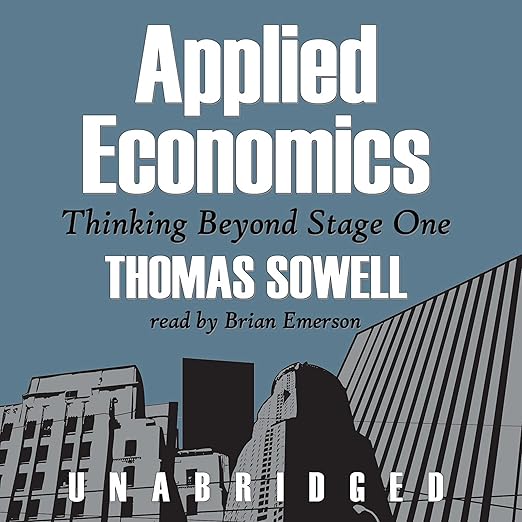
I spent some time during a particularly loud news cycle a few years ago working through Thomas Sowell's Basic Economics. By the end of it I had developed a useful habit I call thinking through stage two, asking myself not just what a policy is intended to do but what it will actually produce once incentives begin operating in the real world. Applied Economics is the follow-up, and where Basic Economics established the framework, this one does what the title promises: it takes the toolkit into specific, contested real-world domains and shows how economic reasoning produces different conclusions than political reasoning does.
Brian Emerson narrates, and his delivery is functional rather than distinctive. He reads clearly and at a pace that suits the analytical content. Sowell's prose is not ornate; it is precise and direct, and Emerson serves that directness without embellishment. At seven hours and forty-seven minutes, the audiobook is manageable across a week of commutes or a long car journey, and the chapter structure makes it easy to pause and return without losing the thread.
The Verdict, Briefly
Sowell's central diagnostic tool throughout the book is the distinction between stage-one and stage-two thinking. Politicians, he argues, are structurally rewarded for stage-one thinking: propose a policy that visibly addresses a problem, collect the credit, move on before the long-term consequences arrive. Economists, by contrast, are trained to think past the immediate effect to the second and third-order results that stage-one analysis misses. This is not a partisan observation; Sowell applies it to policies across the ideological spectrum, though his conservative orientation is visible in which examples he reaches for and how he frames certain debates.
The book works through housing markets, medical care, the economics of discrimination, and the economic development of nations. Each chapter uses Sowell's accumulated framework to cut through what he calls the inherent complexity and conflicting views that obscure most public debate on these subjects. One reviewer described his explanations as straightforward and respectful of basic economic principles without requiring specialist knowledge, which is accurate. Sowell writes for the citizen rather than the graduate student, and that choice shapes both the book's accessibility and its limitations.
Why Listen to Applied Economics
The strongest argument for this book in audio form is that Sowell's chapter structure maps well onto individual listening sessions. Each domain, housing, healthcare, and so on, is largely self-contained, which means a listener can absorb the housing argument on Monday and return to the medical care chapter on Wednesday without the analysis suffering for the gap. The book does not build a cumulative argument that requires earlier chapters to unlock later ones; it applies the same analytical approach to successive problems, which is both a structural virtue and a reason why some readers find it repetitive.
The section on discrimination economics is among the most rigorous and the most likely to generate productive disagreement. Sowell distinguishes between discrimination as a cause of economic disparities and the incentive structures that shape employer and employee decisions in ways that produce disparate outcomes without necessarily requiring discriminatory intent. Whether a listener finds this analysis compelling or partial will depend significantly on prior commitments, but the argument is made with enough precision that it rewards engagement even when it does not convince.
Points to Consider
One reviewer who rated the book one star described the development economics section as weak, noting well-known discussions about market solutions that add little new. That is a fair criticism. Sowell's approach to international development economics summarizes a position more than it advances an argument, and listeners who have read his earlier work on the subject will find less that is genuinely applied and more that is summary.
The book's conservative economic orientation also means that some of Sowell's framing choices push against mainstream economic consensus in ways he does not always acknowledge. His treatment of minimum wage effects and rent control, for example, presents one robust strand of economic thinking on these questions without fully engaging with the countervailing evidence. This does not make the analysis wrong, but it should be read as a perspective within a debate rather than as the settled view of the profession.
Should You Listen to Applied Economics?
Applied Economics is a strong choice for listeners who finished Basic Economics and want to see the framework in action, and for anyone who has felt frustrated by economic debates that seem to generate more heat than light. Sowell's commitment to clarity over rhetorical performance makes him unusually useful for listeners trying to form their own considered views rather than looking for their existing positions confirmed.
Those who find conservative economic perspectives consistently frustrating or who have already read Sowell extensively will get less from this than first-time readers. The book is also most valuable for listeners in the US context, where its specific policy examples, housing markets in San Francisco, Medicare and Medicaid economics, carry the most immediate relevance. International listeners will find the principles transferable but the illustrations more distant.
Questions Listeners Ask
Do I need to read Basic Economics before listening to Applied Economics?
No, but it helps. Applied Economics builds on the stage-one versus stage-two thinking framework introduced in Basic Economics, and Sowell explains it again here. Listeners new to Sowell's work will follow the argument, though those with his earlier book as context will find the connections richer.
Is Applied Economics politically neutral, or does it reflect a particular ideological perspective?
Sowell is a senior fellow at the Hoover Institution and a conservative economist, and that orientation shapes which examples he selects and how he frames certain debates. The analytical tools he uses are drawn from mainstream economics, but his policy conclusions lean consistently in one direction. Listeners should engage critically rather than treating it as ideologically neutral.
How does Brian Emerson's narration handle the more technical economic arguments?
Effectively. Emerson reads at a pace that suits analytical prose, and Sowell's writing is already clear enough that it does not require interpretive performance. The narration is functional rather than distinctive, which is appropriate for this kind of nonfiction.
Does Applied Economics cover healthcare economics in depth?
Yes, it is one of the book's four major domains alongside housing, discrimination, and international economic development. Sowell applies his stage-one versus stage-two framework to medical care markets, government intervention, and the incentive structures that shape healthcare outcomes. It is among the book's more practically relevant chapters for a US audience.