Quick Take
- Narration: Brian Emerson delivers Sowell’s dense arguments cleanly and without excess color, which suits the analytical tone but won’t enliven listeners who struggle with the subject matter.
- Themes: Short-term political thinking vs. long-term economic consequences, housing and healthcare policy, racial discrimination
- Mood: Measured and analytical, occasionally combative in its critique of political incentives
- Verdict: A lucid and sometimes frustrating listen depending on your priors, but one of the clearest popular introductions to applied economic reasoning available in audio form.
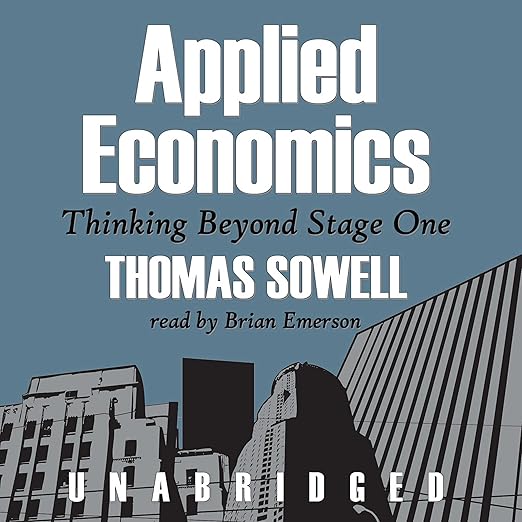
I was somewhere in the middle of my morning commute when Brian Emerson’s voice laid out Thomas Sowell’s central argument: that politicians and economists inhabit fundamentally different time horizons, and that this mismatch explains a great deal of what goes wrong in public policy. It’s not a new thesis, but Sowell states it with such clarity that it functions almost as a perceptual shift. By the time I reached my stop, I had already started mentally sorting the news through the lens of what Sowell calls ‘stage one thinking.’
Applied Economics is, as its subtitle suggests, a sequel to Basic Economics, Sowell’s more foundational text. But it works just as well for listeners who haven’t read the first book. The subject matter here is more applied, as the title promises: housing, medical care, discrimination, and economic development in poorer nations. Each chapter asks what happens when economic decisions are made primarily to satisfy political constituencies rather than to solve underlying problems, and the answers Sowell arrives at are consistently challenging to received wisdom across the political spectrum, though reviewers will correctly identify this as a conservative economist’s framework.
Our Take on Applied Economics
What separates Sowell from many economists who write for popular audiences is his refusal to treat economic ideas as inherently dry. He moves through examples from American housing markets, healthcare policy, and global development with the same patient insistence on looking past stated intentions to actual outcomes. The sequence on housing is particularly sharp: Sowell argues that rent control consistently produces outcomes that harm the very tenants it claims to protect, and he marshals specific historical data to make the case rather than relying on theoretical abstraction. Whether you agree with his conclusions or not, the structure of his argument is clean and worth engaging.
The political economy sections, which examine why politicians consistently choose policies with immediate visible benefits over policies with delayed but larger benefits, are the intellectual spine of the book. Sowell’s language for this, the distinction between stage-one and second-and-third-order thinking, is accessible and practically useful. One reviewer who describes themselves as having read many of Sowell’s books notes that he always provides ‘straightforward explanations of each topic in language that is simple for the layman but respects basic economic principles,’ and that observation captures his method well. He is not simplifying; he is clarifying.
Why Listen to Applied Economics
At seven hours and forty-seven minutes, the audiobook is long enough to develop its arguments properly without overstaying its welcome. Emerson’s narration is competent and steady, suited to the material’s analytical register. He reads without excessive emphasis or performance, which is the right call for a book that trusts its ideas to carry the weight. This is not a listen that rewards passive attention; Sowell’s arguments build on each other, and the section on discrimination in particular requires concentration because he’s making distinctions that are easy to misread on first pass.
The listener who gets the most from this book will be someone genuinely curious about why well-intentioned policies so often produce counterproductive results. Sowell’s framework is useful regardless of your political starting point, because the analysis is empirical rather than ideological in its structure. He asks what actually happened, not what should have happened. The book published in 2004 and updated since then, and while some of the specific policy examples have dated, the methodological approach remains current and applicable.
What to Watch For in Applied Economics
The most substantive criticism in the reviews is from a listener who found the development economics section weak and the overall material too familiar, summarizing it as ‘same old stuff.’ That’s a fair warning for readers already well-versed in free-market economic thought, who may find Sowell covering ground they know well. The book is pitched at the informed layperson, not the specialist, and its strength is in the breadth of application rather than depth of original theoretical contribution.
Sowell’s conservative orientation shapes not just his conclusions but his selection of examples. Listeners looking for a balanced policy assessment will need to supplement this with other sources. Applied Economics is a rigorous argument, not a survey of competing views. That’s a feature for some readers and a limitation for others, and worth knowing before you invest eight hours.
Who Should Listen to Applied Economics
Listeners who want a clear, accessible framework for thinking through the economic consequences of public policy will find this genuinely useful. It’s well suited to anyone frustrated by political debates that never seem to engage with actual outcomes. Listeners who are already deep in economic literature, whether Keynesian or Austrian, may find it covers familiar territory. Anyone seeking a politically balanced or ideologically neutral take on these topics should go in with calibrated expectations: Sowell is a rigorous thinker, but he is arguing from a specific tradition.
Frequently Asked Questions
Do I need to listen to Basic Economics before Applied Economics?
No. Sowell writes each book to stand alone, and the applied focus of this one means you’ll spend most of your time on specific policy areas rather than foundational theory. That said, readers who start with Basic Economics will find the transition very smooth.
How does Brian Emerson’s narration handle Sowell’s prose style?
Emerson reads clearly and without ornamentation, which suits Sowell’s direct argumentative style. He doesn’t add dramatic color, but this is the right approach for a book that relies on the clarity of its ideas rather than rhetorical flourish.
Is Applied Economics ideologically biased?
Sowell is a senior fellow at the Hoover Institution and a well-known conservative economist. His framework consistently prioritizes market mechanisms and is skeptical of government intervention. The analysis is evidence-based but argues from that tradition, so listeners of all political orientations will find something to push back on.
Which policy areas does Applied Economics cover?
The main chapters address housing markets, medical care, discrimination, and the economic development of poorer nations. The running thread is the difference between political decision-making, which tends toward short-term visible benefits, and economic reasoning, which focuses on long-term consequences.