Patrick McGee makes a case that Apple's greatest product, the iPhone, quietly became its greatest strategic vulnerability, and this audiobook lands that argument with the same investigative patience that earned blurbs from Chip War author Chris Miller and journalist Peter Frankopan. Narrator Fred Sanders carries thirteen and a half hours of corporate history, from Apple's near-bankruptcy in 1996 through its 2003 pivot toward Chinese manufacturing and on to the iPhone-era buildout that made China's electronics sector a global powerhouse, one now being leveraged by Beijing in ways Apple's own engineering and capital helped create.
From Near-Bankruptcy to a Geopolitical Liability
McGee's argument works in two directions at once: it is a business history of how Apple actually got built, the outsourcing decisions, the manufacturing scale, the supply-chain relationships, and a geopolitical warning about what that history now means as the US and China escalate a trade and technology conflict. Sanders, whose narration credits include dense material like ADHD 2.0 and Robert Greene's The Daily Laws, brings the same clean, accessible delivery here that health and self-help nonfiction usually gets, which turns out to be exactly the right register for a book explaining complex supply-chain mechanics to a general audience.
The framing device, Apple facing bankruptcy in 1996 and choosing outsourcing as survival, only to have that same choice become a geopolitical liability three decades later, gives the book a genuine narrative arc rather than a flat chronological account. Sanders's pacing tracks that arc, moving briskly through the early rescue-from-bankruptcy material before slowing to let the more analytically dense China-strategy chapters land with full weight.
McGee's background as a financial journalist who has covered Apple closely for years shows in the book's sourcing and its comfort with supply-chain minutiae that a generalist business writer might have glossed over. That specialist's fluency is exactly what a subject this technical, contract manufacturing agreements, component sourcing, factory-scale logistics, needs to stay both accurate and readable across thirteen and a half hours.
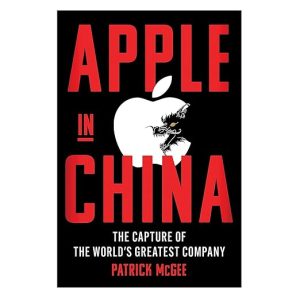
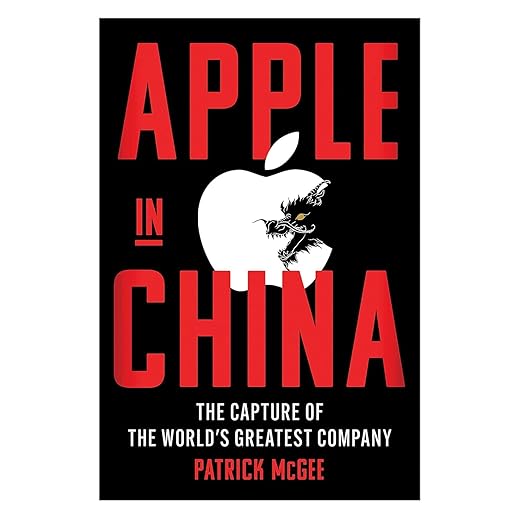
McGee's title itself stakes out a specific claim worth noticing: not Apple and China as two separate entities in relationship, but Apple in China, positioning the company as embedded inside a system rather than simply doing business alongside it. That framing choice previews the book's central argument before the first chapter even starts, and Sanders's narration of the title and subtitle material sets that positioning up clearly from the opening minutes.
Sanders Delivers Thirteen Hours Into a Tariff War
Business and technology nonfiction benefits enormously from a narrator who will not over-dramatize routine corporate decision-making, and Sanders's track record with similarly dense nonfiction, health and behavioral-science content, business-strategy books, suggests exactly that kind of restraint. Apple in China deals in boardroom decisions and manufacturing logistics rather than personal drama, and a narrator who trusts the material's own weight, the way this book's blurbs from Rana Foroohar and Robert D. Kaplan among others suggest McGee's writing does, is the right match.
The book's blurbers are themselves a kind of reading map: Peter Frankopan's The Silk Roads reframed world history around trade routes, Chris Miller's Chip War did the same for semiconductor geopolitics specifically, and Apple in China's own ambition sits squarely in that lineage, applying the same trade-and-technology lens to a single company's multi-decade relationship with a single country's manufacturing base.
The book's timeliness is a genuine selling point right now: it arrives directly into an active tariff war and reshoring debate, and Sanders's clear, unhurried delivery gives listeners room to actually absorb the argument rather than just the news-cycle version of it. For anyone trying to understand why bringing manufacturing back to America is more complicated than a campaign slogan suggests, this audiobook makes that case with specific historical mechanics rather than talking points.
Thirteen and a half hours is a substantial runtime for business nonfiction, but the audiobook format suits a book this dependent on sustained causal argument better than a print copy a reader might set down and pick up out of order. McGee builds his case chronologically and cumulatively, and Sanders's steady pacing helps preserve that structure across a listening schedule that might otherwise get broken into disconnected sessions.
Calling It a Cold War Oversells the Stakes
The synopsis's own language, describing Apple as caught in an escalating Cold War between two superpowers, borrows explicitly militarized vocabulary for what is fundamentally an economic and industrial relationship, a framing choice that signals just how high McGee pitches the stakes of his argument. Whether that Cold War comparison holds up under scrutiny or oversells the drama a little is something listeners can judge for themselves, but Sanders's narration delivers the phrase with the same measured weight as the book's more strictly factual passages, neither undercutting nor amplifying the rhetoric.
The chronological scope here, nearly three decades from the 1996 crisis to the present tariff standoff, is unusually long for a single-company business book, closer to the multi-decade sweep of a national-industry history than the five-or-ten-year window most corporate case studies cover. That length is part of what makes the audiobook format valuable: hearing the throughline read continuously helps a listener hold the full arc in mind rather than treating 1996 and today as two disconnected eras.
No listener reviews are attached to this title yet, a gap worth flagging directly, since everything evaluated above rests on the synopsis, the publisher's chosen blurbs, and Sanders's track record on comparable nonfiction rather than independent listener feedback about how this specific narration actually lands.
This is dense, argument-driven business and geopolitics writing, not a breezy tech-industry narrative in the founder-biography mold. Listeners wanting personality-driven Apple history, founder anecdotes, product-launch drama, should know McGee's actual subject is supply chains, manufacturing strategy, and international politics, a more analytical register throughout.
The 1996 near-bankruptcy the book opens with is a real, well-documented low point in Apple's history, the period immediately before Steve Jobs's return, and framing today's China entanglement as a direct descendant of decisions made purely to survive that crisis gives McGee's argument a clean causal throughline: outsourcing was not originally a strategy so much as an emergency measure that later calcified into infrastructure too deep to easily unwind.
Serious Business and Geopolitics Readers Fit Best
Readers of Chip War or serious business-and-geopolitics nonfiction generally will find Apple in China squarely in their lane, and Sanders's steady narration suits the material's analytical demands well across the full thirteen and a half hours.
Listeners who followed the recent tariff-and-reshoring news cycle and wanted more mechanism than a news segment could offer will find this audiobook answers exactly that need, trading headline-level claims for the actual supply-chain history behind them.
Skip this one if you want Apple's story told through founder mythology and product launches rather than supply-chain strategy and trade politics. This is a book about systems and leverage, not personalities, and listeners hoping for the latter should look toward a more conventional corporate biography instead.
Good to Know
Is this audiobook mostly about Apple's products or its manufacturing strategy?
Manufacturing and geopolitical strategy specifically. Product history appears mainly as context for the outsourcing and China-manufacturing decisions that are the book's real subject.
How current is the material in this audiobook given ongoing US-China trade tensions?
Very current. The book directly addresses the active tariff war and reshoring debate, using Apple's history to argue why simple reshoring strategies face real structural obstacles.