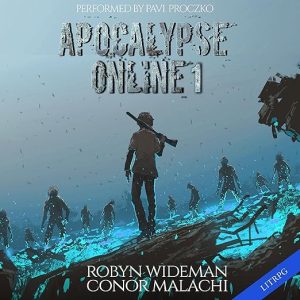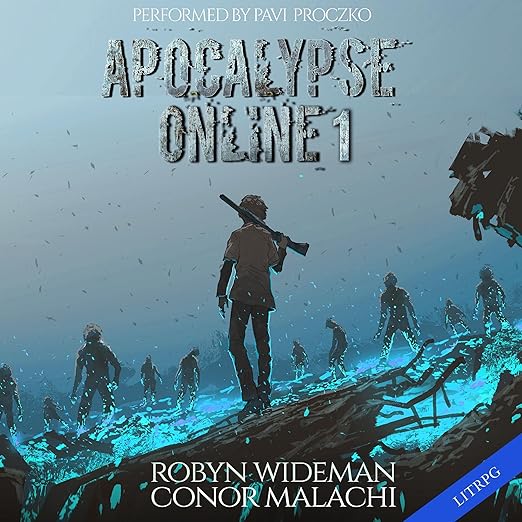
Brad and Sam started playing Apocalypse Online because it was the hot new game. This audiobook, narrated by Pavi Proczko, opens on their moment of realization: they had no idea they were running a rehearsal for the actual end of the world. Conor Malachi's LitRPG series opener makes its central premise explicit from the first chapters: the aliens arrived, and they are not interested in diplomacy. They are interested in fertilizer. The game Brad and Sam had been playing turns out to have been a preparation module, a preview built by a benevolent alien AI to give human survivors a fighting chance against a second wave they may not be equipped to handle. The genre is in efficient motion here: the apocalypse has a tutorial, the tutorial has a System, and the System has levels.
The introduction of Jake, Sam's non-gamer brother, as a third perspective is a smart structural choice that Malachi uses to explain the game mechanics through a character who needs them explained. Brad and Sam arrive with genre fluency; Jake arrives as the reader who has not played this kind of game. That trifecta of perspectives covers most of the audience the book is trying to reach, and the dynamics between them give the early chapters enough interpersonal tension to complement the survival action sequences.
A Closer Look at Apocalypse Online
The book's premise positions it alongside established genre titles, and Malachi is transparent about his influences, referencing System Apocalypse and Defiance of the Fall in the synopsis itself. That transparency is useful because it sets accurate expectations: this is genre fiction working within understood conventions, not attempting to subvert them. The question for LitRPG readers is not whether the conventions are present but whether they are executed with enough specificity and pace to justify the fourteen-hour runtime.
Reviewer Joshua S. identifies both the promise and the challenge of the first volume: the premise is good, the characters feel somewhat underdeveloped, and the time passage between major events occasionally lacks the connective tissue that would give scenes proper weight. That is an honest read of a series opener in a genre where book ones often function primarily as setup infrastructure. Reviewer Kindle Customer Tim N is more positive, praising the action, drama, and character interactions, which suggests the book finds its footing as the individual voices become more distinct. The third reviewer, JMN4555, praises the series as a whole rather than this specific volume, which is characteristic of LitRPG readership: the single book is often less the point than the arc it initiates.
Pavi Proczko handles the LitRPG format's specific requirements with the efficiency the genre demands. System notifications, stat screens, and level-up announcements need to register as events rather than interruptions, and Proczko delivers them with the right weight: present and meaningful without dominating scenes that should be driven by character. The action sequences are clear and spatially coherent, which is a genuine challenge in audio when combat involves multiple moving elements.
At fourteen hours and forty-four minutes, this is a full-commitment series opener. The runtime reflects Malachi's investment in building the world before its consequences fully arrive, and listeners who find the early character work thinner than they prefer should note that reviewer feedback consistently indicates the series develops more texture as it continues. This is a first-book investment in a longer arc, and the audio format makes that investment feel less passive than reading equivalent page counts would require.
Things to Know Before Starting Apocalypse Online
The benevolent alien AI's role in enabling human survival is worth tracking carefully from the opening chapters. Its motivations are not fully explained in book one, and the questions it raises, about what the AI wants and why it chose to help rather than simply observe, generate a secondary mystery running beneath the immediate survival narrative. Malachi seeds that mystery without resolving it, which suggests it will be load-bearing in later volumes.
The second-wave framing, the explicit suggestion that this is preparation for something worse to come, is the structural hook that makes book one feel like the beginning of something rather than a self-contained story. Listeners who commit to the series will want to pay attention to what the first wave reveals about the invaders' capabilities and limitations, since that information becomes the basis for the survival planning that defines the series' ongoing tension across subsequent books.
Who Should Pick Up Apocalypse Online
Listeners already invested in the LitRPG apocalypse subgenre, particularly those who have completed System Apocalypse or Defiance of the Fall and want a comparable series to follow, will find the most immediate satisfaction here. The genre conventions are present and competently executed, and the alien invasion premise gives the System mechanics a concrete enemy rather than a diffuse environmental threat.
Newcomers to LitRPG who are curious about the genre should know this audiobook functions as a series launcher rather than a standalone. The satisfactions of book one are primarily promise and setup, and the full payoff requires commitment to subsequent volumes. Those who prefer complete narrative arcs in a single audiobook should approach accordingly. Series-committed listeners will find this a promising first installment with room for the character depth that reviewers note tends to arrive in later books. The alien-invasion premise and the benevolent-AI setup give the series a mythology to develop, and book one plants enough seeds to make that development feel worth following.
Good to Know
Is Apocalypse Online book one a standalone audiobook or do I need to commit to the series?
Book one functions primarily as a series launcher. The immediate survival narrative has its own shape, but the broader mysteries, including the benevolent alien AI's motivations and the second wave threat, are not resolved in this volume. Series-committed listeners will get the most from it; those who prefer complete self-contained audiobooks may find the setup-heavy structure of book one less satisfying.
How does this audiobook handle the LitRPG game mechanics for listeners who are not familiar with the genre?
Malachi uses Jake, the non-gamer sibling, as a structural device for explaining the System's mechanics through a character who has no prior framework for understanding them. This makes the LitRPG elements accessible to listeners who have not played games in the genre, while still satisfying readers like Brad and Sam who have the genre fluency to recognize what the System offers them.
Reviewer Joshua S. noted that the characters feel underdeveloped in this audiobook. Is that a significant problem?
It is an honest observation about a series opener in a genre where book ones often prioritize world and system establishment over character depth. Reviewer Kindle Customer Tim N found the character interactions more satisfying, suggesting the response varies by expectation. Reviewer JMN4555's enthusiasm for the series as a whole suggests the character work deepens across subsequent volumes, which is the more common LitRPG pattern.
Does Pavi Proczko's narration help distinguish between the three main perspectives in this audiobook?
Yes. Proczko differentiates Brad, Sam, and Jake with enough vocal distinction to track the shifts in perspective clearly, which matters in a narrative that uses the three characters to cover different relationships to the LitRPG mechanics and the alien threat. His handling of the System notification sequences is efficient, registering them as events rather than procedural interruptions in the story's flow.