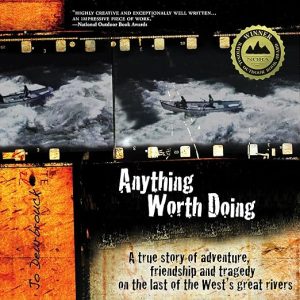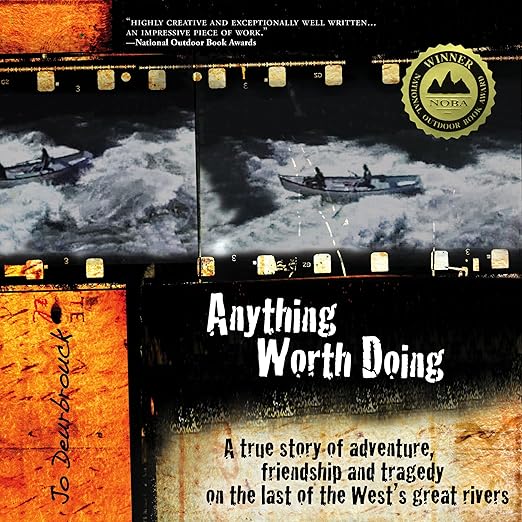
I was sitting on a train somewhere through eastern France when I started Anything Worth Doing, and by the time I reached the section describing the first major expedition on the Salmon River in flood, I had missed my stop. That is not a complaint. Jo Deurbrouck writes with the particular clarity that comes from someone who actually understands what she is describing - the hydraulics, the judgment calls, the way experienced river runners read water and make decisions that look suicidal to outsiders and logical to the people making them. The book is ostensibly about Clancy Reece and Jon Barker, the whitewater guides whose decade of river adventures and June 1996 attempt at a twenty-four-hour speed record on Idaho's Salmon River at peak flood forms the book's central arc. But it is really about a way of living, and what it costs.
Clancy's motto - the title phrase, anything worth doing is worth overdoing - is both the book's engine and its eulogy. Deurbrouck introduces us to two men who chose freedom and passion as non-negotiable requirements and security as something entirely optional. That choice, rendered across a decade of increasingly audacious river expeditions, reads as heroic and reckless and deeply human in equal measure. Deurbrouck does not editorialize. She does not make a case for or against the way these men lived. She lets the story, as one reviewer put it, speak for itself through objective narration, and that restraint is what gives the book its power.
What Jo Deurbrouck Delivers
The structure is one of the book's quiet achievements. Deurbrouck does not proceed chronologically from Clancy and Jon's early river careers to the 1996 Salmon River run. She moves between timelines, using earlier expeditions to build character and establish competence so that when the final run begins, we understand exactly what these men were capable of and what it therefore means that the odds caught up with them. The narrative crosscutting creates the kind of dramatic irony that is available only in nonfiction: we know the ending before it arrives, and that knowledge makes every detail of the men's skill and judgment on the water more bittersweet rather than more reassuring.
The Krakauer comparison in the publisher's description is doing real work. Into the Wild and Into Thin Air both occupy a similar territory: the detailed accounting of what happened when someone with exceptional skill and genuine passion for a dangerous environment pushed too far. Deurbrouck's book belongs in that company. The difference is that Clancy and Jon are not outsiders who underestimated their environment. They were among the most competent river runners alive. The Salmon at peak flood in an extreme high-water year was simply larger than competence could address, and the book is honest about that without turning it into a lesson about hubris.
The Best Parts of Anything Worth Doing
Deurbrouck narrating her own work is the right call. She has the insider knowledge to pronounce the technical vocabulary correctly and intuitively, which matters more than it might seem for a book saturated with river-running terminology. More importantly, the affection and respect she has for Clancy and Jon come through in the delivery in ways that feel genuine rather than constructed. She knew these people. She ran rivers with them. When the narrative reaches the June 1996 launch sequence and the dory pushes off onto the Salmon, you can hear the weight of what she knows is coming in the way she reads the approach to that moment.
Open Book Audio has produced the recording cleanly, and the six-plus hour runtime is nearly ideal for this material - long enough to fully inhabit the world of Pacific Northwest river culture, short enough that the elegiac quality never becomes numbing. Reviewers who came to the book with personal river experience described feeling integrated into the dory itself, the camps along the river, and occasionally the water. That is high praise for a text, and the audio format enables it.
Before You Commit to Anything Worth Doing
One reviewer noted that the early chapters are slower - establishing character, building the river culture context, introducing the technical vocabulary of the world these men inhabited. This is accurate. The first quarter of the book is doing foundational work, and it requires patience from listeners who want to get to the Salmon River sequence directly. That patience is rewarded substantially. The book does not move quickly through the adventure itself; it moves carefully, which is the only pace that makes the human cost legible.
A cautionary note for listeners who have lost someone in a water incident: at least one reviewer mentioned that the book hit close to home in precisely that way, noting a personal loss during a high-water run. Anything Worth Doing is about death as well as life, and it takes both seriously. The tone is not exploitative, but the subject matter is real and the grief embedded in the narrative is genuine.
Should You Listen to Anything Worth Doing?
This audiobook is for adventure nonfiction readers who value specificity over genre scaffolding. It will mean the most to people with any experience of whitewater or outdoor risk culture, where the technical detail creates recognition rather than confusion. But Deurbrouck's character writing is good enough that listeners who have never been on a raft will find Clancy and Jon fully human and fully worth following. Fans of Krakauer, Sebastian Junger's The Perfect Storm, or similar nonfiction that places exceptional human beings in impossible natural situations should put this on their list. Skip it if you need adventure narratives to be triumphant - Anything Worth Doing is honest about what the river took, and it does not sentimentalize the loss into meaning it did not have.
- Performance: Jo Deurbrouck narrates her own book, bringing insider whitewater knowledge and genuine affection for her subjects - the self-narration adds a documentary quality that a professional reader could not replicate.
- What it covers: River culture and risk culture, the cost of freedom lived on one's own terms, friendship and loss
- Feel: Propulsive and elegiac - you know how it ends before you start, which makes the journey more poignant
- Our call: A genuinely excellent piece of adventure nonfiction, specific enough in its whitewater detail to feel real and human enough in its character writing to make the loss matter.
Frequently Asked Questions
Is the outcome of the June 1996 Salmon River run revealed before the narrative reaches it?
The book is transparent about the fact that the odds catch up with the men - this is stated in the synopsis and in how Deurbrouck frames the narrative from the beginning. Knowing the outcome before you start does not diminish the experience. It actually deepens the character work in the earlier chapters, because every detail of Clancy and Jon's skill and judgment becomes more poignant when you know where the story is heading.
How does Jo Deurbrouck's self-narration compare to what a professional narrator might bring?
For this specific material, self-narration is the right choice. Deurbrouck's insider knowledge means the technical vocabulary is pronounced correctly and intuitively, and her personal familiarity with the subjects - she knew Clancy and Jon and ran rivers with them - gives the performance a genuine weight that a professional narrator working from a text would have to construct. Several reviewers specifically noted the quality of the character empathy in the narration.