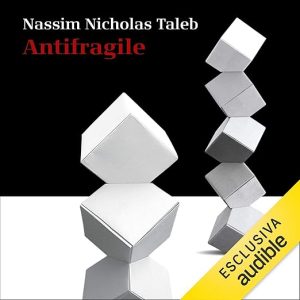
- Read by: Nicola Bonimelli delivers the Italian edition with clarity and appropriate gravity, though his pacing occasionally slows the more combative passages where Taleb's prose crackles with sarcasm.
- At its heart: Disorder as opportunity, the limits of prediction, fragility vs. robustness vs. antifragility
- Vibe: Provocative and intellectually restless
- Short version: Taleb's most ambitious argument in the Incerto series rewards patient listeners with a genuine shift in how they see risk, randomness, and personal decision-making.
I came to this Italian-language edition of Nassim Nicholas Taleb's Antifragile having already read the English original twice, and I was curious whether Nicola Bonimelli's narration would change my relationship to a book that I find both maddening and indispensable. It was a Saturday afternoon, the kind where the rain refuses to decide whether it actually wants to fall, and I started the first chapter while making coffee. Twelve hours later I had not left the apartment.
Antifragile is the fourth installment in Taleb's Incerto series, a sprawling philosophical project that began with Fooled by Randomness and reached its most notorious expression in The Black Swan. If those books asked what randomness and rare events actually are, Antifragile asks the sharper question: what kind of things get better when they encounter volatility? And what does it tell us that modern institutions are almost universally designed to suppress exactly that volatility?
Naming a Category That Never Had a Word
The book's core argument is deceptively simple. Taleb proposes three categories: fragile things, which break under stress; robust things, which resist it; and antifragile things, which actively benefit from disorder, shock, and uncertainty. He is adamant that no word existed for the third category before he coined it, and the absence of that word reflects something deeper: we have collectively failed to even conceptualize the idea that disorder can be a source of strength rather than merely a threat to be managed.
What makes this more than a self-help rebranding of resilience is the intellectual machinery behind it. Taleb draws on evolutionary biology, classical philosophy, financial theory, and medicine, weaving them together with a polemic energy that either electrifies or exhausts depending on your tolerance for a writer who is openly contemptuous of anyone who disagrees with him. The Italian reviews captured both poles: one calls the book illuminating and worth meditating on throughout life, while another notes that Taleb tends to circle back to the same territory, which can feel repetitive across eighteen hours of audio.
Bonimelli Delivers the Denser Passages With Care
The sections I found most challenging were not the abstract theoretical passages but the practical applications. Taleb argues that modern medicine takes credit for longevity gains it did not produce, that less data often yields more accurate analysis, and that the Titanic disaster saved more lives than it took by eliminating overconfidence in ship safety. These are not throwaway provocations. He builds careful cases for each, and the cases are uncomfortable precisely because they hold up under scrutiny.
The chapters on iatrogenics, the harm done by interventions intended to help, are particularly resonant for anyone who has spent time thinking about how institutions manage risk. Taleb's observation that we consistently overestimate our ability to predict outcomes and underestimate the costs of our attempts to control them reads differently after the past several years of global events than it did when the book was first published. In audio format, these arguments land with unusual force because you cannot skim. Bonimelli delivers the denser passages with a methodical care that serves the material well.
This Would Be Tighter at Fourteen Hours
It is worth saying plainly: Taleb is not a modest writer. He is scornful of academics he calls fragilistas, dismissive of economists, and proud of his own intellectual lineage in a way that can feel like a performance. The Italian translation and Bonimelli's reading modulate some of this edge without losing it entirely. Where the English prose has a certain raw aggression, the Italian version has a slightly more formal register that paradoxically suits the philosophical ambition of the project.
One reviewer described the book as the bible of a particular way of understanding systems, which is an accurate description of both its appeal and its limitation. Taleb is a maximalist. He wants antifragility to explain everything from personal diet to the structure of city-states versus nation-states, from financial investment strategy to the ethics of academic credentialing. The breadth is intellectually thrilling and, at eighteen-plus hours, occasionally exhausting. The book would be tighter at fourteen. But compressing Taleb is probably antithetical to his own thesis.
Ochman's English Version Suits Taleb's Combativeness
If you already know Taleb's work in English, the Italian audio edition offers a different texture without adding new content. For Italian-speaking listeners approaching Antifragile for the first time, this is a strong entry point to the Incerto series, though beginning with The Black Swan first lays useful groundwork. Non-Italian speakers looking for the ideas should seek the English-language audio narrated by Joe Ochman, which has a more energized delivery that matches Taleb's combative tone more directly.
One Question This Book Leaves You With
The question this book leaves you with is genuinely productive: where in your own life are you optimizing for robustness when you could be building for antifragility? That question takes root differently for different readers. For me, listening to it on a rainy afternoon, it had to do with how I think about creative work and the relationship between difficulty and improvement. That is not nothing, coming from an economics text. That is actually quite a lot.
A note on listening strategy: at eighteen-plus hours, Antifragile in any language rewards attention in sustained stretches rather than daily commutes. The argument builds architecturally, and fragmented listening loses the cumulative weight that makes the larger claims land. Italian speakers new to Taleb may also want to keep a notepad nearby, not for the technical passages, but for the aphoristic formulations that Taleb scatters through the prose, the kind of sentences that, once heard, reorganize how you see things for weeks afterward.
Is this the Italian-language edition of Antifragile, and can English-speaking listeners follow it?
Yes, this Audible edition is narrated in Italian by Nicola Bonimelli and is intended for Italian-speaking audiences. English speakers should look for the English-language edition narrated by Joe Ochman.
Is Antifragile appropriate for someone without a finance or economics background?
Yes. Taleb writes for an educated general audience and uses historical anecdotes, biology, and everyday examples to carry the argument. You do not need specialist knowledge, though some technical passages on derivatives and financial instruments assume basic familiarity with markets.