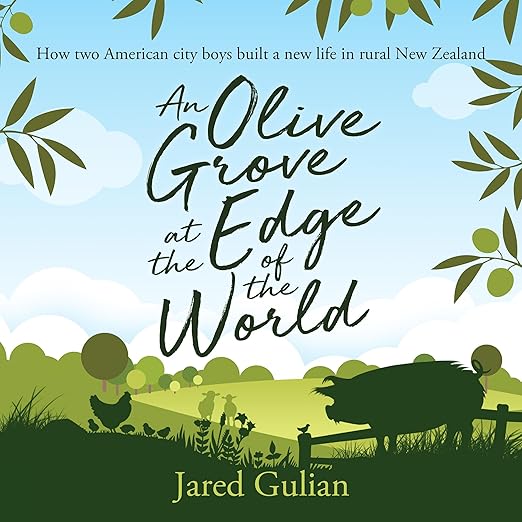
I had been looking for something to listen to on a long drive through the French countryside last spring when I found An Olive Grove at the Edge of the World. The coincidence of geography turned out to be entirely appropriate. Jared Gulian's memoir of moving from Wellington to a rundown olive grove in New Zealand's Wairarapa Valley is fundamentally a book about what it means to stop being a tourist in your own life, and it hit me differently on that drive than it might have sitting at my desk. I came to it knowing Peter Mayle's A Year in Provence well enough to recognize the genre, and I am pleased to report that Gulian earns the comparison without simply reproducing it. His situation is different, his country is different, and his emotional register is his own. What he shares with Mayle is the genuine surprise of someone who chose displacement and then discovered, slowly and specifically, what they had chosen.
The setup is modest and specific, which is part of why it works. Gulian and his partner CJ are already committed expatriates by the time the memoir opens: they have left the United States for Wellington, New Zealand, a significant displacement in itself. Then CJ makes the further decision that they must buy an olive grove in the countryside, a property with 500 untended olive trees, a geriatric rooster, warring hens, a large pig of questionable temperament, cast sheep who need intervention to get back on their feet, and neighbors who communicate through regional idioms that Gulian cannot decode despite speaking the same language. Gulian, who is terrified of heights and must regularly drive over the dangerous Remutaka ranges to reach the property, is not the obvious candidate for this kind of transformation. That gap between who he is and what the land requires of him is where all the best material lives, and Gulian returns to it throughout the book with a consistency that keeps even the digressive chapters from feeling aimless.
What We Made of It
The comedy in this memoir is specific enough to feel real rather than constructed. The chapter involving a Kiwi neighbor telling Gulian neeks steep, meaning something specific about the terrain that Gulian cannot parse for pages, is the kind of scene that works because you can feel the actual confusion and the actual warmth on both sides of it. One reviewer laughed out loud at this section, which tracks with my own response. Gulian's humor is self-directed throughout: he is perpetually the least competent person in any given farming situation, and he is honest about that without performing false modesty. The pigs, the sheep, the olive harvest logistics, the question of what you actually do with 500 trees that have not been pruned for years. Each of these challenges arrives with its own comedy and its own instruction, and Gulian learns something from all of them at exactly the pace that feels true to the experience rather than tidied up in retrospect for narrative convenience.
Why An Olive Grove at the Edge of the World Works as an Audiobook
The book covers the first four years of their life in the Wairarapa, and by the end of that span, Gulian has become something he was not at the beginning: a person who belongs to a specific place. The community that surrounds the grove, farmers and neighbors and people who show up with practical knowledge Gulian desperately needs, is the real subject of the second half of the book. Readers who come for the fish-out-of-water comedy will stay for the account of how that community absorbed two completely unprepared urban Americans and turned them into something more. One reviewer described the book as inspirational, about the courage to try new things, the kindness of neighbors, and how to become a local. That is exactly right, and the emotional weight of that transformation arrives without sentimentality because Gulian has earned it through four years of specific, documented failure and learning. Another reader, writing during a period she described as one where the world does not always seem a very positive place, found herself totally immersed in a story about people with a genuine zest for life. That is one of the genuine functions of this kind of memoir and this book fulfills it well.
What Might Not Land
Gulian narrates this himself, and it is exactly the right decision. His voice carries the particular blend of warm self-deprecation and genuine surprise that defines the writing. He reads as someone who is still slightly astonished by what happened to them and who finds the astonishment funny. The pacing is relaxed without being slow, and his Kiwi accent work, when it appears in dialogue, is affectionate rather than performative. At just over ten hours, this is a comfortable listen for a road trip, a long walk, or a string of evenings where you want to be somewhere else for a while. The free audiobook availability on Audible makes it an easy recommendation for anyone looking for something warm and specific. Readers who have enjoyed Peter Mayle, Frances Mayes, or James Herriot will find this sits naturally in that company. Those who need dramatic stakes or tension in their nonfiction may find the low-conflict warmth unsatisfying, but for most listeners looking for something genuinely restorative, Gulian delivers exactly that.
Who Should Pick Up An Olive Grove at the Edge of the World
The readers who respond most strongly to this memoir are those who are contemplating their own version of what Gulian and CJ did, not necessarily buying an olive grove in New Zealand, but some kind of deliberate displacement from the life they have been living toward a life they have been imagining. The book does not romanticize that displacement. It shows the full cost and comedy of it. But it also shows, through four years of specific accumulating evidence, that the belonging you find on the other side of that displacement is different in quality from anything available before it. At ten hours, the free audiobook fits naturally into a long weekend or a week of commutes, and Gulian's narration makes the time genuinely pleasant rather than merely occupied.