Before You Press Play
- Narrator: Jeff Cole draws the listing's one serious complaint, a one-star reviewer citing robotic delivery and mispronounced South Pacific place names within four minutes; sample before committing.
- Subjects: Voluntary solitude, South Pacific island life, self-sufficiency, the practical reality behind a common fantasy.
- Tone: Calm and unhurried, closer to a well-kept log than to a survival thriller.
- Bottom line: A quietly excellent castaway account on a recording that at least one listener could not tolerate, so audition it first.
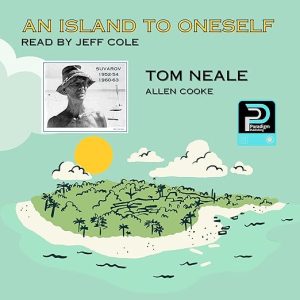
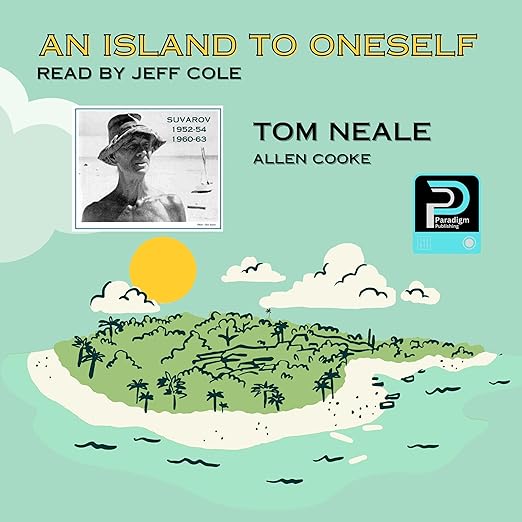
Two verdicts sit inside this listing and they are not speaking to each other. One calls it a favorite book of all time. The other switched off four minutes in. An Island to Oneself is Tom Neale's account of a solitary life on an uninhabited South Pacific island, and this audiobook edition runs seven hours and fifty-eight minutes, read by Jeff Cole. The split between those two verdicts has almost nothing to do with whether the story is good, and almost everything to do with the recording, which makes this one of the rare titles where I would tell you to sample first and read the review second.
The Review
The description attached here is two sentences long, which is unusual enough to name, because it leaves the material to carry itself. What those sentences establish is the essential shape: the copy describes "a man who took it upon himself to live alone on a deserted island in the South Pacific," and adds that he loved it enough to go back and stay longer the second time. No coordinates. No dates. Nothing about what he ate or how he got there. The reviewers supply what the copy withholds, and Fiji Laural compresses the entire appeal into one sentence: "What a grand life Tom Neale lived."
What makes the book durable, judging by how people here talk about it, is that Neale is not performing solitude for an audience. The copy calls it "a true castaway story that deserved to be preserved for generations to come." Preservation rather than promotion is exactly the register the readers respond to. Mason's endorsement is the strongest single line in the file: "The only book that I'll reread on an annual basis." That is a specific claim about rereadability, and in this genre rereadability usually signals that the prose stays calm enough to return to. A castaway account told without self-mythology is rarer than the crowded survival-memoir shelf would suggest.
That second stay deserves more attention than two sentences of description can give it. Neale did not merely survive the island, he went back to it. A first stay can be explained away by curiosity, or by a stunt, or by the sort of restlessness that burns itself out in a season. A second stay cannot. Whatever he found out there was durable enough to pull a person back to a place with no company, no resupply and no audience, and the book is effectively an extended answer to why. The readers who return to it annually are circling that same question from the opposite direction.
Eight hours is a well-judged length for this kind of book, because a solitude memoir works through accumulation rather than incident. You are not waiting for a plot turn. You are settling into the rhythm of repeated days, and audio handles rhythm better than the page does, provided the reading moves at the pace the writing was built for. Fiji Laural's formulation captures the pull of it: "Life on an isolated island is a dream come true, to real life." The sentence is slightly tangled and the feeling underneath it is not. A fantasy most people entertain for ten minutes was actually executed by somebody, at length, on purpose.
Which brings us to Jeff Cole and to the only hard evidence this listing offers about the reading. A one-star reviewer stopped at four minutes, writing that "the robot-like narrator has already mispronounced several of the South Pacific island names." That single sentence carries two complaints of very different weight. Mispronouncing Pacific place names is a real and checkable failure on a book whose entire setting is the Pacific. Robot-like, by contrast, is a subjective impression of delivery, and one listener's flatness is another listener's restraint. What can be said without hedging is that at least one buyer found the reading a dealbreaker within four minutes, while 54 ratings averaging 4.6 indicate that most listeners did not.
Before You Commit to An Island to Oneself
So the practical advice is unusually concrete: sample before you commit. Not the opening thirty seconds, which almost any reader can carry, but several minutes into the body of the text, listening specifically for how the island names land and whether the delivery holds enough variation to sustain eight hours of one man's routine. Solitude memoirs are the least forgiving format for a flat reading, because no dialogue breaks the surface and no second voice arrives to change the texture. If the register suits you it will suit the entire book. If it grates in the first ten minutes, it will grate for the remaining seven and a half hours.
The writing needs its own expectation-setting. Two sentences of description is thin, and what those sentences promise is a record rather than a drama. A listener arriving in search of a survival thriller, a crisis, a rescue at the last possible moment, will instead find a man who chose this, prepared for it, and largely enjoyed the result. One consequence of the copy giving away the return trip is that no dread accumulates while you listen. You already know how it ends, twice over. What has to hold you instead is the texture of the days themselves, and whether eight hours of that texture holds you depends entirely on whether you find competence interesting. Several readers here plainly do.
Who It's For
I would hand this to the listener who reads about mountaineering, ocean crossings and long solo walks and keeps circling the same question underneath all of them, which is what the ordinary days were actually like. It suits people who want the Pacific specifically, since the setting here is not interchangeable scenery but the whole practical problem. And it suits anyone who has held the leave-it-all-behind fantasy long enough to start wondering about logistics, because Neale is the rare person who answered that curiosity with an experiment instead of a daydream, then went back and ran it a second time.
Steer clear if a flat or mispronouncing reading would spoil the experience, and weigh that risk seriously given the specific complaint sitting on this listing. Pass as well if you need narrative propulsion, since the pleasures on offer are the quieter pleasures of a well-kept log. My position is that the story earns its keep while the recording carries an asterisk, which is an awkward thing to write about a book two of its three reviewers plainly love. Sample it properly. The wrong voice will bury a good book across eight hours, and this one deserves better than being abandoned at minute four.
A Few Questions About An Island to Oneself
Is the narration on this audiobook actually a problem?
One reviewer gave it a single star, stopping after four minutes over robotic delivery and mispronounced South Pacific island names. Against that, 54 ratings average 4.6, so most listeners were untroubled. Mispronunciation is checkable and worth sampling for; the flatness complaint is subjective.
Does An Island to Oneself work as a survival story?
Not in the crisis-and-rescue sense. Neale chose the island, prepared for it and enjoyed it enough to return for a second stay. The tension comes from daily competence and isolation rather than from disaster, which is precisely why one reviewer describes returning to the book every single year.
How long is the audiobook and does the length suit the material?
Seven hours and fifty-eight minutes, which fits well. A solitude memoir accumulates rather than escalates, and eight hours gives the rhythm of repeated days room to establish itself without padding. The length only becomes a liability if the reading voice does not work for you.
Why is the book description so short?
The listing carries just two sentences, naming a man who chose to live alone on a deserted South Pacific island and loved it enough to return. No dates, coordinates or detail are offered, so the reviews do most of the work of telling you what to expect.