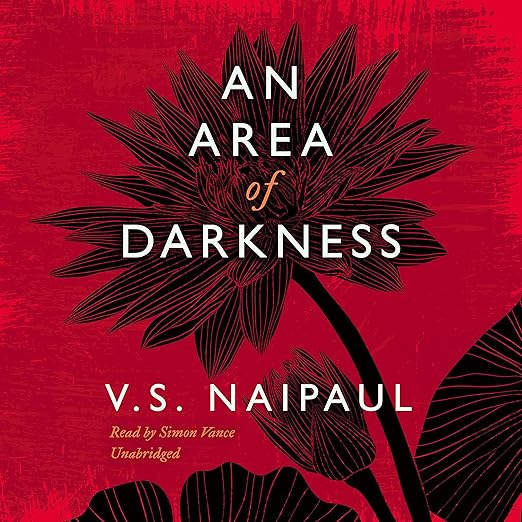
- Narrator: Simon Vance's reputation for handling literary nonfiction with precision is well established, though no review of this specific title confirms his performance directly.
- Subjects: Postcolonial identity, travel writing, ancestral homeland
- Tone: Elegant, uncomfortable, intellectually demanding
- Bottom line: A dense, sometimes harsh classic of travel writing, best suited to listeners who already appreciate literary nonfiction over light travelogue.
Bombay's bureaucratic morass gives way to Kashmir's ethereal beauty within the same audiobook, and V.S. Naipaul, arriving in India for the first time despite it being his ancestral homeland, finds himself asking a question this book never fully resolves: does blood alone make a place home? Naipaul travels from a sacred ice cave in the Himalayas to an abandoned temple near Madras, encountering government workers worn down by their own bureaucracy, an imperious servant class, a self-serving holy man, and even a deluded American religious seeker along the way. What makes the book a classic rather than just a well-observed travelogue is Naipaul's refusal to resolve his own ambivalence: he is neither a comfortable insider nor a straightforward outsider, and the book never pretends otherwise.
What V. S. Naipaul Delivers
Naipaul's most demanding material concerns India's caste system and its 'apparently serene acceptance of poverty and squalor,' observations that read as genuinely uncomfortable rather than distanced academic commentary, precisely because he's writing as someone with ancestral ties to the place he's critiquing. Albert V. Lesley's review captures the tension directly: 'Mr. Naipaul is so down on India and her people,' Lesley writes, while disagreeing based on personal, more recent experience finding Indians 'gracious, helpful, kind, and quite wonderful.' That disagreement isn't a flaw in the book so much as evidence of exactly the friction Naipaul's harsh, unsparing perspective was always going to generate.
The book also threads through India's conflicted relationship with its own colonial history, caught between a genuine desire for self-determination and an unexpected nostalgia for aspects of the British raj, a contradiction Naipaul observes rather than resolves. Kindle Customer's review describes the book as a journey by 'a traveller looking for sense in seemingly chaotic but illusive world,' noting that 'some passages are hilarious with witty humour' alongside others that provoke real discomfort about how, despite serious challenges, 'India still ticks and life goes on.' That tonal range, wit sitting right alongside real anguish, is characteristic of Naipaul's prose throughout.
The book's most quietly devastating passages concern the servant class Naipaul encounters, an imperious dynamic the synopsis mentions briefly but that Naipaul explores at real length: a rigid social hierarchy that persists regardless of formal independence from British rule, complicating any simple narrative about colonialism ending cleanly with a change in flag. Naipaul's own outsider-insider position lets him notice these persistent hierarchies more sharply than either a purely foreign observer or a comfortable insider might, since he arrives expecting some version of kinship and instead finds himself constantly renegotiating his own relationship to a caste system he didn't grow up inside.
The deluded American religious seeker the synopsis mentions in passing is a good example of Naipaul's method in miniature: rather than treating the encounter as a throwaway comic aside, he uses it to probe a larger question about what different kinds of outsiders project onto India, spiritual seekers looking for enlightenment, colonial administrators looking for order, Naipaul himself looking for some version of belonging, each bringing expectations the country was never obligated to fulfill.
What V. S. Naipaul Gets Right
Simon Vance narrates with the kind of restrained, literary precision his broader catalog is known for, an Audie-recognized career built substantially on demanding literary and historical nonfiction, though none of this title's own attached reviews comment on his performance directly, so this assessment rests on his established reputation rather than a title-specific listener quote. What this book specifically demands from a narrator is control: Naipaul's voice shifts constantly between lyrical description, dry irony, and genuine moral discomfort, sometimes within a single paragraph, and a narrator without real restraint could easily tip that mixture into either parody or blandness.
At ten hours and one minute, the audiobook gives Naipaul's dense, carefully constructed prose room to build without feeling rushed, which matters for writing this precise and this reliant on tonal control. Liza's five-star review calls Naipaul 'a superb writer' with descriptions of places she's personally visited that he 'describes... perfectly,' a strong endorsement of the prose's accuracy and specificity that a careful, unhurried narration serves well, letting the descriptive passages land with the same precision on audio that they clearly carry on the page.
It's worth noting the book predates Naipaul's Nobel Prize by several decades, written while he was still establishing himself primarily as a novelist rather than the towering, controversial literary figure he'd later become, which gives An Area of Darkness a different energy than his later, more assured nonfiction: this is a writer actively working out his own relationship to inherited identity in real time, not looking back on it from a position of settled authority.
Where V. S. Naipaul Loses Some Ground
This is not a warm, inspirational travel narrative, and listeners expecting the genre's more common cheerful destination-highlights approach should recalibrate before starting. Naipaul is often genuinely harsh, both about the India he encounters and, at points, about his own complicated reactions to it, and Albert V. Lesley's review is a useful signal here: even a reader who ultimately enjoyed the book pushed back hard against Naipaul's tone toward Indian people specifically, a reaction future listeners should expect to have some version of themselves.
Albert V. Lesley's review also mentions, almost in passing, Naipaul's real-life falling out with fellow travel writer Paul Theroux, a well-documented literary feud that eventually produced Theroux's own memoir about their broken friendship. That's a useful piece of context for understanding Naipaul's reputation more broadly: he was, by most accounts including his peers', a genuinely difficult, uncompromising personality, and that same uncompromising quality is exactly what makes his prose here so unsparing and, for many listeners, so valuable despite the discomfort.
Runtime pacing is worth a final practical note: at ten hours, this asks for real sustained attention across multiple sittings rather than a single sitting, and listeners who prefer to binge a travel memoir in one or two long sessions should plan accordingly, since Naipaul's argument-driven structure rewards continuity of attention more than a book you can dip in and out of casually.
Who Should Pick Up An Area of Darkness
This audiobook suits listeners who already appreciate literary nonfiction and travel writing that prioritizes psychological complexity over comfortable narrative, and especially anyone interested in postcolonial identity, diaspora, and the specific discomfort of visiting an ancestral homeland as a genuine outsider. Readers of Naipaul's later, more famous fiction who haven't yet gone back to this earlier nonfiction work will find it a valuable, more directly autobiographical companion piece to the novels.
This is also a valuable listen for anyone studying travel writing as a genre specifically, since so few travelogues interrogate the writer's own authority to describe what they're seeing the way Naipaul does here, treating his own reactions as material worth questioning rather than a neutral lens the listener should simply trust without pushback.
Listeners wanting a gentler, more conventionally uplifting travel memoir, or anyone likely to be put off by a genuinely harsh authorial perspective on the place being described, should sample a chapter first rather than committing to the full ten hours. If Naipaul's real, well-documented reputation for difficulty, both personal and literary, sounds like a dealbreaker rather than part of the appeal, a gentler contemporary India travelogue may serve you better.
Common Questions
Does this audiobook require knowing Naipaul's later, more famous books first?
No, though listeners already familiar with his later fiction will find this earlier nonfiction work adds valuable, more directly autobiographical context to his novels.
How does Simon Vance's narration handle Naipaul's dense, often unsparing prose?
His established reputation for restrained, literary narration suits the material's constant shifts between lyrical description and dry irony, though this title's own reviews don't comment on his performance directly.
Is this audiobook a good starting point for new Naipaul listeners?
It works well as an entry point specifically for listeners interested in his nonfiction and his relationship to India, though his later novels are a more common starting place for readers new to his fiction.