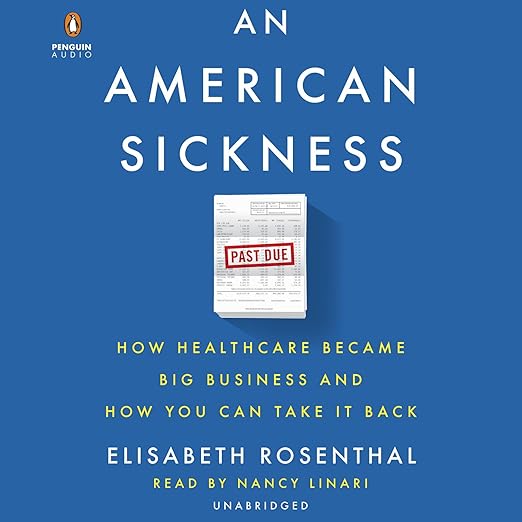
Rosenthal's diagnosis of American healthcare is not a surprise: the system is broken. What An American Sickness delivers that most critics of US healthcare do not is a chapter-by-chapter forensic accounting of exactly how each sector of the industry became broken on its own specific terms. This audiobook, narrated by Nancy Linari, is over thirteen hours long, and every hour of it is substantively different from the one before it, because Rosenthal never lets the argument collapse into a single villain or a simple story. Hospital systems, insurance companies, pharmaceutical manufacturers, device makers, physician specialists: each gets its own structural autopsy, and the diagnosis in each case traces back to specific regulatory decisions, market incentives, and institutional capture that accumulated over decades.
Industry by Industry, Deeper Than Reid or Klein
Rosenthal's method is to break the monolithic healthcare system into its component industries and examine each one separately. This is the book's central structural intelligence. If you have read T.R. Reid's The Healing of America or Ezra Klein's Why We're Polarized, you have encountered the systemic critique in broad strokes. Rosenthal goes narrower and deeper. She explains how hospital systems began behaving like predatory lenders, how research charities became entangled with pharmaceutical funding, how patients receive bills in billing codes from physicians they never met. The individual anecdotes she deploys, drawn from her years as a physician and New York Times health correspondent, give the structural analysis human texture without reducing it to individual melodrama.
Reviewer Emilio Corsetti III notes that Rosenthal 'examines every facet of healthcare, going back to the beginning,' which is accurate. She traces the current dysfunction to specific historical junctures: the shift from nonprofit to for-profit hospital systems, the emergence of managed care in the 1980s, the Medicare Part D negotiation ban. Listeners who come in hoping for a simple 'this is when it went wrong' answer will not find one, because Rosenthal's argument is that the dysfunction accumulated across multiple industries simultaneously, each responding to market incentives in locally rational but systemically destructive ways.
Linari's Steady Read Through Diagnosis and Advocacy
Nancy Linari's narration is clean, professional, and well-paced for the genre. She handles medical terminology accurately and does not editorialize during Rosenthal's more pointed passages, which is the right call for a book that wants to be taken seriously as journalism rather than advocacy. At thirteen-plus hours, the audiobook benefits from a narrator who can maintain listener engagement across dense policy and medical content without resorting to artificial energy. Linari does this. She is not a narrator who imposes personality on the material; she serves it, and for this kind of investigative journalism, that is exactly what is needed.
Reviewer ComplexAamoeba describes the book as making the listener 'a better patient and advocate,' which points to the practical second half of Rosenthal's project. The book is divided roughly in half: the first half diagnoses the systemic dysfunction, and the second half offers actionable guidance for individual patients navigating the system as it exists. How to decode medical billing. How to identify when a price has no rational basis. How to understand what insurance coverage actually means in practice. This second half makes the audiobook unusually relistable; the practical sections are worth returning to before specific medical encounters.
Reading 2017 Policy Details as a Snapshot
The book was published in 2017, which means some of the specific policy landscape it describes has shifted. The Affordable Care Act passages and the discussion of ongoing regulatory debates reflect the political climate of that moment. The structural analysis of how the industries operate, however, remains almost entirely current; the incentive structures Rosenthal documents have not fundamentally changed, and in several cases have accelerated. Listeners should read the policy specifics as a 2017 snapshot while taking the structural diagnosis as durable.
Vocabulary That Changes Your Next Medical Bill
At thirteen hours and thirty-eight minutes, this is a commitment. The audiobook rewards sustained listening over a series of sessions rather than casual background play; Rosenthal's arguments build on each other, and the individual industry chapters make more sense in sequence than they do in isolation. For listeners who have been frustrated by US healthcare and want to understand the system rather than just rage at it, the length is entirely justified. Reviewer chad describes it as 'an excellent synopsis of how we got to where we are with healthcare,' which is accurate but undersells the depth. This is a structural analysis with genuine explanatory force.
One of the book's lasting contributions is the vocabulary it provides for navigating the system as it exists. Rosenthal's explanation of how medical billing codes function, how surprise bills are generated by practitioners outside a contracted network, and how pharmaceutical pricing bears no relationship to production cost gives listeners tools that translate directly into self-advocacy. The healthcare system she describes has not changed substantially since publication; if anything, consolidation among hospital systems and pharmacy benefit managers has accelerated the dynamics she identifies. Listeners who finish this audiobook will approach their own healthcare encounters differently, which is the most practical test of whether a book about a broken system is actually useful.
Worthwhile for Patients, Providers, and Policy Readers
Any American adult who interacts with the healthcare system, which is to say almost everyone, will find material here that is directly applicable to their own situation. Healthcare professionals who want to understand the financial architecture surrounding their practice will find it particularly illuminating. Policy listeners who have read high-level critiques and want the operational detail beneath them will find An American Sickness the most comprehensive single-volume accounting currently available. Those looking for a quick political overview rather than a sustained forensic examination would do better with a long-form journalism piece; this audiobook rewards patience and repays it substantially.
Good to Know
How does this audiobook compare to other healthcare reform books like T.R. Reid's The Healing of America?
Reid's book focuses on international comparisons to argue for systemic reform. Rosenthal goes deeper into the American system's specific mechanisms, examining each industry sector separately. The two complement each other well; Rosenthal is the better choice for understanding how the US system works from the inside.
At over thirteen hours, is An American Sickness the kind of audiobook you can listen to in the background?
Not really. Rosenthal's arguments build chapter by chapter, and the industry chapters are most useful in sequence. This rewards active listening in sustained sessions rather than background play. Listeners who give it focused attention will absorb considerably more of the practical guidance in the second half.