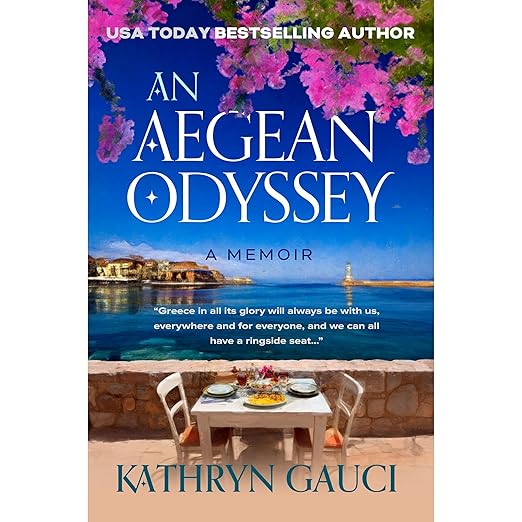
Carpet designs and mastic villages might seem an unlikely pairing, but for Kathryn Gauci, they form the spine of An Aegean Odyssey: A Memoir, an audiobook about the extraordinary courage it takes to leave one life behind and step into another. Gauci spent more than three decades as a successful carpet and textile designer before deciding, in her fifties, that she wanted to write. Greece, where she had lived and worked in Athens in the 1970s, called her back. So in 2005 she packed a bag and went alone in search of a Greece that was being swallowed by package tourism and modernity.
What she found across Chios, Lesbos, Karpathos, and Crete is the heart of this memoir, and it is rich material. Gauci draws on her background in textiles, pattern, and color to bring Greek landscapes to life with remarkable precision. She is not writing a guidebook. She is writing about what it feels like to stand in a centuries-old mastic village and know, at some cellular level, that this place has meaning beyond the photogenic.
Gauci's guiding conceit, that she would be like Odysseus wandering in search of adventure and leave the outcome to fate, gives the memoir a loose structural rhythm. Each island becomes a chapter not just in geography but in her interior life. Chios and its mastic production, one of the most specific and sensory sections of the book, gives way to Lesbos with its vast olive groves and the world's finest ouzo producers. Karpathos offers turquoise beaches and an older, slower Greece. Crete brings everything together in a crescendo of mythological weight, partisan history, and the indomitable Zorba spirit that shaped so many literary imaginations before hers.
The literary touchstones she carries with her matter: Nikos Kazantzakis, Patrick Leigh Fermor, Henry Miller, Homer himself. Gauci is not namedropping. She is placing herself in a tradition of writers who found Greece transformative, and then asking whether it can do the same for her. The answer, over ten hours and forty minutes of listening, is quietly and convincingly yes.
Why It Works in Audio
Reviewer Sharon B. captures something important when she describes Gauci as "the travelling companion I want." The memoir succeeds not because Gauci has extraordinary adventures but because she is genuinely curious about what she encounters. She stays in unspoiled villages and mountain retreats, eats regional food cooked in age-old tradition, and pays attention to the people who cross her path in ways that feel earned rather than performed. The descriptive passages around food are particularly effective. Reviewer Alyson Sheldrake warns readers that Gauci's accounts of meals will leave your mouth watering, and that is not an exaggeration. The descriptions of mezedes, ouzo cloudy with ice at a sidewalk table lined with pink oleander, are small pleasures that accumulate.
The narration on this audiobook comes via Virtual Voice, an AI-generated performance. For a memoir this personal and contemplative, a human narrator would have added a layer of intimacy the technology cannot quite replicate. That said, the prose is descriptive and measured enough that the narration does not significantly impede the listening experience. The voice handles the unhurried rhythm of the text competently, even if it cannot reproduce the warmth of Gauci reading her own words.
Before You Commit to An Aegean Odyssey: A Memoir
Gauci is honest about the uncertainty that drove this journey. She did not go to Greece knowing what she would write about. She went because she needed to find out. That openness makes the memoir feel genuine in a genre that can sometimes tip into false profundity. When she writes that she felt different, that she could sense a peacefulness she had not had for years, and that she had not even noticed it happening, the observation lands because she has earned it through five hundred pages of careful attention to her surroundings.
The historical material woven through the island chapters is substantial without becoming academic. Gauci's passion for the Greek past, Ottoman resistance, World War II on Crete, the legend of the Minotaur and the weight of Crete as the home of Zeus, surfaces through story and landscape rather than lecture. Listeners who come expecting a pure travel narrative might be surprised by how much cultural and historical texture is embedded here. Those who find that texture rewarding will be very well served.
One reviewer noted that the book is "rich with detail and humour," and the humour is easy to underestimate. Gauci is not writing comedy, but she has a dry, warm eye for the absurd and the unexpected. She finds characters in villages who seem to have stepped directly from a Kazantzakis novel and describes them with affection rather than condescension. That tonal balance, curious but never patronizing, is one of the memoir's real strengths.
Who Will Get the Most From It
This audiobook will appeal most to listeners who love the intersection of travel writing, personal memoir, and cultural history. If you have read Lawrence Durrell, Patrick Leigh Fermor, or Helene Cooper and responded to that particular mode of deeply attentive travel writing, Gauci's account of the Aegean islands will be immediately familiar and genuinely satisfying. It is also well suited to anyone considering a trip to Greece who wants to move beyond the usual itineraries toward the less-visited islands and their particular characters.
Listeners seeking plot-driven narrative or dramatic personal revelation may find the pace too gentle. This is a book about observation and slow transformation, not crisis and resolution. Those who know what they are signing up for will find it deeply enjoyable. Those expecting a conventional midlife crisis memoir with a tidy arc may be less patient with its unhurried wandering across the Aegean.
- Narrator: Virtual Voice handles the contemplative, descriptive prose reasonably well, though the warmth of a human narrator would suit this personal travel memoir more naturally.
- Subjects: midlife reinvention, Greek cultural history, the search for an authentic sense of place
- Tone: Sun-soaked and reflective, with a quiet undercurrent of personal courage
- Bottom line: A vivid and personal account of island-hopping Greece that rewards listeners who love history, food, and honest self-discovery.
Questions Listeners Ask
Is the An Aegean Odyssey audiobook suitable for listeners unfamiliar with Greek history?
Yes. Gauci weaves historical context into the narrative naturally, explaining the significance of Chios, Lesbos, and Crete without assuming prior knowledge. You do not need to be a student of Greek history to follow and appreciate the material.
Does this audiobook cover mainland Greece or only the islands?
The memoir focuses almost entirely on the islands. Gauci's starting point is her earlier life in Athens in the 1970s, but the 2005 journey at the heart of the book takes her through Chios, Lesbos, Karpathos, and Crete.
How does the Virtual Voice narration affect the listening experience for a personal memoir like this?
Virtual Voice narration is AI-generated and lacks the warmth a human narrator brings to intimate memoir prose. The narration handles Gauci's descriptive, measured style competently, but listeners sensitive to AI-generated performance may find it slightly distancing for such personal material.