In Brief
- Narrator: Virtual Voice narration is functional for the dialogue-heavy material but lacks the comic timing and warmth that a skilled human narrator would bring to children's comedy.
- Subjects: grumpy-but-kind protagonists, unlikely alliances, space adventure with absurdist humor
- Tone: Energetically silly with a genuine heart; built for short attention spans and big laughs
- Bottom line: A funny, game-adjacent middle-grade comedy that will hook Among Us fans aged 7-12, though the Virtual Voice narration is the format's limiting factor.
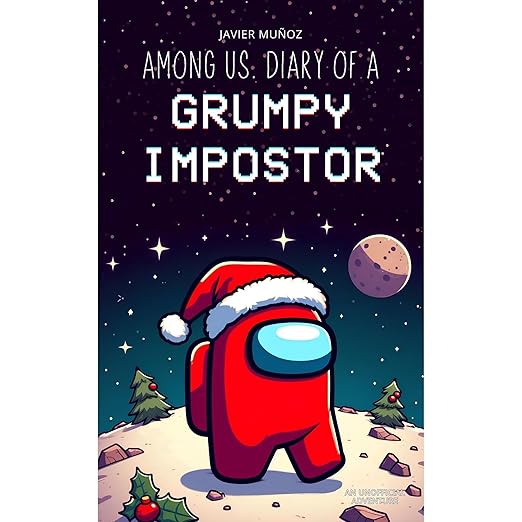
Valiant, the grumpiest impostor in the galaxy, has decided he no longer wants to sabotage crewmates. He wants to pilot a spaceship and explore the universe, which is a reasonable aspiration until his second intergalactic journey ends with him crashing into Santa Claus's vessel in deep space. That setup, drawn from the world of the massively popular video game Among Us, is the premise of Javier Munoz Ruiz's children's audiobook Among Us: Diary of a Grumpy Impostor, and it establishes the book's governing principle immediately: absurdist comedy with a logic of its own, aimed squarely at readers aged seven to twelve who are navigating the transition from picture books toward longer narrative fiction.
The audiobook runs two hours and is delivered through Virtual Voice narration, the AI-generated format available on select titles. For children's content at this level, the format works adequately: the short, dialogue-dense chapters that define the diary-style structure are accessible rather than literarily demanding, and the humor lands on the page in ways that don't require exceptional vocal performance to convey. Young fans of the Among Us game will bring their own imaginative investment to the material, which supplements whatever the narration provides.
Cowardly by Temperament, Brave by Necessity
The book's strongest structural asset is Valiant himself. A grumpy protagonist is a reliable comic device in middle-grade fiction, but Munoz Ruiz gives the character a contradiction that elevates him above the standard grumpy-but-secretly-kind archetype: Valiant is cowardly by temperament and brave by necessity, mischievous in intent but kind in effect. The synopsis describes him as 'a main character full of contradictions, teaching kids that appearances can be deceiving,' and that's both accurate and understated. Valiant works because his contradictions feel real rather than programmed.
The Santa subplot is where the book's sense of humor becomes most inventive. Santa in this version is 'almost as grumpy as Valiant,' has exiled all his helpers in 'a fit of rage,' and has no idea how to retrieve them. Two grumpy characters who are each too proud to be helpful are forced into an alliance of convenience, which is the premise of a great deal of classic comedy from vaudeville to animated film. Munoz Ruiz uses it with reasonable craft for the target age group, and the callbacks to earlier chapters that reviewers mention as a structural strength help maintain engagement over the full narrative arc.
A Laughing Ten-Year-Old Is the Reliable Indicator
Reviewers report children finishing the book in approximately an hour when reading the print version, suggesting the text moves quickly enough to hold attention throughout. In audio, the two-hour runtime spreads that material appropriately. Multiple parents describe children 'laughing out loud' while engaged with the story, which is the most reliable indicator available for children's comedy: adult analysis can tell you why something should be funny; a laughing ten-year-old tells you whether it actually is.
The Among Us game connection is both the book's main marketing asset and its primary structural choice. Valiant and his partner Candice exist within the game's visual and conceptual world, which gives young fans an immediate point of identification. The book functions as a kind of alternate-universe fan fiction set within a universe the target audience already inhabits imaginatively. This is a smart approach for middle-grade fiction aimed at gaming-adjacent readers: the world-building is pre-done, which allows the plot to move quickly without preamble.
Virtual Voice Cannot Replicate Bedtime Warmth
The Virtual Voice narration is the primary limitation of this audiobook for younger listeners. Children's audiobooks typically benefit enormously from a skilled human narrator who can differentiate character voices, land comic timing, and sustain the kind of read-aloud warmth that young listeners associate with bedtime stories and shared reading experiences. Virtual Voice provides comprehensible delivery but cannot replicate those qualities. Parents listening alongside their children may want to supplement with their own characterization; the book is described as 'great for solo or shared reading,' and the shared format may be more satisfying in audio than solo listening.
The book is clearly designed as a series setup. The 'second intergalactic journey' implies a first journey that presumably has its own volume, and the ending positions Valiant for further adventures. Young readers who fall for the character will likely want to follow him across multiple books. Parents should be prepared for that investment.
The book's short chapters and dialogue-heavy passages make it an accessible choice for reluctant readers in the seven-to-twelve range, and the audiobook offers those same readers a path into the story without requiring reading stamina. That accessibility is among the book's genuine contributions to its target audience.
The book's diary format, which structures Valiant's account as a series of log entries from the perspective of the impostor himself, gives young readers a first-person interiority that the Among Us game, a multiplayer social deduction game, deliberately withholds. In the game, the impostor is a role you play against other players; in the book, the impostor is a character you inhabit. That shift from role to character is where the book's genuine literary work happens, and Munoz Ruiz manages it without over-complicating the premise for the target age group.
The Audio Format Stays Purely Functional
This audiobook is a natural recommendation for children aged seven to twelve who play or are interested in Among Us, for parents looking for a laugh-out-loud comedy that holds young attention without demanding prior gaming knowledge, and for anyone who needs an accessible, short-chapter story that works for reluctant readers. The Virtual Voice narration means the audio format is more functional than expressive, so families who prioritize voice performance may prefer the print version read aloud by a parent. But as an introduction to longer narrative fiction for the game-loving middle-grade reader, this delivers on its premise.
Does a child need to play Among Us to enjoy this audiobook?
No, but familiarity with the game adds an extra layer of delight. The book uses the Among Us impostor/crewmate world as its setting but tells a self-contained story about Valiant, Candice, and a grumpy Santa. Non-gaming children can follow along without difficulty.
What age range is this audiobook best suited for?
The publisher targets ages seven to twelve, and reviewers confirm ten-year-olds engage fully. Children who are early in the transition from picture books will find the short chapters and dialogue-heavy style accessible. Older middle-grade readers may find it slightly simple.
Is this audiobook part of a series?
Based on the synopsis referencing Valiant's 'second intergalactic journey' and the open-ended adventure setup, this appears to be part of a continuing series. Young listeners who enjoy it should expect further Valiant stories.