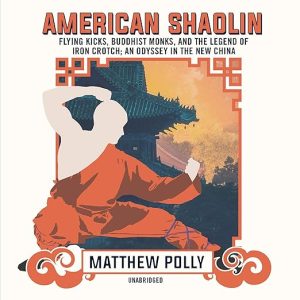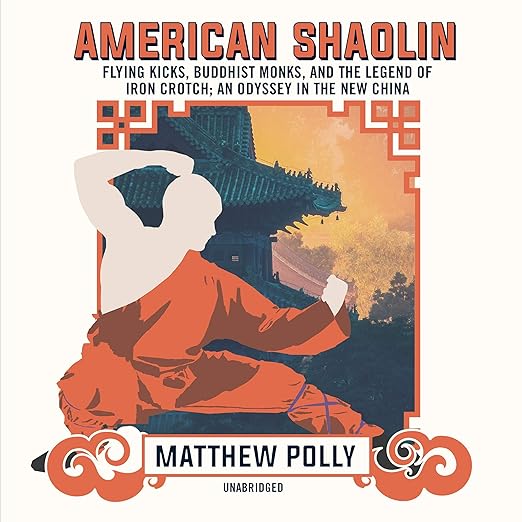
I came to American Shaolin with a somewhat dismissive initial expectation: another wide-eyed Westerner goes to Asia, finds himself, comes home changed. The synopsis's invocation of both Bill Bryson and Bruce Lee suggested charm but also formula. I was wrong to expect formula. Matthew Polly is a genuinely gifted writer, funny in the specific, self-aware way that requires a person to have made real peace with their own embarrassment, and what he produced from two years training with the Shaolin monks in the early 1990s is something considerably more interesting than the mystical-journey narrative the concept implies.
The setup is real: Polly, a self-described ninety-pound weakling from Kansas tormented by childhood bullies, becomes obsessed with the Shaolin Temple through the 1970s Kung Fu television series. He drops out of Princeton with one year remaining, much to his parents' understandable horror, to pursue the dream before it's too late. He expects a remote citadel of supernatural ascetics. What he finds is a tourist trap run by Communist Party officials, with monks who nonetheless train with genuine dedication in forms that have been practiced for centuries. The gap between expectation and reality is the engine of the book's humor, and Polly exploits it with perfect comic timing.
Where This One Lands
What elevates American Shaolin above travel memoir competence is the depth of the cultural observation layered beneath the comedy. Polly arrived in China in 1992, a specific historical moment when the country was modernizing at breathtaking speed while carrying institutional structures and social habits formed under Maoism. The monks he trained with, the Communist officials who managed the temple's commercial operations, the Chinese students he befriended, they exist in a China that is neither the mystical ancient civilization of Western martial arts romanticism nor the global economic superpower of later decades. Polly captures the specificity of that in-between moment with the clarity that comes from genuine curiosity rather than ideological expectation.
One reviewer who lived in China for five years notes the accuracy of the period detail and the recognizable patterns of social interaction, that certain dynamics Polly describes from the early 1990s persisted into the early 2000s. Another reviewer who practices martial arts found the Shaolin training sequences both technically credible and accessible to non-practitioners. The "iron kung fu" discipline, in which intensive training makes body parts including, as the synopsis memorably notes, the crotch virtually indestructible, is treated with the appropriate combination of awe and incredulity that the absurdity demands.
Why American Shaolin Works as an Audiobook
George Newbern's narration is an ideal match for Polly's prose. The humor in American Shaolin is dry and self-deprecating, it works through understatement and the careful revelation of Polly's own delusions about what he was walking into. Newbern has the comic discipline to resist overselling the jokes, which is rarer than it should be in comedic memoir narration. He lets the text do the work and trusts the listener to arrive at the punchline on its own timeline. For a 10-plus hour listen, that restraint matters enormously, the alternative, a narrator who mugs through every funny observation, would make the experience exhausting rather than pleasurable.
Multiple reviewers describe the book as impossible to set down, and one notes genuine disappointment at the ending, not because the book was unsatisfying but because they wanted more time in the world Polly created. That's the highest compliment a memoir can receive. The coming-of-age arc, Polly going from frightened weakling to temple representative in international competitions, accepted as close to one of their own as any Westerner had ever been, is genuinely earned rather than cinematically compressed. The transformation is shown rather than announced.
What Gives Us Pause
Listeners who come for the martial arts content and stay for the China portrait may be surprised to find that Polly's book is as interested in the social and political texture of early-1990s Dengist China as it is in the mechanics of kung fu training. This is not a weakness, the cultural observation is often the most valuable part of the book, but listeners who want sustained technical martial arts content should know that Polly is writing about the experience of training, not a training manual.
The 2018 audiobook release date means the recording is relatively recent for a book originally published in 2007, and Newbern's narration sounds well-produced and clean throughout the 10-plus hours. No audio quality concerns to flag.
Should You Listen to American Shaolin?
Listeners who enjoy travel memoir with genuine depth and self-aware humor will find this one of the better examples of the form. Martial arts enthusiasts, particularly those with interest in the historical and cultural context of the Shaolin tradition rather than only its technical content, will find Polly's portrait of the temple in its post-Mao commercialization era fascinating. Readers who enjoyed Peter Hessler's River Town and its account of early-reform-era China as a lived experience will recognize a similar quality of immersive cultural observation. This is also an excellent recommendation for listeners who want a coming-of-age story that earns its transformation rather than asserting it.
- Performance: George Newbern brings dry warmth and self-deprecating ease to Matthew Polly's voice, his delivery suits the memoir's humor perfectly, and the comedic timing in the kung fu training sequences is genuinely sharp.
- What it covers: Coming-of-age through physical transformation, the gap between myth and commercial reality, Western romanticism colliding with a rapidly changing China
- Feel: Raucously funny with unexpected depth, think travel memoir crossed with martial arts coming-of-age story
- Our call: One of the best underrated travel memoirs in audio, George Newbern's narration elevates Polly's already excellent writing, and the portrait of early-1990s China in transition is as valuable as the kung fu story.