
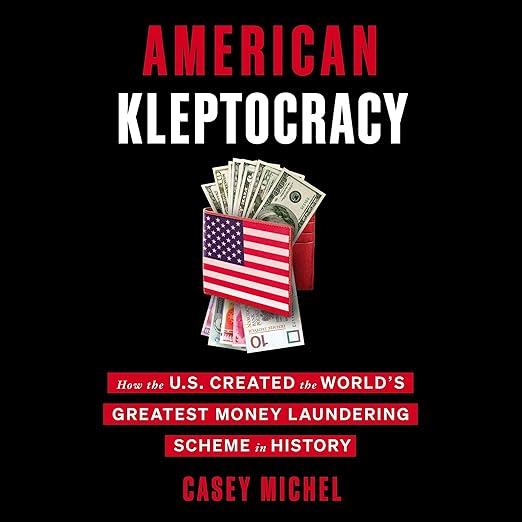
- Performance: Joe Dwyer handles the book's investigative density with clarity, keeping the complex financial mechanisms accessible without dumbing them down.
- What it covers: Offshore finance, corruption laundering, the gap between American self-image and financial reality
- Feel: Alarming and exhaustively reported, reads like long-form investigative journalism at its sharpest
- Our call: One of the most important financial accountability books of the last decade, and more relevant now than when it was published.
I started American Kleptocracy on a Sunday morning with coffee, expecting something like a useful briefing. By the time I was through the Delaware shell company chapters I had moved past briefing into something closer to slow-burning anger. Casey Michel is not editorializing. He is simply laying out, methodically and with specific names and dollar figures, how the United States became the world's premier destination for money that does not want to be found.
This is investigative journalism in book form, and it is remarkable debut work. Michel had been covering the kleptocracy beat as a reporter for years before writing this, and the book carries that accumulated knowledge without becoming encyclopedic. He knows how to find the narrative inside complex financial mechanics, and Joe Dwyer's narration keeps that narrative accessible even when the underlying structures are genuinely intricate.
Delaware and Nevada Built the Offshore Machine
The central argument of American Kleptocracy is uncomfortable in a specific way. Michel is not arguing that foreign kleptocrats have corrupted an otherwise clean American system. He is arguing that the American system actively built the infrastructure of that corruption, state by state, decade by decade, with Delaware and Nevada leading the way through anonymous shell company registration, and with the real estate, banking, and lobbying industries each contributing their own layers. The United States, Michel contends, is the world's largest offshore haven, and it got there by design.
That argument lands harder because Michel documents it at the ground level: specific oligarchs, specific properties, specific lobbyists, specific universities and cultural institutions that accepted money they did not scrutinize. The abstraction of dark money becomes concrete when you are reading about a particular Central Asian despot's family members buying real estate in Kansas City or a post-Soviet kleptocrat funding an endowed chair at a prestigious American university. The specificity is both the book's strength and the reason one reviewer with a graduate degree in social science noted it was a little hard to read: the information is dense precisely because it is real.
Joe Dwyer Delivers Revelations Without Amplification
Joe Dwyer is well-suited to this material. He has a reporter's instinct for which words carry weight and which need to be delivered straight, without emphasis that might feel leading. Investigative nonfiction has a specific narration challenge: the narrator needs to convey urgency without sounding like he is performing outrage on the author's behalf. Dwyer manages this. The book's revelations land because they are delivered with restraint, not amplification.
At just under ten hours, the runtime is proportional to the scope. Michel covers several distinct mechanisms of American offshore finance, from the founding era of shell company law through the post-9/11 anti-money-laundering reforms that inadvertently funneled illicit money into new channels, through Trump's specific contributions to a trend already well underway, and through to what reform might require. Each section is self-contained enough that you could stop and start without losing the thread, though the cumulative picture that emerges from listening straight through is more powerful.
Nazi-Era Lobbyists Built Today's Reputation-Laundering Template
The book was published in 2021 and includes material through the early Biden administration. The specific political figures and policy recommendations have evolved since then, and some of the reforms Michel calls for have been partially implemented, partially stalled, or in some cases actively reversed depending on the political moment you are reading this. The structural analysis, however, is durable. The mechanisms Michel describes, anonymous shell companies, perpetual trusts, opaque real estate transactions, reputation laundering through nonprofits, did not appear with any one administration and will not disappear with any one election.
Michel is particularly strong on the lobbying dimension: how the Nazi-era lobbyists who worked to rehabilitate post-war European fascists created a template that their successors applied to African despots and post-Soviet oligarchs, and how that industry became one of the primary tools of reputation management for figures who had looted their countries. That thread of the book is the least-covered aspect of kleptocracy in popular media, and it is where Michel's reporting breaks the most genuinely new ground.
Kleptopia and Moneyland Readers Need This Companion
Essential listening for anyone interested in financial accountability, international corruption, or the structural underpinnings of American political influence. Readers who found Tom Burgis's Kleptopia or Oliver Bullough's Moneyland compelling will find Michel's American-focused analysis a necessary companion. This is not casual background listening: the material requires attention and some tolerance for dense financial mechanics. Come ready to sit with uncomfortable conclusions about American exceptionalism.







