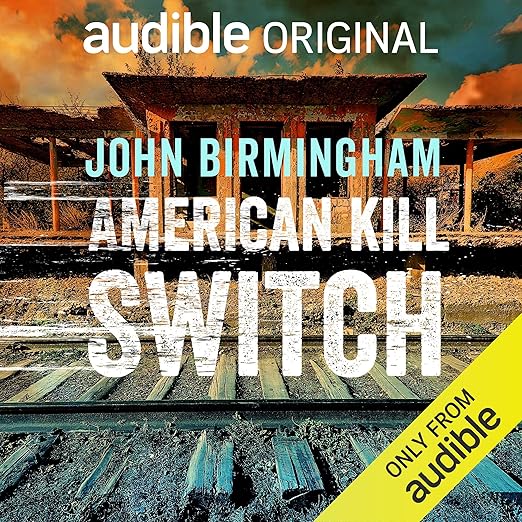
Zero Day is the name the description gives to the moment the internet went dark, the grids failed and the cities began to starve. This audiobook is the end of that story rather than the beginning: a fifteen-hour finale in which the survivors of a global cyberwar work out that what they now have to fight is not the collapse itself but a fascist militia growing inside the wreckage of a failing country.
How American Kill Switch Holds Up
John Birmingham's premise has a specific advantage over most collapse fiction, which is that the mechanism is unglamorous and plausible. No asteroid, no plague, no divine judgment, just a targeted campaign of online sabotage and everything downstream of a network refusing to work. The description calls the trilogy prescient, a word that usually means nothing, and here the failure chain is ordinary enough to be genuinely unnerving.
Rupert Degas draws the only performance comment anywhere on this page, and it is emphatic. A five-star response from March 2021 describes Degas, in its own choice of words, as a huge bathtub of awesomeness, and credits him with bringing a diverse cast to life with real talent. That same account praises the author's range of vocabulary and, oddly and specifically, of anatomy, which tells you a good deal about the violence.
Cyberwar is over before this book opens, and that is the structural decision making the finale work. The collapse has already happened. What remains is the part collapse fiction usually skips, which is the political reorganization afterward, and the description is direct that the threat is a militia assembling among ruins rather than a fresh catastrophe arriving to reset the board. That is a harder story to write than the first two, because the enemy now has an argument rather than merely an appetite, and the survivors have to answer it rather than outrun it.
Why American Kill Switch Works as an Audiobook
Collapse stories tend to run out of energy once the lights go off, because the interesting question was always the falling and not the landing. Birmingham's answer is to make the third act about governance: who claims authority, who enforces it, and what people will accept in exchange for order. The description frames the whole trilogy around why some societies hold and others come apart.
Fifteen hours and forty-four minutes is a great deal of finale, and the length reads as a feature if the previous two volumes worked for you. A ragtag band of survivors, an organized militia, a failing state and an argument about resilience all need room to move. If you are arriving cold, that same length is the clearest reason not to start here.
Birmingham writes action at a high rate, and the promise of a high-octane conclusion is not misleading. What raises it above the shelf is that the ideas keep running underneath the set pieces. The question of why some societies survive is not decoration between fights, it is what the fights are arguing about, and characters end up on opposite sides of it rather than merely on opposite sides of a barricade. The militia is not written as a mob. It is written as a proposal, which is the version of that threat worth reading about, and the version most post-apocalyptic fiction avoids because a proposal has to be argued with rather than shot at.
Weak Spots in American Kill Switch
Series information is missing from this listing entirely. The description calls this the final installment of the End of Days trilogy, names the trilogy and calls it a conclusion, while the series fields sit empty: no number, no series name, no route to the two books preceding it. The copy also carries spellings from a non-US edition that nobody adjusted, which is a small clue about how this page was assembled.
Two ratings sit under this title. Two, on a fifteen-hour finale from a working novelist, both at five stars. That is not a verdict, it is an accident of exposure, and it means the displayed average carries no information whatsoever. The two written responses are the entire evidence base available to a buyer, which is thinner than most self-published debuts manage.
Neither of those responses separates this book from its predecessors. An October 2022 five-star account says only that the trilogy was enjoyable and worth recommending, which is a signal about the sequence and no help at all in judging whether this finale holds up by itself. Both accounts are reviewing three books at once, and the page presents them as reviews of one.
The Right Listener for American Kill Switch
Post-collapse readers tired of the genre's mystical turn are the natural audience. This is infrastructure fiction: supply chains, power, transport, and what people do in the fourth week rather than on the first afternoon. The militia plot gives it an antagonist that is neither undead nor extraterrestrial, and the description is willing to name what the villains believe instead of leaving it abstract. It also suits listeners who like a long sequence finished properly. The description commits to a conclusion rather than a hand-off, and after two volumes of accumulating threads a finale that closes them is worth more than another cliffhanger would be.
Completists of the trilogy are the only listeners who should buy this without hesitation. Everybody else needs the first two volumes, and finding them from this page is harder than it should be, since the metadata refuses to name them. The description supplies the trilogy's title and stops, which is enough for a search and nowhere near enough for a purchase decision.
Find the first book before you touch this one. If the premise then holds for you across two volumes, this is a finale with a real argument inside it and a reader whom at least one listener thought carried the entire cast single-handed. Do not judge the trilogy by the two ratings on this page, because almost nothing sits behind them. Two votes on a title of this size is a distribution problem, not a quality one, and the single detailed response on the page is more enthusiastic about both the writing and the reading than the bare number could ever convey. Judge it on the sample and on the first two books instead.
Quick Take
- Narrator: Rupert Degas draws the only performance comment on the page, from a five-star account crediting him with carrying a large and varied cast.
- Subjects: Infrastructure collapse after a cyberwar, fascism assembling in the ruins, why some societies hold together
- Tone: Fast, grim, unusually interested in governance
- Bottom line: A capable trilogy finale with an argument inside it, sitting on a listing that never admits it is a finale.
Before You Listen
Is American Kill Switch a standalone or part of a series?
It is the third and final volume of the End of Days trilogy, which the description states and the series fields on this page do not. No number, no series name and no links to the earlier books appear in the metadata. Search the trilogy name and start from the first volume instead.
How long is the audiobook, and how much does it assume?
Fifteen hours and forty-four minutes, and it assumes a great deal. The survivors arrive carrying histories, the world is already broken when it opens, and the description introduces the new threat as eerily familiar, which only reads that way if you have met its earlier form in the previous books.
What kind of collapse story is this?
An infrastructure one. The trigger is a coordinated campaign of online sabotage that takes down the internet, transport and power, and the consequences are hunger and improvised authority rather than anything supernatural. If you want the mechanics of a state coming apart rather than a monster, this is the register.
Why does the audiobook carry so few ratings?
The page shows just two, both at five stars, on a title published in 2021. That is an exposure problem rather than a quality signal, and it makes the average meaningless. Both written responses praise the trilogy as a whole rather than assessing this volume, so the record is thinner than the count suggests.