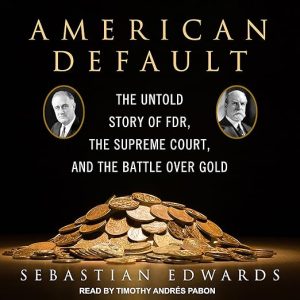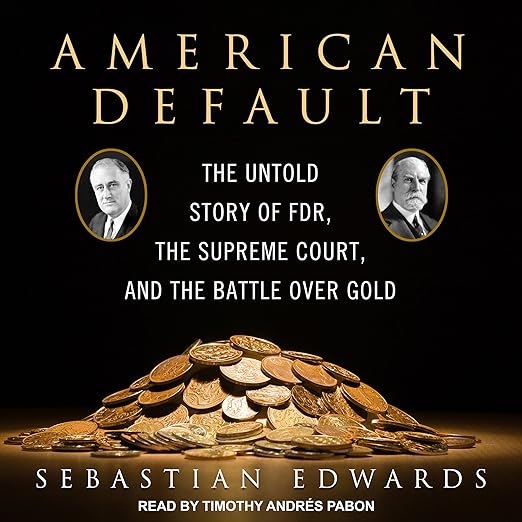
Sebastian Edwards opens American Default on April 5, 1933, when Franklin D. Roosevelt signed an executive order requiring all Americans to sell their gold holdings to the federal government. Within weeks, the US had abandoned the gold standard entirely and retroactively rewritten every private and public debt contract in the country, effectively devaluing those obligations by nearly half. The audiobook version of this economic and legal history, narrated by Timothy Andres Pabon at just over nine hours, recovers a chapter of American financial history that has been strangely neglected given how much it determined the subsequent course of the New Deal and FDR's relationship with the Supreme Court.
Edwards is an economics professor at UCLA with a long career studying sovereign debt and currency crises, primarily in Latin America. That expertise gives American Default its distinctive analytical frame: Edwards approaches FDR's gold policy not as a domestic curiosity but as an experiment in currency devaluation and debt restructuring that, as he notes in the audiobook, several major economies have since approached, or refused to approach, as policy options. The historical is made contemporary without being tendentious; Edwards is genuinely interested in what the 1933 episode can tell us about the mechanics and consequences of such policies.
Jansen Calls This Tremendous Monetary Scholarship
Reviewer John J. Jansen, who spent a career at the Federal Reserve's Open Market Desk and then thirty-five years trading US Treasury securities, describes the book as "a tremendous work of scholarship about a bit of monetary and economic esoterica." That credentialed assessment matters here. This is not popular financial history that simplifies for accessibility at the cost of accuracy; it is rigorous economic analysis rendered in prose clear enough for engaged non-specialists. Jansen's confidence in the scholarship is the relevant endorsement.
Reviewer Ronald H. Clark covers the Supreme Court dimension of the story, which is where American Default becomes genuinely dramatic. In 1935, the gold cases came before the Court, putting FDR's entire debt restructuring program at risk. The confrontation between FDR and Chief Justice Charles Evans Hughes, a conservative who loathed New Deal expansionism but ultimately wrote opinions that upheld key elements of the gold policy, is one of the more fascinating legal episodes of the 20th century. Edwards covers it with the detail it deserves, including the aftermath: FDR's fury at even the narrow victories, and the court-packing scheme of 1937 that attempted to restructure the judiciary itself as a response.
Reviewer Jim W., in a more mixed assessment, notes wanting more coverage of the early decisions to go off the gold standard. The critique has some validity: Edwards's primary interest is the legal battle and the economic consequences rather than the internal deliberations of FDR's Treasury Department. Listeners who want the full backstory of how Keynes, Warren, and Fisher influenced the administration's gold-buying program will find the audiobook thorough in some areas and compressed in others.
Pabon Sustains Tension Through the Supreme Court Chapters
Timothy Andres Pabon's narration is well calibrated for this material. Economic history requires a narrator who can make technical vocabulary, gold clauses, devaluation, the relationship between the dollar price of gold and aggregate price levels, clear without slowing the narrative, and who can also shift register when the story becomes legally dramatic. Pabon manages both. The Supreme Court chapters, in particular, benefit from his ability to sustain tension in what is essentially extended legal argument. The oral presentation of the Court's confrontation with FDR's gold policy is one of the audiobook's strongest sequences.
The book's structure is chronological but organized around analytical themes. Edwards moves from the economic crisis context of 1933 through the specific policy decisions, into the legal challenges, out through the Supreme Court battles, and then into a broader assessment of what the episode means for how we understand sovereign debt and currency management. That structure serves the audiobook format well: each phase has its own internal momentum, and the progression from economic crisis through political decision to legal confrontation to historical reckoning gives the nine-hour listen a shape that rewards completion.
The contemporary relevance Edwards implies throughout the book has only increased since its publication. Questions about sovereign debt, currency devaluation, and the limits of executive authority over financial contracts have not gone away. Several economies have faced debt crises that involved exactly the policy options FDR exercised in 1933. The episode Edwards describes is not a historical footnote; it is the foundational American test case for policies that remain contested and consequential.
Active Listening Required for the Gold Clauses
Listeners without background in monetary economics will need to stay attentive through the chapters on gold clauses, the relationship between gold holdings and currency value, and the mechanics of how the debt devaluation actually worked. Edwards explains these concepts clearly, but they require active rather than passive listening in audio format. The book's scholarly reputation reflects its accuracy and depth; that depth means following the argument is work rather than entertainment in the passive sense.
The legal and political drama of the Supreme Court confrontation is the section where American Default most rewards committed listeners who have stayed through the economic foundations. FDR's relationship with Hughes, the specific arguments in the gold cases, the decision that effectively upheld the rewriting of private contracts retroactively while avoiding the most explosive constitutional confrontation, these chapters read with genuine narrative tension. Edwards has done the archival work that makes those sequences specific rather than generalized political history.
Reviewer Jim W. notes correctly that the book's early sections on the decision to abandon the gold standard could be more extensive. Edwards's primary archival contribution is in the legal history; the economic decision-making antecedents receive somewhat less attention. Listeners who come primarily interested in the intellectual history of the gold standard's abandonment may find Edwards's coverage complementary to but not exhaustive of that subject, and may want to read supplementary material on the Warren gold-buying program and its theoretical underpinnings.
Legal Historians Get as Much as Economists
Economic history enthusiasts who want to understand the 1933 gold episode in real depth will find this the definitive treatment. Financial professionals with interest in sovereign debt history, monetary policy, and the precedents that shape current thinking about currency devaluation and debt restructuring will find Edwards's economic analysis directly relevant to their professional understanding. Legal history readers interested in the New Deal Supreme Court battles will find the gold cases material as compelling as the more famous Commerce Clause confrontations of the same period.
Pass on this as casual listening. The material is rigorous and specific, and rewards preparation and attentiveness more than background audio consumption. But for listeners willing to engage with a dense and rewarding piece of financial and legal history, American Default recovers a genuinely important story that has been overlooked in favor of the more familiar New Deal narratives, and makes the case for why it should not have been.
- Voice: Timothy Andres Pabon reads Edwards's economic and legal history with the controlled authority it needs, sustaining the technical argument without sacrificing the story's dramatic momentum.
- Big ideas: Presidential power and economic crisis, the gold standard as political weapon, the judiciary as check on executive action
- Atmosphere: Precise and riveting, the legal and economic material turns genuinely dramatic once the Supreme Court enters
- Worth it?: Sebastian Edwards recovers a forgotten chapter of American financial history that turns out to be neither obscure nor irrelevant, and this audiobook makes the dense material genuinely compelling.
Before You Listen
Does this audiobook require a background in economics or finance to follow the argument?
Not strictly, but it rewards prior familiarity. Edwards explains the mechanics of gold clauses, currency devaluation, and the dollar-gold relationship clearly enough for engaged non-specialists to follow. Listeners with some background in monetary economics or financial history will absorb the argument more easily, but the book is designed for a general educated audience rather than specialists exclusively.
How does the audiobook balance the economic history with the Supreme Court legal drama?
The legal and judicial confrontation between FDR and Chief Justice Charles Evans Hughes is the book's dramatic and analytical climax, and the audiobook's structure builds deliberately toward it. Timothy Andres Pabon's narration handles the shift from economic policy analysis to legal argumentation effectively. Reviewers with financial backgrounds identify the legal sections as among the audiobook's strongest material.
Is American Default relevant to understanding current debates about sovereign debt and currency policy?
Yes. Edwards explicitly frames the 1933 episode as a relevant historical precedent for current policy debates about debt restructuring and currency management. Several major economies have faced choices similar to those FDR confronted in 1933, and the mechanisms Edwards describes, gold clause cancellation, retroactive debt rewriting, devaluation, remain live policy options whose consequences are illuminated by this historical test case.
Does this audiobook cover the broader New Deal context, or is it focused specifically on the gold policy and its legal battles?
It is focused primarily on the gold policy and its Supreme Court confrontation, though it provides necessary New Deal context throughout. Listeners wanting comprehensive coverage of the broader New Deal or of FDR's relationship with the Court beyond the gold cases should treat this as a companion volume rather than a complete account. The gold cases and the 1937 court-packing attempt are covered in depth; other New Deal programs and battles receive less attention.