Key Details
- Voice: Tom Weiner's even, authoritative delivery suits Rothbard's dense economic argument well, he maintains clarity through complex passages without flattening the prose.
- Big ideas: Austrian business cycle theory, government intervention vs. free-market correction, revisionist economic history
- Atmosphere: Intellectually rigorous and polemical, demanding full attention but rewarding it generously
- Worth it?: An essential listen for anyone who wants to understand the Austrian critique of Keynesian economic orthodoxy applied to one of history's defining crises.
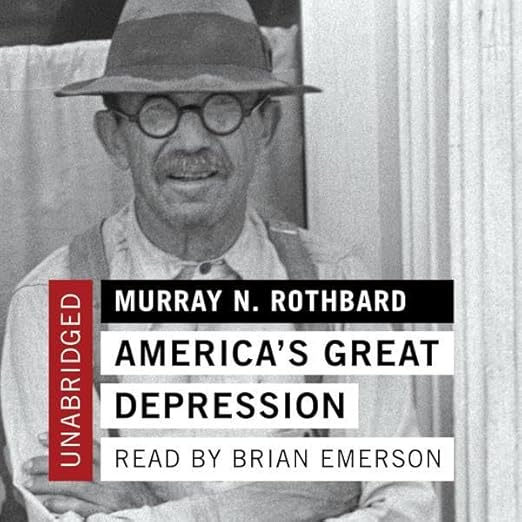
Murray Rothbard's audiobook argument is not subtle: the Great Depression was not a failure of capitalism but a product of government interference with natural market correction. He built that case in 1963, and the work has not been revised to soften its edges or hedge its conclusions. What you get in this ten-hour listen is the full force of applied Austrian economics directed at the decades between the First World War and the early 1930s, a sustained, evidence-heavy prosecution of the monetary and credit policies that Rothbard believed manufactured the crash. Tom Weiner narrates with appropriate gravity, treating the argument as what it is: serious economic history that demands serious attention. That clarity of purpose is part of what has kept this book in continuous print for over sixty years.
The 1920s Monetary Policy Rothbard Excavates
Rothbard's method here is worth understanding before you commit to the listen. This is not social history. Reviewer Frank Donnelly, a non-economist who came to this book with college-level economics background, was clear on that point: do not come expecting the human drama of breadlines or Dust Bowl displacement. What you get instead is a precise excavation of monetary policy in the 1920s, the Federal Reserve's credit expansion, the resulting boom, and the argument that the correct response to the resulting downturn was to let the market clear rather than compound the damage through New Deal intervention. Rothbard barely touches Roosevelt. The real antagonists, in his framing, are the policymakers of the Coolidge and Hoover eras who inflated the bubble in the first place.
For a book first published in 1963, the clarity of its argument is striking. Reviewer Chase noted that within the first twenty pages, listeners get a working understanding of Austrian business cycle theory, the notion that artificially low interest rates and credit expansion generate malinvestment that must eventually unwind. From that foundation, Rothbard builds forward through the decade of the twenties, tracing the specific policy decisions that, in his account, made the eventual crash both inevitable and more severe than it needed to be. The argument is internally consistent and presented with genuine rigor, which is why free-market economists still return to this text as a primary reference more than half a century after its publication.
Weiner's Narration Eases the Technical Passages
The case for listening rather than reading this one is real. Weiner's narration smooths the denser technical passages, the sections on money supply figures and banking reserve ratios, which could feel relentless on the page, become more manageable as audio because the rhythm of speech forces a natural pace. At just over ten hours, the book is appropriately sized for its ambition: long enough to make its case fully, not padded with repetition or unnecessary review.
Reviewer Robert Gaffney, making a point that cuts to the heart of Rothbard's project, observes that you cannot understand the New Deal without first understanding the 1920s policies that preceded it. That reframing is precisely what this book offers: a counter-narrative to the Keynesian consensus that for decades defined how the Depression was taught in economics classrooms. Whether you find Rothbard's conclusions fully persuasive or not, the analytical apparatus he deploys here, applying Austrian theory to documented historical data rather than to abstract scenarios, represents the work at its most compelling and its most useful as an intellectual counterweight to mainstream treatments.
Rothbard's framing of the Depression as a corrective business cycle downturn that government policy transformed into a prolonged catastrophe is still provocative, and deliberately so. The audiobook format allows that provocation to develop at the pace the argument requires, building the evidentiary foundation before making the larger claims. Weiner's measured delivery prevents the book from feeling combative even when the argument is at its most pointed, which is the right instinct for this kind of economic polemic.
Advocacy Scholarship With a Selective Scope
The polemical edge is real and worth naming. Rothbard wrote explicitly as a free-market advocate, and this book is not attempting to present a balanced survey of competing interpretations. Listeners who come to the Great Depression primarily through Keynesian or monetarist frameworks will find substantial sections that read as direct rebuttals to positions they may hold. That is not a reason to avoid the book, intellectual friction is valuable, but it is worth knowing that this is advocacy built on scholarship, not neutral history.
The book's scope is also selective by design. Social conditions, political developments, and international dimensions of the Depression receive little attention. Rothbard's focus remains on the domestic monetary and credit dynamics, which means large and important parts of the historical event are simply outside the frame. Listeners who want comprehensive coverage should treat this as one essential lens among several, not as a standalone account of everything that happened during the Depression years.
Keynesian Listeners Should Start With Rothbard
This audiobook is built for listeners with some economics background, not necessarily formal academic training, but at minimum a working familiarity with concepts like interest rates, credit cycles, and monetary policy. Complete novices will find the early chapters sufficient orientation, but the middle sections become dense quickly. Students of economic history, libertarian and free-market thinkers, and anyone who has encountered Austrian economics in passing and wants a rigorous, full-length example of it applied to a major historical event will find this essential. Keynesian-leaning listeners who want to engage seriously with the strongest opposing argument should start here rather than with secondary summaries of Rothbard's position. The investment of ten hours pays off in a thorough understanding of why the Austrian critique of managed monetary systems has remained intellectually vital.
Is this audiobook accessible to listeners without a formal economics background?
Marginally, but it will test them. The first twenty pages establish Austrian business cycle basics in accessible terms, and Weiner's narration helps pace the dense sections, but the middle chapters assume comfort with monetary policy concepts. Listeners with even a survey-level economics background will fare much better.
Does this audiobook present multiple perspectives on the Great Depression, or is it argued from one position?
Rothbard is explicit that this is Austrian economics applied to historical evidence. It is not a survey of competing interpretations. That is both its strength, the argument is fully developed and consistent, and its limitation if comprehensive coverage is what you need.
How does Tom Weiner handle the technical economic passages in the narration?
Very well. His pacing through the denser sections on monetary policy and banking statistics is deliberate without being monotonous. The narration gives listeners time to absorb the reasoning without rushing past the connective tissue that holds the argument together.
At ten hours, does this audiobook cover the full 1929-1939 period of the Depression?
No, and that is an important distinction. Rothbard's focus is on the monetary and credit dynamics of the 1920s that he argues caused the crash, and on the early response under Hoover. The New Deal era receives relatively little treatment, his argument is that the damage was done before FDR arrived.