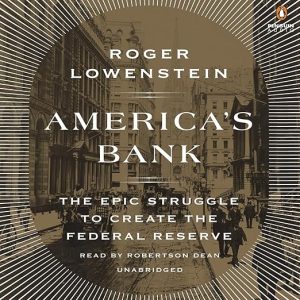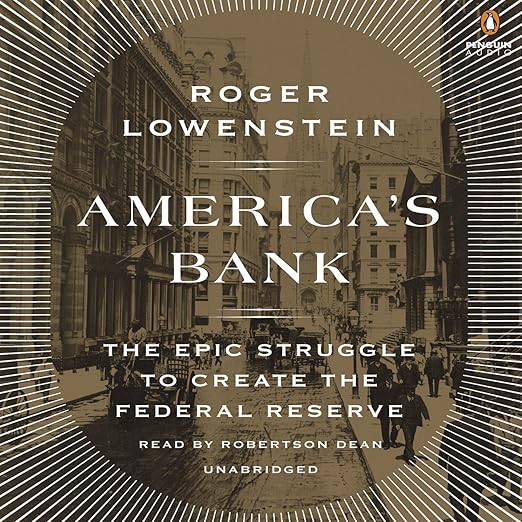
Why did the United States go nearly a century without a central bank while every other developed nation had one? This audiobook opens with that contradiction and spends its runtime explaining how badly it hurt the country: repeated financial panics, bank runs, money shortages, and depressions, all traceable to a system where, as the synopsis puts it, 'each bank was left to stand on its own.' Roger Lowenstein, the financial journalist behind When Genius Failed and The End of Wall Street, uses that dysfunction as the setup for the fight to create the Federal Reserve in 1913.
Four Men With Distinct Motives Build the Fed
Lowenstein structures the story around four men rather than abstract policy debate: Paul Warburg, the German-born financier appalled by America's primitive banking system; Nelson W. Aldrich, the Rhode Island power broker running the Senate; Carter Glass, the Virginia congressman who chaired the House Banking Committee; and Woodrow Wilson, whose progressive instincts had to be reconciled with southern Democrats' deep suspicion of federal control. Reviewer Ricardo Mio opens his own review by invoking James Madison's line about angels and government before noting the same logic applies to bankers, a fitting frame for a book about why nobody trusted anybody enough to build this institution sooner.
The book earns comparison to the best group-biography history writing precisely because it treats the Federal Reserve's creation as a character story first and a policy story second. Reviewer Michael A. Holt, who found it more substantive than both The Creature from Jekyll Island and Liaquat Ahamed's Pulitzer-winning Lords of Finance, still flags a real gap: the book never mentions the 1918 Amendment to the Federal Reserve Act, a detail worth knowing if you want the complete legislative picture rather than just the founding drama.
Each of the four central men gets distinct motivation rather than interchangeable statesmanship. Warburg arrives as a horrified outsider bringing European banking sophistication to what he sees as a primitive system; Aldrich wields entrenched Senate power without needing to justify it to anyone; Glass converts reluctantly to ideas he originally distrusted; Wilson spends much of the book forcing a genuine reconciliation between progressive federal ambition and the states'-rights suspicion baked into his own party. That range keeps the group biography from flattening into one voice.
Dean's Unhurried Authority Suits Gilded Age Politics
Narrator Robertson Dean has built a reliable reputation across dense financial and political history for measured, unhurried authority, letting research carry weight rather than performing the material for effect. That restraint suits America's Bank specifically well: a story with this many overlapping political maneuvers and Gilded Age personalities needs a narrator who trusts the facts rather than dramatizing every twist, and Dean's track record on comparably dense nonfiction supports exactly that expectation here.
The book also benefits from Lowenstein's own credentials. Having already written on financial collapse from two different angles, When Genius Failed covered the Long-Term Capital Management crisis and The End of Wall Street the 2008 meltdown, he approaches the Fed's founding already fluent in how financial institutions fail and what political will it takes to fix them. That expertise shows in how confidently the book connects 1913's arguments to recurring modern debates about banking oversight.
The book's most genuinely surprising thread involves the bankers themselves. Lowenstein details a real conspiratorial effort by a group of Wall Street's own 'vilified captains' to engineer reform from behind the scenes, fully aware that open banker involvement would doom any bill in a country deeply suspicious of exactly those men. That contradiction, reform for the common good orchestrated in secret by the people the public trusted least, gives the political maneuvering real narrative tension beyond dry legislative process.
One Reviewer Finds the Wilson Treatment Too Favorable
Not every listener will agree on the book's neutrality. Reviewer AJCCT, while praising the writing, argues it is 'impossible to discuss the Fed's history' without reckoning more critically with Woodrow Wilson's presidency, and reads Lowenstein's treatment of Wilson as favorable in a way that undersells his flaws. Listeners sensitive to how a historian frames a polarizing president should go in aware that at least one experienced reader found a point of view baked into the storytelling.
This is dense material delivered at a brisk narrative clip rather than a textbook pace, which is a strength for engagement but means listeners without any prior grounding in basic banking concepts, reserves, lenders of last resort, bank runs, may want to look up a term or two along the way rather than expect every piece of financial vocabulary defined from scratch.
The synopsis frames the whole founding fight as a 'small miracle' that ever succeeded, given how deeply America's Jeffersonian small-government instincts and its mistrust of concentrated banking power reinforced each other for nearly a century. Listeners get a real sense of just how many separate, often contradictory constituencies, farmers, populists, competing regional banks, had to be talked into a compromise none of them fully wanted.
Skip It If You Want a Neutral Textbook
History and finance readers who enjoy Ron Chernow-style group biography, along with anyone who has already read Lowenstein's other work, are the clearest audience. Listeners curious why banking regulation debates still sound familiar a century later will find the through-line satisfying.
Listeners drawn to how a single piece of legislation gets built out of competing, often contradictory self-interests will find plenty to chew on here too, since Lowenstein never lets any of his four central figures off the hook for their own motivations along the way.
Skip it if you want a strictly neutral, textbook-style account with no discernible authorial perspective, given at least one reviewer's specific complaint about Wilson's treatment, or if you are looking specifically for coverage of the Federal Reserve Act's later amendments rather than its founding fight.
Quick Take
- Read by: Robertson Dean brings measured, unhurried authority well suited to dense political and financial history.
- At its heart: The founding of the Federal Reserve, Gilded Age banking panics, political compromise under pressure.
- Vibe: Authoritative, character-driven, occasionally dense.
- Short version: A strong pick for history and finance readers, with one credible caveat about its handling of Woodrow Wilson.
Common Questions
Do I need an economics background to follow the America's Bank audiobook?
No. Lowenstein builds the story around four personalities and a political fight rather than technical monetary theory, though a little familiarity with basic banking terms helps with a few denser passages.
How does Robertson Dean's narration handle this much financial and political detail?
His delivery leans measured and unhurried rather than dramatic, a style that has worked well across other dense nonfiction narration and suits a book built on Gilded Age political maneuvering rather than action.
Does the America's Bank audiobook cover the 1918 Amendment to the Federal Reserve Act?
No. At least one reviewer specifically notes its absence, so listeners wanting the complete legislative history beyond 1913's founding fight will need a supplementary source.
Is the America's Bank audiobook biased toward a particular view of Woodrow Wilson?
One reviewer believes so, arguing the book treats Wilson's presidency more favorably than the reviewer thinks it deserves. Most other feedback focuses on the storytelling rather than raising the same objection.