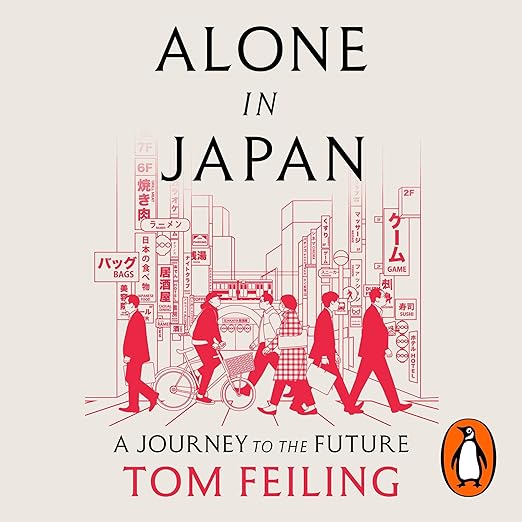
Penguin released this audiobook on February 26, 2026 behind a hook that has nothing to do with cherry blossom: No sex. No kids. No future? Tom Feiling first arrived in Tokyo as a student in the early nineties, when Japan read as the future itself, a rising superpower and a global advertisement for prosperity, civility and success. He went back twenty-four years later and found a country still functioning as a sign of things to come, except that the sign now said something entirely different. Twelve hours and fifty-seven minutes, read by Feiling.
Under the travel category is where this sits, tagged for Asia, filed alongside guidebooks and walking memoirs. That classification is going to disappoint somebody. What the book actually contains is demographic reportage: a population shrinking by a third with each new generation, the mid-seventies identified as the moment a silent transformation began, and a long investigation into why men and women have stopped pairing off and having children. Shrines, bars, rice fields, mango farms, coffee shops and homes for the old all appear along the way, so the travel label is not fraudulent. It is describing the vehicle and ignoring the cargo, which is a meaningful difference when somebody is choosing what to spend thirteen hours on.
Self-narration changes what this recording is. Feiling built the account out of countless interviews, which means the audio asks one voice to carry every person who agreed to talk: farmers, drinkers, care home residents, people explaining a private decision to a stranger with a notebook. A reporter reading back other people's speech is doing something unlike an actor performing dialogue, and unlike a memoirist reading themselves. The advantage is that the reporter knows which sentence out of a two-hour conversation actually mattered and precisely where the weight fell in it. The cost is close to thirteen hours in a single register, with no second voice to mark where testimony stops and analysis resumes.
What Stands Out
Twelve hours and fifty-seven minutes buys an unusual amount of ground. The book travels from the furthest-flung villages to the dynamism of the megacities and back again, and the structural claim underneath it, that a vast silent process started in the mid-seventies and is still unfolding, gives the reporting somewhere to go instead of settling for a run of vivid encounters. Feiling connects sexual appetites and behaviors to the evolving economy in both directions, treating them as forces that reshape each other rather than as a curiosity to be gawked at from a distance. That is the harder version of this subject, and much the more useful one.
Interviews carry the argument, and the one paragraph anybody has written about this book landed on precisely that. Filed from the United Kingdom on March 14, 2026, two and a half weeks after release, it recommends the book to anyone who has visited Japan on holiday or business, been impressed by the politeness and the order at surface level, and now wants to dig underneath to the demographic pressure. That response also frames the payoff as portable rather than local: what an aging but well-developed society is learning about itself is not information that stays inside its own borders, which is what the closing chapters set out directly.
Weak Spots in Alone in Japan
Tourists reaching for a companion to a two-week itinerary should understand what they are buying. Nothing here functions as a recommendation. The mango farms and coffee shops are field sites, the bars are places where people explain why they live alone, and the homes for the old are the destination the whole argument has been walking toward from the first chapter. Anyone who wants Japan rendered as wonder will find the wonder present and thoroughly subordinate. The book's own framing calls the country a warning rather than a beacon, and it means that in the plainest possible sense. The word beacon appears in the copy so that it can be withdrawn one sentence later, and the word chosen to replace it is warning.
Half a month after release, the entire rating column holds two votes. Both have to be fives for a 5.0 to display at that size, and two votes on a major-house title amounts to no evidence whatsoever; the number should be read as a page that has not been used yet rather than as a consensus anybody reached. The description also ends on its own rights line, with the 2026 copyright and audio production statement left sitting exactly where a closing summary would normally go, which is a small tidy-up that nobody performed before the record went live. Small, certainly, and still the kind of detail that tells you how recently a page was assembled and how little traffic it has seen.
Best Suited For
Demography readers are the primary audience, whatever the shelf label says. Anybody following fertility decline, aging populations, or the economics of solo living in Europe, in North America, or anywhere the same curve has begun to bend will recognize their own subject arriving here earlier and further along. Japan has been running this experiment longer than anywhere else, and the book treats it as a place to learn from rather than an oddity to explain away. Listeners who like long-form reporting assembled from interviews rather than from statistical tables will find the method familiar and the setting unfamiliar, which is usually the right pairing at this sort of length. Anyone who has read long-form reporting on an unfamiliar country and found it thin will notice what twenty-four years of intermittent attention buys a writer.
Visitors wanting atmosphere, food and temples should hold off, since the book keeps steering back toward birth rates and living arrangements no matter how appealing the setting gets. Listeners who need reporting delivered on clear numerical scaffolding may also find an interview-led account frustrating, because the shape is cumulative rather than tabulated. The page currently offers almost nothing a buyer can weigh, so this is a purchase made on the strength of the publisher, the premise, and nearly thirteen hours of a reporter reading back his own fieldwork.
Before You Listen
Is this audiobook actually a travel book about Japan?
Not in the usual sense. The category tag says travel and the settings are vividly drawn, but the subject is population decline, solo living and changing sexual behavior. Villages, bars and mango farms appear as reporting locations rather than destinations, and nobody will finish it with a list of places to visit.
Does the audiobook go beyond Tokyo?
Considerably beyond it. The stated range runs from the quiet of the furthest-flung villages to the dynamism of the megacities, taking in rice fields, mango farms, shrines, coffee shops and homes for the old. Tokyo anchors the author's own history with the country, but the reporting is national rather than metropolitan.
How recent is the reporting?
Recent enough to matter. The book carries a 2026 copyright and traces a transformation the author dates from the mid-seventies through to the present, framed around a return visit made twenty-four years after an early-nineties stay. The historical span is fifty years; the fieldwork sits at the near end of it.