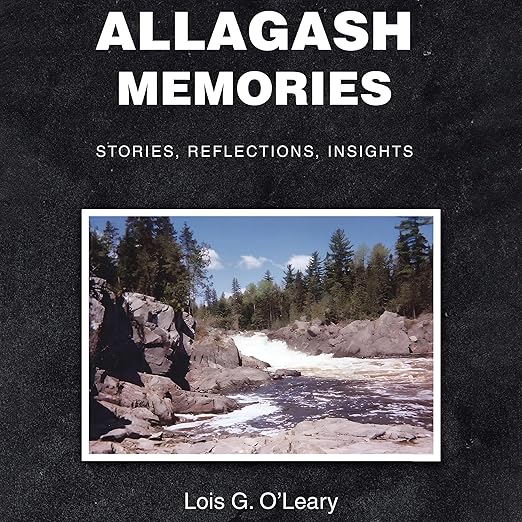
I finished Allagash Memories on a rainy Saturday afternoon, the kind of day when you do not want anything urgent or demanding from a book. I had been in a stretch of heavier reading, economically dense nonfiction and a couple of thrillers that kept me awake past midnight, and I wanted something that would slow me down. Lois G. O'Leary's memoir did exactly that.
The book takes its name from the small northern Maine town where O'Leary was born, Allagash, a place so remote that electricity arrived the same year she did. The Allagash River, now a federally designated Wild and Scenic Waterway and a state park, frames her early life. What follows is a decades-spanning personal history told with the kind of dry humor and unflinching clarity that only comes from someone who has actually lived through what she is describing.
O'Leary's Self-Deprecating History of an Ordinary Life
O'Leary's voice is the book's central pleasure. She describes herself as someone who, having lived long enough, has become a kind of history book, not the Harvard variety, but the kind that a generation of people still living would recognize. That self-deprecating framing is accurate and disarming. She is not trying to make her life seem more dramatic or consequential than it was. She is simply recording it, clearly and with affection, letting the details do the work.
Those details are often extraordinary in their ordinariness. Running a canoe rental and sporting camp business on the Allagash while raising three children and pursuing a college degree. Managing a husband who held the particular conviction that women could do it all. Caring for a mother in the early stages of Alzheimer's while also navigating a family member's kidney disease and transplant surgery in Chicago. None of these experiences are treated as exceptional. They are simply what happened, which somehow makes them more affecting.
Egan's Unhurried Pace Gives the Memoir Room to Breathe
Moe Egan's narration is well-matched to the material. He reads with an unhurried quality that reflects O'Leary's own pacing. The memoir does not rush, and neither does Egan. There is warmth in his delivery without any sense of sentimentality being performed, which is the right call for a text that earns its emotions through accumulation rather than dramatic peaks.
At just over nine hours, the audiobook has room to breathe. The chapter on the Virgin Islands, where O'Leary's life took an unexpected turn, provides a sharp contrast to the austere Maine landscape of the opening sections, and that structural movement keeps the memoir from feeling static. The geography of the book, from Allagash to the Virgin Islands to central Maine, mirrors the movement of an actual life rather than the arc of a constructed narrative.
Restraint Instead of Pathos in the Hard Chapters
O'Leary handles her family's medical crises, the kidney disease, the Chicago transplant, and her mother's Alzheimer's, with a restraint that some listeners may find surprising given how emotionally loaded this material tends to be in memoir writing. She does not exploit these experiences for pathos. She describes them with the same combination of wry humor and plain practicality that characterizes the rest of the book. That consistency of voice is a real achievement, and it keeps the darker chapters from feeling tonally discontinuous with the warmth of the Allagash sections.
One reviewer who grew up in Allagash described the opening paragraph bringing her to tears, specifically a detail about an apron and the smell of homemade bread, and the clicking of a grandmother's knitting needles. That kind of sensory specificity is where O'Leary is at her strongest. She is a writer who trusts the particular detail to carry emotional weight without underlining it.
A Storyteller's Memoir, Not a Literary Experiment
This is a memoir for readers who respond to place-rooted personal history and who do not need a dramatic narrative arc to hold their attention. If you love books like Annie Proulx's Maine-set work or the kind of regional memoir that has largely disappeared from mainstream publishing, Allagash Memories will feel like a genuine discovery. It is also a good choice for listeners interested in midcentury rural American life, specifically the particular experience of women who built careers and families in isolated communities with minimal institutional support.
It is not for listeners looking for dramatic revelation or literary experimentation. O'Leary is a storyteller, not a stylist, and the book's pleasures are those of company and memory rather than formal innovation. But as company goes, she is excellent.
Good to Know
Do you need to know anything about Allagash, Maine to appreciate this memoir?
No prior knowledge needed. O'Leary provides enough context about the town and the river to ground any listener, and the Allagash Wilderness Waterway's designation as a federal Wild and Scenic Waterway is explained within the text.
How does Moe Egan handle the memoir's emotional passages, particularly around illness and loss?
Egan reads them with the same unhurried warmth he brings to the rest of the book. He does not amplify the emotional content beyond what O'Leary's text invites, which is the right instinct for a memoir written with restraint and dry humor.
Is this memoir primarily about family life or about the landscape and history of the region?
Both are interwoven throughout. O'Leary uses the Allagash River and the town itself as a kind of structural spine, but the book is ultimately a personal family history rather than a nature or regional history title.
How does O'Leary's humor come through in audio form?
Well. Her dry, self-deprecating observations land naturally in Egan's reading, and the humor serves as a genuine counterweight to the harder material rather than feeling like a deflection from it.