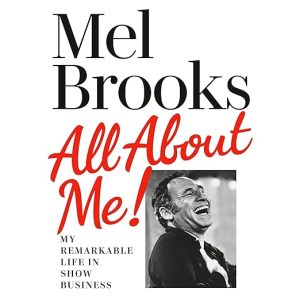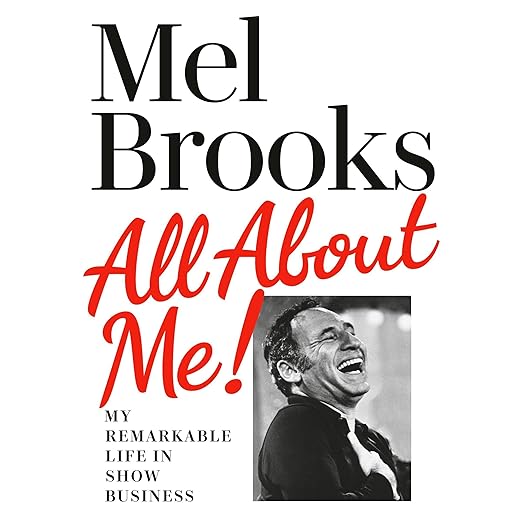
Mel Brooks reads his own memoir here, which matters more than a self-narration credit usually does, and the recording stretches across fifteen hours. Comedy timing cannot be transferred. A professional reader can deliver an anecdote accurately and still leave the pause in the wrong place, and the pause is where a Brooks joke actually lives. The publisher's copy says the EGOT winner is telling his story in his own words for the first time, and on this audiobook the words arrive in his own delivery too.
Comedy Built for the Ear First
Some of this man's most durable work was made for the ear before it was made for anything else. The 2000 Year Old Man records were built as audio, improvised into a microphone, and they sold on delivery rather than on premise. Handing that performer his own memoir to read is not a marketing convenience. It restores the material to the medium in which he first proved he was funny, and the sweep of the book gives him a great deal to work with, from the vaudeville rhythms of his childhood to the studio meetings of his sixties.
Like Having Brooks Tell You Stories
The January 19 entry, top marks, puts the effect simply, describing the experience as being like having Brooks himself telling you stories and songs. That is precisely what a self-read memoir aims at and precisely what most of them fail to achieve, because most authors are not performers. This one has been performing since the Catskills, and the difference between an author reading his pages and an entertainer working an audience shows up inside the first ten minutes.
Chronology governs the book itself, and it is a straightforward life told in order: a Depression childhood in Brooklyn, the United States Army in World War II, teenage comedy work in the Catskills, then the writers' room on Your Show of Shows alongside Carl Reiner, Neil Simon, and Larry Gelbart. From there come the comedy albums, Get Smart, and the run of films that made the name. The structure is conventional and the material is not, and the plainness of the chronology keeps the anecdotes from collapsing into a shapeless pile of famous names.
From The Producers to Spaceballs, and Beyond
Filmmaking chapters are the reason most listeners will come, and they earn the visit. Brooks talks about writing, directing, and starring in The Producers, The Twelve Chairs, Blazing Saddles, Young Frankenstein, Silent Movie, High Anxiety, and Spaceballs, then about producing pictures nobody would have predicted from him, including The Elephant Man and The Fly. That second list is the more interesting one, and the memoir treats it seriously rather than as a footnote to the comedies.
Susan, who rated it five in November 2025, identifies the quality that carries the earlier chapters: the atmosphere of an older America comes through as strongly as the jokes do, and that reader was reminded throughout of My Favorite Year, a film Brooks produced which drew on the same television era. Live comedy writing in the nineteen fifties was a specific and largely undocumented profession, and this is a firsthand account of how it operated week to week, under deadlines that would be considered unreasonable in any modern production.
Anne Bancroft, Above All the Others
Friendship is the other current running underneath everything. Sid Caesar, Carl Reiner, Gene Wilder, Madeleine Kahn, Alfred Hitchcock, and above all Anne Bancroft appear throughout, and the affection is unfeigned. Hearing a man in his nineties talk about people he has outlived gives the comic material a floor under it, and the moments where the delivery slows are more affecting than any deliberate attempt at poignancy would have been.
A Review Written by Someone Else's Husband
Strangest response on this listing is a top-rated entry from January 5, 2026 whose content is not the reviewer's own. Sharon Fratepietro explains that a husband read the book aloud at home, then relays his verdict at length. He enjoyed it thoroughly, and his single reservation is substantive: he found it disappointing that Brooks still seems to feel the loss of a father who died when he was two, when the life that followed was so plainly a good one.
Ration It Like a Stack of Comedy Records
That reservation is worth carrying into the listening, because it identifies a real thread running under the whole book. The absence sits beneath the comedy, and anyone expecting an unbroken performance will meet it repeatedly across the early chapters. Whether it reads as unresolved grief or as the honest admission of a man in his nineties depends largely on your own patience for the subject, and the response quoted above lands firmly on one side of that question.
Length is the practical warning. This is a long stretch for anecdote-driven material with no plot pulling you forward, and the middle chapters can blur if you take them in large sittings. Ration it across weeks, an hour at a time, in the way you would work through a set of comedy records rather than a novel. Taken that way it never wears thin, and the payoff in the later film chapters arrives fully earned.
He Explains the Joke, Then Performs It
Lifelong admirers of these films are the core readership here, along with anyone interested in how American television comedy was actually manufactured in the fifties, by a small number of people in one room under enormous weekly pressure. Listeners who care about the craft of joke construction will find more of it here than in most books that promise exactly that, largely because Brooks cannot help demonstrating while he explains. He will describe why a line worked and then perform the line, which no description on a page can quite reproduce.
Career First, Marriage and Loss a Distant Second
JTG, four stars in March 2025, sets the right expectation: this is a book about the professional career above all, full of hilarious passages and anecdotes, from one of the best comedians ever to work. Take the emphasis seriously before you buy. Anyone hoping for a sustained account of the private life, the marriage, or the losses will find those chapters considerably shorter than the ones about production schedules and studio meetings.
Approach with care if you want a reckoning with the comedy of an earlier era, since Brooks is not in the business of relitigating his own jokes, and skip it entirely if long-form anecdote bores you. A December 2025 reader describes laughing again while he told the stories behind the films, which is the whole proposition here. An entertainer of ninety-five with total recall and nothing left to prove is a rarer offer than it sounds.
In Brief
- Performance: Mel Brooks reads it himself, which returns the material to the medium where he first proved he was funny
- What it covers: Brooklyn childhood and wartime service, the fifties television writers' room, film production, friendship and outliving people
- Feel: Warm, digressive, funnier than it is reflective
- Our call: The rare celebrity memoir that gains everything from the self-narration credit, best rationed rather than binged.
Frequently Asked Questions
Does Mel Brooks read the audiobook himself?
Yes, the reading credit is his, and it is the main argument for choosing this format over print. His career began in live comedy and on records made for the ear, so the delivery is part of the work rather than a bonus feature added afterward. Timing is the asset no substitute reader could reproduce.
How much of the audiobook covers the films rather than his early life?
The films take the larger share, though the Brooklyn childhood, wartime service, and Catskills years all get real space first. Studio chapters run considerably longer than domestic ones, and the balance is clearly deliberate. Expect production stories, writers' room anecdotes, and casting decisions ahead of anything about the marriage.
Is fifteen hours too long for a comedy memoir?
It is long, and the material is episodic rather than plotted, so momentum depends on you. The sensible approach is an hour at a sitting across several weeks. Listeners who try to take it in large blocks tend to find the middle stretch of anecdotes blurring together, which the writing does not deserve.