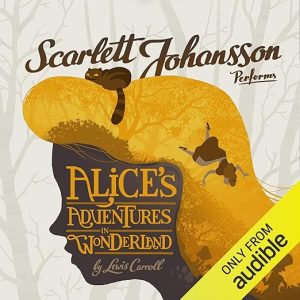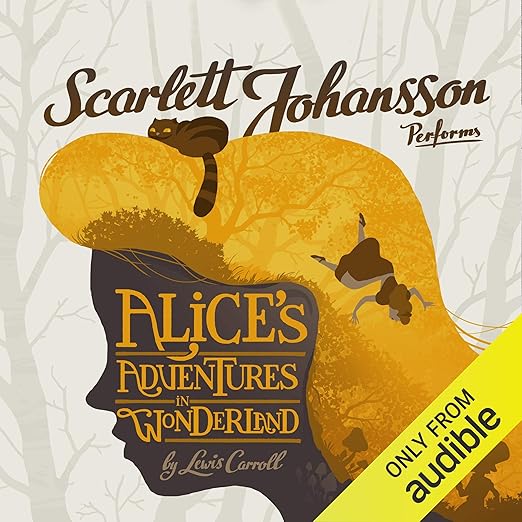
I listened to this edition of Alice's Adventures in Wonderland on a Sunday afternoon when I wanted something complete in a single sitting. At two hours and forty-four minutes, it fitted exactly. But the listening experience turned out to be more interesting than I expected, not because the text surprised me, I have read Carroll several times, but because Scarlett Johansson does something with the performance that most single-narrator versions of this book do not attempt. She actually acts it, fully, the way an audiobook might if it were staffed by a theater company rather than a single reader making do.
Alice's Adventures in Wonderland was first published in 1865 and has spent the intervening century and a half being adapted, referenced, deconstructed, and reimagined to the point where many listeners believe they know the story primarily through what it has become rather than what it is. The Disney film is one text. The Tim Burton films are another. Carroll's actual novel is a third thing entirely: drier, stranger, more philosophically playful, and significantly less interested in narrative momentum than any of the film versions would lead you to expect.
Johansson Voices a Full Wonderland Cast
Carroll's text is organized as a sequence of encounters rather than a conventional plot. Alice falls through the rabbit hole and meets a succession of Wonderland inhabitants, each of whom represents a different flavor of adult illogic, authority, and absurdity. The book's comedy is primarily linguistic, puns, logical paradoxes, the subversion of nursery rhyme and didactic verse, and this is where listening rather than reading actually changes the experience. Carroll's wordplay lands differently when delivered aloud, because the comic timing becomes a performance choice rather than a reading pace choice. Johansson understands this and plays the timing with evident pleasure.
The range of characters she voices is impressive across a short runtime. The White Rabbit's flustered urgency, the Caterpillar's languid condescension, the Mad Hatter's chaotic confidence, the Queen of Hearts' explosive authority, each has a distinct vocal register that Johansson maintains consistently across their scenes. One reviewer pointed out how much cleverness the Disney adaptation removed from Carroll's original, and they are right. The Cheshire Cat's philosophical exchanges with Alice, the trial sequence, the extended tea party, these are intellectually richer than their screen versions suggest, and hearing them performed makes the richness more accessible.
No Music, Just Johansson and Carroll's Text
The Audible Studios production supports Johansson's performance cleanly. No music or sound design overlay distracts from the text, which is the right call, Carroll does not need atmospheric enhancement, and adding it would shift the tone away from the book's particular combination of dreamlike strangeness and bone-dry wit. The production treats the text with respect rather than trying to make it something it is not, and the result is a listening version that feels like the book rather than a presentation of the book.
Dream Logic Replaces a Conventional Plot Arc
Carroll's novel is not a linear adventure story with a satisfying arc. One reviewer described it accurately as a collection of scenes with Alice stumbling through, connected by dream logic, with brief framing paragraphs that do almost no structural work. Listeners who want forward momentum and narrative resolution will be frustrated. The pleasure of Alice's Adventures in Wonderland is entirely local, each encounter, each exchange of wordplay, each piece of subverted verse is its own thing. If you can read it that way, the two hours and forty-four minutes are delightful. If you need the plot to go somewhere, this is not the book that will convert you to Carroll.
Revelatory for Adults, Engaging for Strong Readers
Adults who know the story primarily through its adaptations and have never actually read Carroll's original will find this a revelatory two hours and forty-four minutes. The differences between the novel and its screen versions are striking, and hearing Johansson perform the actual text makes those differences vivid. Children who are strong readers or accustomed to longer fiction will find the audio version engaging, Johansson's character voices are especially effective for younger listeners. Classic literature readers looking for a short, satisfying commitment that rewards attention to language rather than plot will find Carroll here in a version that does the text genuine justice.
In Brief
- Narration: Scarlett Johansson voices every character with genuine distinction, the Cheshire Cat, the Queen of Hearts, the Mad Hatter, with a sense of theatrical joy that the short runtime sustains completely.
- Themes: Logic versus nonsense, authority questioned by innocence, the dream as space outside ordinary rules
- Mood: Bright and slightly unhinged, Carroll's comedy lands differently read aloud than on the page
- Verdict: A well-performed reading of a classic that makes the case for hearing Wonderland rather than just reading it, particularly for those who know it primarily through film adaptations.