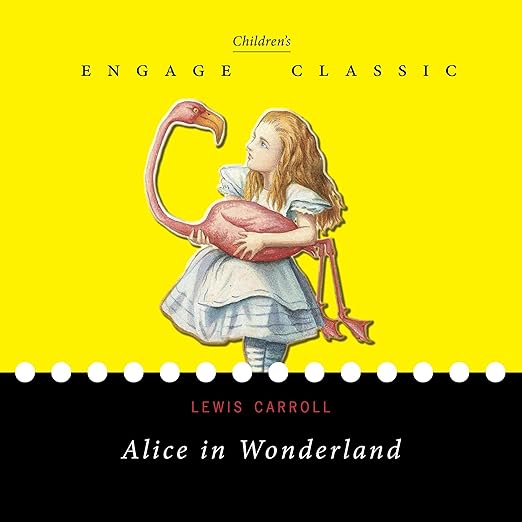
Lewis Carroll's Alice In Wonderland began as a story told aloud, in a rowboat near Oxford, to three little girls on a summer afternoon in 1862. That oral origin matters when considering the audiobook format specifically: this story was always meant to be heard before it was ever meant to be read. Kara Shallenberg narrates this edition, which runs two hours and forty-four minutes, bringing Carroll's cascade of impossible logic, punishing authority figures, and perfectly ridiculous creatures to life with the committed vocal variety the text has always demanded. That author's note, that ten-year-old Alice Liddell asked for the story to be written down and two years later it was published with immediate success, is itself a reminder that all the best stories begin in performance.
Carroll's genius, and the reason the book has survived every era and adaptation, is that the absurdity is governed by internal logic. Wonderland is not random. It is a world with rules that are consistently applied, just not the rules Alice or the reader recognizes. The Cheshire Cat who can vanish into thin air while his grin remains is following precise logic. The Mad Hatter who speaks in riddles is observing a social protocol, just not one that maps onto the world above ground. The Queen of Hearts who shouts her threats with monotonous frequency is an authority figure operating in a system of absolute and arbitrary power, which any child who has experienced adult authority recognizes viscerally even without being able to name it.
Carroll's unique play on logic is the engine of the book's lasting appeal to adults, while remaining one of the most beloved children's tales ever written. The book operates simultaneously on both levels: as an adventure for children who delight in the absurd logic of each encounter, and as a sustained, darkly comic meditation on authority, identity, and the rules that govern social life for adults who read it again decades later. Shallenberg's narration honors that duality by pitching the performance at Alice's level without simplifying the language, which is dense and playful and rewards unhurried listening.
Shallenberg Voices the Caterpillar, Hatter, and Queen
The audiobook format brings out something the print version cannot fully replicate: the voices. Carroll's characters are primarily voices. The Caterpillar's languid authority, the Hatter's aggressive hospitality, the Queen's hair-trigger rage, these are vocal performances embedded in the text that need a narrator to realize them fully. Shallenberg handles the character variety with clear differentiation, making each creature distinctly itself without resorting to caricature. The White Rabbit's anxious urgency, which sets the entire plot in motion, is read with a quality of genuine alarm that establishes the pace from the first minutes of the recording.
At two hours and forty-four minutes, this is an audiobook that fits naturally into a single session or a week of short bedtime installments. The runtime also makes it accessible for younger listeners whose attention spans are still developing: Alice's adventures in Wonderland are structured episodically enough that a pause between chapters does not break the narrative in the way it would in a more continuous novel. The book's enduring classroom appeal is supported by this modular structure, and Shallenberg's consistent characterization means that re-entry after a break is never disorienting for young listeners.
Alice Does Not Want to Be in Wonderland
Carroll's Alice has one quality that almost no children's-literature protagonist shares: she does not want to be in Wonderland. She did not choose the rabbit hole, and her primary motivation throughout is to get home. That makes her a structurally unusual heroine for a fantasy: a child who encounters the marvelous and is consistently frustrated rather than enchanted by it, who applies rigorous common sense to every absurd situation and finds the situation wanting. Shallenberg's narration captures that quality of Alice's determined practicality amid the surrounding madness, and it is what gives Carroll's comedy its particular bite. The humor is not at Alice's expense but at Wonderland's, which is the book's most politically pointed quality and its most enduring one.
The trials and authority figures in Wonderland are more unsettling than modern adaptations typically acknowledge. The Queen of Hearts is a genuinely threatening figure, and the trial sequence near the end of the book, where Alice is charged with stealing tarts in a court that has no interest in evidence or fairness, is as pointed a satire of arbitrary power as Victorian literature produced. Children encounter this as exciting absurdity. Adults may hear something else in it. Both responses are valid and both are present in Carroll's original text.
Listeners coming to this edition after familiarity with the Disney animated adaptation or more recent film versions should be aware that Carroll's original is quieter and stranger than any of those visual interpretations. Wonderland in the text is more intimate and more verbal than the visual spectacle of the adaptations. The humor is almost entirely linguistic, built on puns, logical inversions, and the collision of formal Victorian language with impossible situations. Shallenberg's narration makes that verbal humor fully accessible, but listeners expecting action-heavy sequences will find the book more conversational than they anticipated.
Shallenberg Turns Dense Victorian Prose Fluid and Playful
This audiobook is ideal for children encountering Wonderland for the first time, particularly through listening rather than reading independently. The dense Victorian prose, which can slow readers who encounter it on the page, is transformed by Shallenberg's narration into something fluid and playful. Adults who want to revisit the original text after decades of adaptation-mediated familiarity will find Carroll's actual language considerably richer and stranger than they may remember. Classroom use is supported by the episodic structure and the rich thematic content around logic, authority, and identity. Listeners who prefer plot-driven audiobooks with sustained narrative tension may find Wonderland's digressive structure less satisfying, but for anyone who wants Carroll's original as Carroll wrote it, this narration is a worthy rendering of a text that has earned every hour of its endurance.
- Read by: Kara Shallenberg brings playful variety to Carroll's menagerie of eccentric characters, handling the Queen of Hearts' volatile outbursts and the Cheshire Cat's riddles with distinct vocal personalities.
- At its heart: Logic inverted by absurdist rules, childhood agency in a world designed to confuse, wordplay as a form of power and play
- Vibe: Whimsical and slightly unnerving, exactly as Carroll intended
- Short version: Lewis Carroll's original remains the richest possible entry point to Wonderland, and Shallenberg's narration makes this audiobook a strong choice for first encounters and classroom listening alike.
Is this audiobook version of Alice In Wonderland appropriate for young children, and from what age?
Most children ages six and up handle the content comfortably. Some authority figures, particularly the Queen of Hearts, are frightening in an age-appropriate way. The language is Victorian and dense but Shallenberg's narration makes it accessible for younger listeners who might struggle with the print version.
Does this audiobook include both Alice's Adventures in Wonderland and Through the Looking-Glass?
The title and synopsis refer specifically to Alice In Wonderland, Carroll's first Alice book. Through the Looking-Glass is a separate work and should be confirmed as a distinct audiobook title before purchase.
How does Kara Shallenberg handle the large cast of eccentric characters in this audiobook?
Shallenberg gives each major character a distinct vocal quality without exaggerating into caricature. The Cheshire Cat, Mad Hatter, Queen of Hearts, and White Rabbit are all clearly differentiated, making the book's rapid character rotation easy to follow even for younger listeners.
At 2 hours and 44 minutes, is this audiobook complete or abridged?
The runtime is consistent with an unabridged recording of Carroll's original text, which is a relatively short novel. If completeness is a concern, verify the edition's status before purchase, as multiple Carroll editions exist.