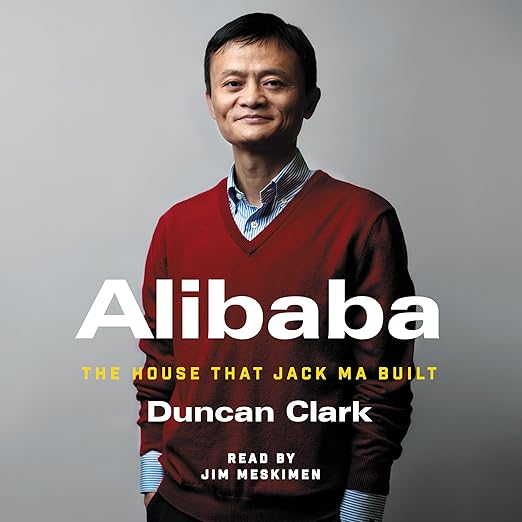
Jack Ma's rise from English teacher in Hangzhou to the architect of a $25 billion IPO is the kind of story that should strain credulity but doesn't, mainly because Duncan Clark was there for much of it. Clark met Ma in 1999 in the apartment where Alibaba was founded, advised the company in its early years, and spent two decades watching the Chinese internet develop around it. That proximity gives this audiobook a specificity that most tech biographies lack, and narrator Jim Meskimen has the range to make both the corporate strategy and the personal portrait feel equally substantial across nine hours.
I came to Alibaba wanting to understand not just how the company grew but how it survived. The 2014 IPO number is staggering, and Clark's account of the path A full of moments where the whole enterprise could have collapsed: the dot-com bust, eBay's aggressive entry into China, the internal crisis over Alipay's controversial separation from Yahoo. What Clark offers, which most outside observers couldn't, is context for how Ma navigated each of those crises in a business and political environment that foreign observers consistently misread.
Meskimen's narration fits the register Clark is working in. This isn't hagiography, and Meskimen doesn't read it as such. The earlier chapters, where Clark is clearly in admiration of Ma's vision and tenacity, carry appropriate energy. The later chapters, where Clark addresses the Alipay controversy and Ma's complicated relationship with the Chinese Communist Party, land with a more measured tone that reflects the book's shift toward critical analysis. That tonal flexibility is what makes the difference between a narrator who serves the text and one who overrides it.
One reviewer noted that the book opens with what feels like worship before settling into a more balanced account, and that arc is accurate. Clark's early access and genuine friendship with Ma created some blind spots that are visible in retrospect. But he corrects for them. The section on how Ma effectively forced Yahoo's Softbank-backed stake to accept the Alipay separation is told with a clarity that doesn't flinch from what actually happened: a founder exploiting a contractual ambiguity to transfer a key asset under pressure. Clark explains the business rationale without excusing the method.
Why Alibaba Works as an Audiobook
The audiobook is most valuable for what it teaches about the specific conditions that made Alibaba possible. Clark's argument is that Alibaba didn't succeed despite China's chaotic, underregulated business environment in the late 1990s; it succeeded because of it. Trust between strangers was scarce, payment infrastructure was absent, and physical retail was fragmented. Ma built systems to solve precisely those problems, which meant Alibaba's moat was essentially the dysfunctions of the Chinese market that every competitor also had to navigate but that Ma understood more deeply than anyone from outside could.
The eBay story is particularly instructive. eBay entered China in 2002 with enormous resources and a product that had proven itself globally. Ma countered with Taobao, a rival platform he made free to use, funded by Alibaba's existing cash flow. eBay's management, reporting to headquarters in California, made product decisions for the Chinese market without understanding how Chinese consumers actually used the internet. Ma understood. Taobao ate eBay's Chinese market share within three years. Clark tells this story without triumphalism but with the precision it deserves.
Weak Spots in Alibaba
The book was published in 2016, which means it predates significant developments in both Alibaba's trajectory and Ma's relationship with the Chinese government. Listeners should treat this as the authoritative account of Alibaba's founding era rather than a comprehensive picture of where the company stands now. The questions Clark poses in his synopsis, whether Alibaba can maintain its 80% market share, whether it will expand overseas, how the government views its rise, have been answered in ways that Clark couldn't have anticipated in 2016. The regulatory crackdown on Alibaba that began around 2020 and effectively sidelined Ma himself falls entirely outside this book's frame.
That limitation doesn't undermine what the book does cover. Clark's inside access to the company's early years is irreplaceable, and no subsequent account can substitute for someone who was present at the founding. The portrait of Ma as a communicator and motivator, someone who built loyalty through charisma and vision rather than through systems and structure, is vivid and credible. The audiobook is the right format for this material because Clark writes in long argumentative paragraphs that reward sustained listening rather than the skimming you might give a newspaper article.
The competitive dynamics Clark documents extend beyond the eBay battle. His account of Alibaba's relationship with Google, which briefly operated in China before its own withdrawal, and the broader story of why foreign internet companies consistently underperformed in the Chinese market despite their resources, provides useful context for understanding how Alibaba's advantages were partly structural rather than purely visionary. Ma understood that a Chinese platform built by Chinese engineers for Chinese consumers, operating within the constraints and opportunities of Chinese regulatory and infrastructure realities, had inherent advantages that no amount of foreign capital or technology could quickly replicate. Clark makes this argument without nationalistic framing, grounding it instead in the specific decisions that each company made and why those decisions led to the outcomes they did.
The Right Listener for Alibaba
Listeners interested in Chinese business history, tech entrepreneurship, and how e-commerce develops in markets without established trust infrastructure will find this audiobook genuinely useful. It's also recommended for anyone trying to understand how global internet giants in non-Western markets developed differently from their Silicon Valley counterparts. Skip it if you're looking for a current picture of Alibaba or Jack Ma; the 2016 publication date is a real constraint, and you'll want to supplement with more recent reporting to understand how the story continued.