The Short Version
- Voice: Vikas Adam is the sole credit, which puts the wisecracking kid, the worried parents, the teachers and the bully in one pair of hands.
- Big ideas: Family illness, being the only brown kid in a new school, bullying, and the books that crack a resistant reader open
- Atmosphere: Funny on top, anxious underneath
- Worth it?: A strong pick for a middle-school household that wants the hard thing handled lightly, provided you accept that the reading list is half the point.
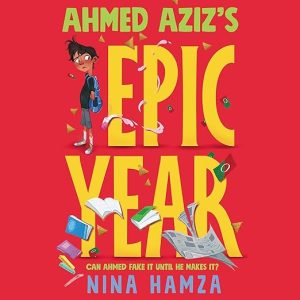
Middle-grade fiction about a sick parent usually announces itself before you press play. Nina Hamza's debut declines to. The audiobook runs six hours and forty-two minutes, and for long stretches it behaves like a comedy about a self-described slacker who has been moved from Hawaii to Minnesota against his will, dropped into a school where he is one of the only brown kids, and handed a bully who will not let up. His father's illness sits underneath all of it. It simply refuses to be the only thing in the room.
Adam Holds Every Discovery in One Pair of Hands
Three novels do most of the structural work. Ahmed is assigned Holes, Bridge to Terabithia, and From the Mixed-Up Files of Mrs. Basil E. Frankweiler, and the surprise of the story is that a boy who has built an identity out of not trying discovers he does not hate any of them. Spoken aloud, those titles arrive as objects a listener can act on rather than as cover images glimpsed on a page. Vikas Adam holds the only performance credit on the file, which puts every one of those discoveries in a single pair of hands.
Dialogue is where the warmest praise lands, and the entry that gives it is specific about why: you can actually picture twelve-year-olds saying these things, it argues, which is not always true when adults write children talking. The same entry lands on a formula worth keeping, sweet without being sappy, funny without being slapstick. That describes the register Hamza works in accurately, and the register is what makes an illness plot survivable for the age group the copy names without turning the whole thing into a lesson.
Underneath the school-year comedy runs a second inquiry. An uncle died before Ahmed was born, and the boy reassembles him in pieces from a family that has not volunteered much. The copy calls that recovery the one upside of the move, and it gives the book its shape, since the child learning his own history is the same child learning to want something. Minnesota, the place he cannot imagine living in, happens to be where his father grew up, so the move is a homecoming for one of them and an exile for the other.
A Reading List Instead of a Plot Summary
Ask a young listener what the book did and you may get the answer one response reports from a ten-year-old, offered as two numbered reasons: she wants to read every book named inside this one, and she was glad Ahmed found friends and learned about himself. The first reason is the strongest argument for putting this on in a household with a resistant reader. A child comes out the other end holding a reading list rather than a plot summary, which is a rarer result than it sounds and one no rating captures.
The publisher stacks its own evidence high. A starred notice from SLJ is quoted calling the book destined to become a classic, readers of Merci Suárez Changes Gears and John David Anderson are pointed this way, and four honors follow, among them a Chicago Public Library Kids Best Book of the Year listing and a Minnesota Book Award finalist spot. Every one of those honors grades a 2021 text that arrived with institutional backing, which is worth knowing and worth keeping separate from the file itself.
A single credit covers a wide spread here: a wisecracking kid, two parents managing bad news, teachers with expectations, and a bully the copy never bothers to describe. Nothing on the page states how those registers are kept apart, so the sample carries the whole burden of proof, particularly if the listener is young enough that one voice doing several people is either the pleasure or the obstacle. Play a stretch of classroom dialogue rather than the opening pages, since the opening is mostly interior complaint.
Full of Mental Battles, Judged as Something Read
Print is what the column underneath is grading. Entries talk about reading, about characters, about a story that keeps moving; a response filed by a sixth grader reports that every moment was a moment I could at least half relate to, if not 100%, and calls the book full of mental battles. What those entries are judging, in other words, is the book as something read, and they judge it warmly. That leaves the reading itself as something a buyer settles alone.
Two threads may want a parent's judgment before a shared listen. A father's health hangs in the balance for the length of the story, and a bully refuses to leave Ahmed alone; the copy states both and describes neither. Households currently living through a serious diagnosis should know the illness is not tidied away offstage in the first hour. Content guidance is absent from the record entirely, and the children's shelf this sits on does not supply any on its behalf.
Format is the one place this loses nothing. The novel's central device, a boy working through three named books, needs no illustration, no chart and no appendix, so very little goes missing between the printed page and the file. The listing names no companion document, and the story shows no sign of wanting one. That makes this a cleaner audio proposition than most titles on the children's shelf, where pictures are frequently half of what the buyer thought they were paying for.
Treat the Reading List as Part of Buying
Middle-school households are the obvious target, and one response says so from the trenches: finding books for middle school is hard, especially for middle school boys, and this one was a hit, funny and well written, with likeable characters. Resistant readers are the specific case worth naming. A kid who has decided that books are not for him is precisely the kid the protagonist is at the start, which is an old trick and still an effective one when the comedy carries it.
Two kinds of listener should pass. Anyone wanting either a straight comedy or a straight illness story will find this both at once, switching between the two often. Anyone wanting something that runs quietly in the background will lose the assigned-novel thread, which rewards attention, along with the family history, which arrives in fragments rather than in one explanatory scene. At just under seven hours the file sits closer to road-trip length than to a bedtime serial, and the copy aims it at the tween end of its shelf.
Adults who read youth fiction on purpose will find the register holds up, which is not something every book written for this age band manages. The strongest case for the recording is structural rather than sentimental: a story whose main effect is to send a child after other books has done something no star average can measure, and it does that work through titles a listener hears rather than sees. Treat the reading list as part of what you are buying, and the runtime pays for itself twice.