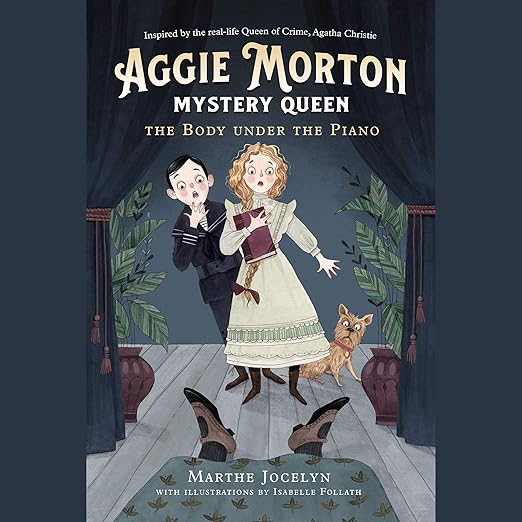
Murder arrives early: a dead body on the floor of the Mermaid Dance Room, found by a shy girl who has had very little to do since her father died. Marthe Jocelyn's audiobook runs eight hours and thirteen minutes and it is aimed squarely at middle-grade listeners, which makes the corpse a startling opening gambit. It is also the correct one. Children ready for mysteries are ready for the fact that a mystery requires somebody to be dead, and this book does not pretend otherwise.
Aggie Brings Curiosity, Hector Brings Method
Agatha Christie is the engine here, and Jocelyn is refreshingly unembarrassed about it. The premise is the imagined childhood of Christie herself, paired with a boy who is a young Poirot in all but name, and the series title says the quiet part out loud. In other hands that would be a marketing exercise. It works because the two children are given jobs that genuinely suit them: Aggie brings the curiosity and the noticing, Hector brings the method, and neither of them is permitted to be the sidekick. For a first book in a series, the division of labor is unusually clean.
Enola Holmes came first, according to a June 2021 four-star that describes wandering back into Victorian-era mysteries and landing here, then singles out Hector and his little grey cells as the pleasure of the whole thing. That entry closes by looking forward to the next story, which is the signal a first-in-series most needs to produce. This is volume one of Aggie Morton, Mystery Queen, and the question a parent is actually asking is whether the child will want volume two.
English Voices a Shy Girl and a Belgian Newcomer
Period detail is where historical fiction for children usually goes wrong, either drowning the plot in research or reducing 1902 to bonnets. Jocelyn keeps the world small enough for a child to hold: a dance room, a growing list of suspects, a town on the English coast, several helpings of tea and sweets, and a beloved dance instructor about to be charged with a crime she did not commit. Stakes that fit inside one village are exactly the right scale for eight hours of middle-grade listening, and they keep the plot legible when attention wanders.
Grief is the quiet second subject, and it is handled without a single speech about it. Aggie is introduced as a girl whose life stopped when her father died, adventurous and imaginative but too shy to do anything with either quality, and the murder is what finally gives her somewhere to put all of it. Detection as a coping mechanism is an old idea in crime fiction, and it is rarely handed to a child this directly. It also explains how the tone stays light while the premise stays entirely serious.
Sarah English has a specific problem to solve across those hours: two children who must be distinguishable inside a single line of dialogue, one of them a shy English girl and one a Belgian newcomer, on a book where both the homage and the comedy depend on the two of them never sounding alike. Add a town's worth of adults, several of whom are suspects, and a telling voice that has to stay young without tipping into squeak. Start at the discovery in the dance room rather than at chapter one, because a children's mystery is decided by whether that moment frightens a listener or merely informs one.
Metadata Mislabels a Story About a Corpse
Metadata is where this listing lets the book down. The topical tag reads Holidays and Celebrations, which is a peculiar label for a story about a corpse in a dance hall and a wrongful arrest, and nothing in the description mentions a holiday of any kind, so a parent filtering for seasonal reading lands somewhere nobody intended. The displayed title also lowercases the word under, while the publisher's own copy capitalizes it, meaning the same book carries two spellings depending on which line of the page you happen to read.
One entry in the column opens by disclosing that its copy came from Tundra Books in exchange for a fair and honest review, and Tundra Books is the publisher named on this listing. The disclosure is exactly what a disclosure should be, and the entry is generous and specific, walking through Aggie in 1902 Torquay, the nanny, the Belgian boy sponsored by a reverend and his wife, and the dance instructor at the Mermaid. It is worth knowing all the same that one of the five arrived by way of the house that made the recording.
Reading the lowest grade closely is instructive. A three-star from March 2020 restates the plot almost line for line from the description, breaks off mid-sentence on the duo needing every tool at their disposal, and never actually says what disappointed its writer. That pattern is common on children's titles, where the person buying and the person listening are rarely the same person. A 4.4 average across 156 ratings is healthy for a middle-grade debut, provided you remember that on a book like this the rating and the listening are often done by different people.
Light Mystery Territory for Read-Aloud Households
Middle-grade listeners, which is the audience the copy names, who like puzzles and can tolerate a body, are the target, and a January 2025 five-star supplies the shortest endorsement available: a very cute light mystery. Light is accurate. The death is the engine of a puzzle rather than a source of dread, and the tea and sweets keep arriving on schedule. Read-aloud households will get more from it than solo listeners will, because the deduction rewards a pause and a guess, and pausing is easier when somebody else holds the phone.
Households that avoid death in children's fiction should not begin here, since the corpse is on the floor before the story has properly started, and a child who wants chases rather than deduction will find eight hours of noticing very slow going. Anyone hoping for authentic Christie should adjust too, because this is a homage built for readers who have not met Poirot yet rather than a puzzle designed to defeat adults. Aggie Morton is a fine first detective for a child who has just worked out that a story can be a problem to solve, and that is worth more than a clever solution.