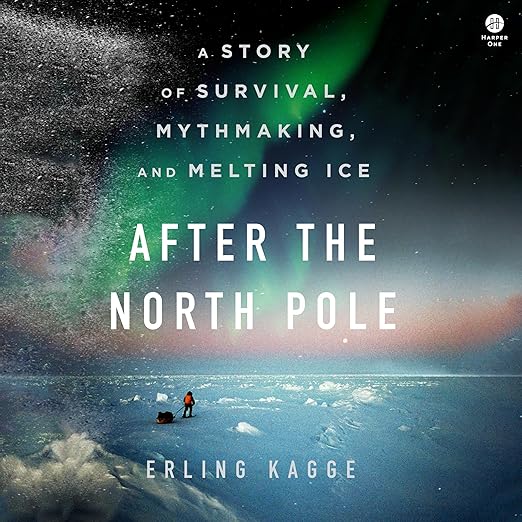
Fifty-eight days on skis, hauling everything, with no animals in front and no engine anywhere. What does a person actually think about across fifty-eight days like that? Erling Kagge and Børge Ousland made the crossing, and the publisher copy states the record precisely: they were the first 'to ever reach the pole without dogs, without depots and without motorized aids,' setting out from a drop-off point on the ice edge of Canada's northernmost island. The audiobook runs eleven hours and twenty-six minutes, read by Atli Gunnarsson, and it is only partly the expedition account that description leads you to expect.
The Review
Kagge is presented as an explorer, a philosopher, and a writer, and the book distributes its attention across all three, though not in that proportion. The expedition itself, the physical fact of two men skiing over drifting sea ice for two months, occupies less of the eleven hours than anyone expecting an adventure narrative will assume. Around it Kagge assembles a history of the obsession: the earlier attempts, the place the pole holds in legend and art, and the question of why a spot on a rotating planet with nothing on it has held human attention for centuries.
That structural choice is the book's defining feature and the source of its only consistent complaint. Reviewer heddielou, who gave four stars, names it exactly: 'Very interesting but a bit too much history of previous expeditions. And some of the writing about his theories on silence got repetitive.' She still recommends it. Her review title, 'Philosophy Versus Detail,' is the most accurate two-word summary anyone has offered, because the tension she identifies is not a lapse. Kagge is deliberately declining to write a straightforward endurance memoir, and whether that refusal reads as depth or as padding depends almost entirely on what you arrived wanting.
One phrase from the publisher copy is worth pausing on, since it describes the ambition better than any summary. The pole is called 'the ultimate Otherland in a world mapped and traversed,' and Otherland is a strange, deliberate word: not wilderness, not frontier, but somewhere defined by being categorically not here. Kagge's project is to test whether that holds up once a person has physically stood on it. His answer, roughly, is that it does, and that standing there confirms the strangeness rather than dissolving it.
Why After the North Pole Works as an Audiobook
Where the book is strongest, to my ear, is in the disorientation. Kagge describes sub-zero temperatures and a strange year built from one sunset and one sunrise, a fact most people know abstractly and almost nobody has processed. Hearing it stated plainly in the middle of a passage about hauling a sled does more than a diagram would. Reviewer Nina S landed in the same place, calling the book 'a revelation' and observing that 'While many of us recognize the North Pole by name, our actual understanding of it is limited.' That gap between the name and the thing is the territory Kagge is working in.
One production fact deserves more attention than it usually receives. The English text is Kari Dickson's translation from Kagge's Norwegian, which means the cadence a listener hears was chosen twice, once by the author and once by the translator. That matters more here than it would in a plot-driven book, because heddielou's complaint about repetitiveness in the silence passages is a judgment on rhythm, and rhythm is precisely what translation reshapes. Atli Gunnarsson is the credited narrator, delivering eleven hours of prose that alternates between physical procedure and sustained abstraction, a combination that punishes any reader who settles into one tempo. Every review attached here concerns the book rather than the recording, so the delivery is best judged by sampling it.
The contemporary argument gives the material a second life. Kagge is explicit that the pole sits at the center of the planet's rotation and among the places most exposed to a changing climate, and he connects the ice he crossed to current climate and geopolitical conversations. An expedition memoir written a generation ago would have been pure adventure; written now, the same crossing carries the knowledge that the surface itself is provisional. Robert MacFarlane's line about 'Kagge's extraordinary life in wild places,' quoted in the publisher copy, is accurate enough, but it undersells how much of this particular book concerns what those places are becoming.
The Caveats
Expectation management is the main task with this one. Anyone buying an eleven-hour book about a fifty-eight-day polar crossing is probably picturing frostbite, pressure ridges, and the daily arithmetic of calories against distance. Those elements appear, but they share the book with long stretches of exploration history and longer stretches of reflection. heddielou closes with the clearest signal in the review set, writing that it is 'Still worth reading though you might check your local library or find a used copy.' Coming from a four-star reader, that is a comment about proportion rather than about the quality of the writing.
The format carries one specific limitation worth naming. A book ranging across a century of expeditions, with many names, nationalities, dates, and competing claims, is a book a reader will want to page back through, and audio does not page back. If you care about keeping one polar claimant distinct from another, either accept a looser grip on the roster or expect to look things up separately afterward. The numbers fit that picture too: a 4.3 average across fifty ratings is respectable rather than emphatic, and the lone four-star review in the visible set explains part of the shape, since readers are disputing the ratio of philosophy to detail and not the prose.
Who Should Listen to After the North Pole
Readers of contemplative nature writing, the kind that treats landscape as an occasion for thinking rather than a backdrop for feats, will get the most from this. So will anyone drawn to the psychology of extreme endurance, since Kagge is more curious about why a person wants to do this than about how he survived it. Listeners who care about the Arctic as a political and climatic space rather than as scenery are also well served, because that argument runs underneath the whole book instead of arriving as a closing chapter.
Straight adventure listeners should think twice. A blow-by-blow survival narrative with mounting physical peril is not the shape of this book, and expecting one is the surest route to being disappointed by something that does a different job well. Anyone impatient with repetition should heed heddielou, since the silence material returns more than once. And anyone wanting polar-exploration history specifically, without a memoir wrapped around it, would be better served by a dedicated history. I found the mixture worth the eleven hours, largely because the reflective passages are anchored to a crossing the author actually made, which is a form of authority no amount of research supplies.
Is this audiobook an expedition narrative or a book of ideas?
Both, weighted toward ideas. The fifty-eight-day crossing anchors the book, but exploration history and reflection on solitude, silence, and why the pole draws people occupy more of the eleven hours than the trek itself. One four-star reviewer flagged exactly that balance, so treat the adventure as the frame rather than the content.
Was the book originally written in English?
No. Kagge wrote in Norwegian and Kari Dickson translated it, which is credited in the listing. That matters for a book whose effect depends heavily on cadence, since a translator makes rhythm decisions on every page. The English you hear is a second set of choices layered over the author's first.
Does the audiobook work without maps or photographs?
Mostly, with one caveat. The geography of a drift across sea ice is easier to follow than a land expedition, since the route is essentially a straight push toward a point. The harder part is the roster of earlier expeditions, which arrives as names and dates that a listener cannot flip back to check.