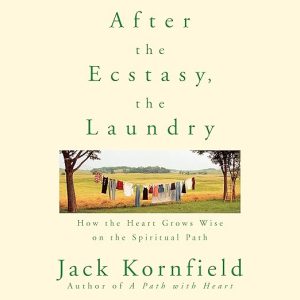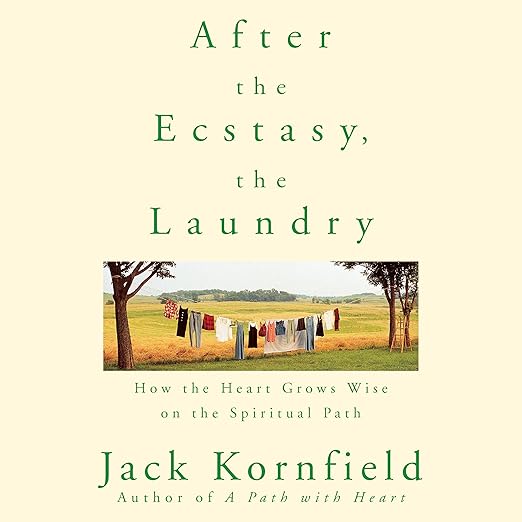
The title alone stopped me when I first encountered this book years ago. After the Ecstasy, the Laundry is one of those titles that functions as a complete argument in six words, and Jack Kornfield, who has spent decades helping Western practitioners understand what Buddhist practice actually involves rather than what they hope it might deliver, is exactly the right person to make that argument at length. I returned to this audiobook recently after a long gap, and found it richer than I remembered.
At 9 hours and 52 minutes, self-narrated by Kornfield, this is an original audio adaptation of the book, not simply a recording of the print edition but a production designed for the medium. That distinction shapes the listening experience in ways that aren't immediately obvious but accumulate over the course of the listen.
The Review
The book begins from a deceptively simple observation: the spiritual literature is full of accounts of awakening, of satori, of transformation. It is largely silent about what happens the morning after. Kornfield wanted to know what practitioners who had experienced genuine awakening, Zen masters, rabbis, lamas, nuns, long-term meditation students, found when they came back to daily life. So he asked more than a hundred of them. The result is a book built from testimony: real people describing the gap between what awakening offered and what their lives still required of them.
What Kornfield found is that awakening doesn't resolve the ordinary. Teachers with decades of practice still struggled with anger, with loneliness, with the temptations specific to being in positions of spiritual authority. The book's most challenging sections address teachers who abused that authority, who found that profound spiritual insight coexisted with profound personal failure. Kornfield handles this material with compassion but not with evasion. He is not protecting institutions. He is describing what he actually found.
Kornfield is the author of A Path with Heart, which remains one of the most widely recommended introductions to Western Buddhist practice. That book established his voice: warm, clear, without the performance of authority that can make spiritual writing feel inaccessible. In this audiobook, that voice is physical, unhurried, as if the man has genuinely stopped rushing, and it creates a listening atmosphere that's hard to replicate on the page. One reviewer describes his delivery as having a great sense of humor that will lift your spirits. That's accurate. Kornfield is funny in the way that people who've thought carefully about suffering sometimes become: gently, without aggression, because the absurdity of the human condition is genuinely amusing once you've stopped fighting it.
The course-style structure of the audio adaptation, with explicit objectives at the opening, may feel slightly clinical compared to the book's organic flow, but it also provides an organizing framework that's useful for listeners returning to the material over multiple sessions.
Things to Know Before Starting After the Ecstasy, the Laundry
This book's audience is specific: people who have had some meaningful meditation or contemplative practice, or who are seriously considering it, and who want an honest account of what sustained spiritual engagement actually looks like over time. It is not a beginner's guide to meditation. It is not a book about how to achieve enlightenment. It is a book about what practitioners find after they've achieved significant spiritual experiences, and why the laundry still has to be done.
Listeners who approach this expecting a how-to or an inspirational framework for spiritual achievement will find the book's fundamental message a bracing correction. Kornfield is deliberately arguing against a certain kind of spiritual materialism, the idea that enough practice will eventually deliver a state where ordinary struggle ceases. The book's argument is that this is not what happens, and that understanding this is liberating rather than discouraging. That message lands differently depending on where the listener is in their own practice.
Who It's For
This is essential listening for anyone with a serious contemplative practice who has experienced genuine peak states and is grappling with the gap between those states and ordinary life. It is equally valuable for people who have encountered spiritual communities and felt troubled by the gap between a teacher's teaching and their conduct. For newcomers to contemplative practice, the book will be more meaningful once there is some personal experience to anchor it to. If you've read A Path with Heart and want to go deeper, this is the natural progression.
Frequently Asked Questions
Do you need a meditation practice to appreciate After the Ecstasy, the Laundry?
Some personal experience with contemplative practice will significantly deepen the book's resonance. Kornfield is addressing practitioners who have had meaningful experiences with meditation or other spiritual disciplines and are working out what those experiences mean for ordinary life. The book is intellectually accessible without that background, but it lands most fully when the reader has something personal to anchor it to.
Is After the Ecstasy, the Laundry specific to Buddhism, or does it apply across spiritual traditions?
Kornfield draws his testimony from over 100 teachers and practitioners across traditions: Zen masters, rabbis, Christian contemplatives, lamas, and senior students from various lineages. The book is rooted in Kornfield's Buddhist background, but its central argument, that awakening experiences don't eliminate the challenges of ordinary human life, is framed as a universal finding rather than a tradition-specific teaching.
How does Kornfield's self-narration compare to having a professional narrator read the material?
For this particular book, self-narration is the right choice. The material is deeply personal, Kornfield is drawing on interviews he conducted, teachers he knows, experiences from his own practice, and his voice carries an authenticity that a professional narrator reading the same words could not fully replicate. The unhurried pacing reflects genuine inhabitation of the material rather than performance.
Does After the Ecstasy, the Laundry address the scandals and misconduct of spiritual teachers directly?
Yes, and with more honesty than is typical for books within spiritual communities. Kornfield engages directly with documented instances of teachers whose spiritual insight coexisted with personal misconduct, abuse of power, sexual exploitation, financial corruption. He treats this not as an anomaly to be explained away but as evidence of the book's central argument: that profound awakening does not automatically resolve ordinary human psychology. That candor is one of the book's most distinctive qualities.