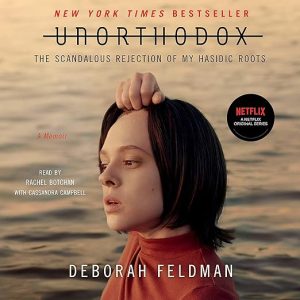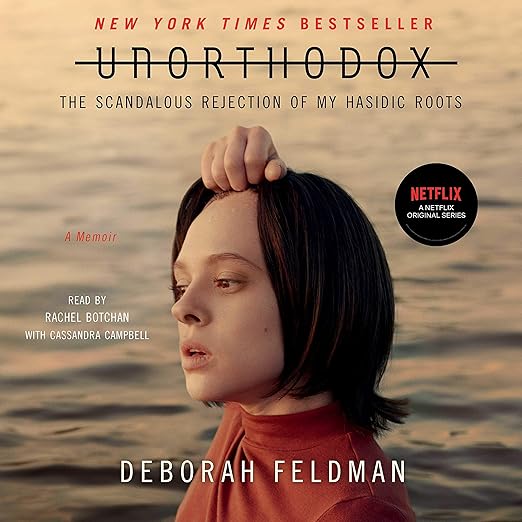
I read the original edition of Unorthodox some years before the Netflix adaptation made it a widely familiar title, and returning to it in audio, narrated by Rachel Botchan, was a different experience in ways I did not entirely anticipate. The book's power is cumulative. It builds through the accumulation of small, specific details about what life inside the Satmar community actually looked like: the modesty rules, the prohibited languages, the negotiated silences, the particular shame attached to English-language reading. None of these things are dramatic in isolation. Together they constitute a world so thoroughly enclosed that the reader only gradually understands how complete the enclosure was.
Deborah Feldman grew up in Williamsburg, Brooklyn, surrounded by Manhattan but effectively sealed from it. Her stolen moments with Jane Austen and Louisa May Alcott, hidden books, reading by flashlight, imagining lives that the women around her had no framework to conceive of, are the memoir's emotional center. She is not looking for secular liberation in those pages. She is looking for evidence that female interiority exists, that a woman's internal life is something that can be the subject of a serious narrative rather than an obstacle to proper Satmar wifehhood.
Where This One Lands
Reviewer Hillel Kaminsky's description of Feldman as extraordinary, not just for her qualities but for her ability to overcome indoctrination, pettiness, and the active suppression of joy, gets at what makes this memoir distinctive. The Satmar community Feldman describes is not a caricature of religious extremism. It is a functioning social world with internal logic, genuine pleasures, deep community bonds, and specific mechanisms for enforcing conformity. Feldman understands that world from the inside, and she refuses to reduce it to its worst features even while documenting those features with unflinching specificity.
Reviewer Darcy A. Huffman's observation, that the book offers a rare insight into an extreme sect of Judaism without requiring the reader to be Jewish, points to one of the memoir's real accomplishments. Feldman writes as an anthropologist of her own community, explaining practices and beliefs that would be opaque to outsiders without condescending to the insiders. That double address is difficult to sustain across three hundred pages, and she manages it.
Rachel Botchan's narration is the right choice for this material. The book's emotional temperature is controlled throughout, Feldman writes about experiences that could easily tip into raw outrage, but the prose stays measured and the detail stays primary. Botchan honors that restraint in her performance. She does not push the emotional peaks; she reads each scene with the same careful attention that Feldman brings to writing it, and the cumulative effect across ten hours is more powerful than any single dramatic reading could produce.
The audiobook includes the new epilogue that was added to a later edition. This is worth noting for listeners who may have read an earlier print version, the epilogue provides perspective on how Feldman's life changed after the memoir's initial publication and after the dissolution of her marriage, which is described in the main text.
Weak Spots in Unorthodox
The passages about language are the memoir's most intellectually rich sections. Yiddish versus English, the hierarchy of texts, the specific prohibition on secular reading, Feldman is a careful writer about how language shapes consciousness, and her account of learning to read for her own pleasure rather than for approved purposes has the quality of a small liberation with enormous downstream consequences.
The marriage narrative is the memoir's most difficult section, not because it is melodramatic, it isn't, but because Feldman describes a sexually and emotionally dysfunctional relationship with a level of specificity and without retrospective anger that is almost uncomfortable in its clarity. She is not performing victimhood. She is documenting a situation that many women in the community normalized, and the documentary impulse is more unsettling than complaint would have been.
Who Should Listen to Unorthodox
Readers interested in the mechanics of closed religious communities, the particular world of ultra-Orthodox Judaism, or the broader question of how individuals develop independent judgment within systems designed to prevent it will find this essential. It is equally compelling for readers who came to it through the Netflix adaptation and want the more detailed, more nuanced account that the series necessarily compressed.
Those who require a traditional narrative resolution, a clear before and after, a protagonist who arrives at settled happiness, should know that Feldman's memoir ends in motion rather than arrival. She is free of the community; she is not yet free of everything the community installed in her. That honest incompleteness is one of the book's most valuable qualities, even if it makes for a less comfortable ending.