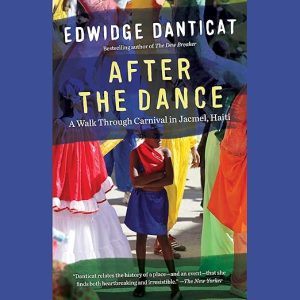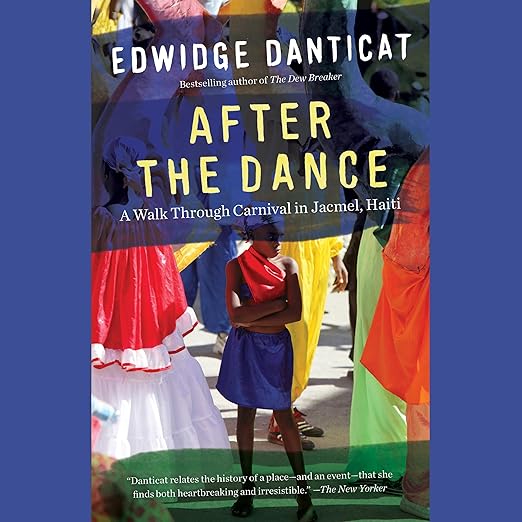
I had read Edwidge Danticat's fiction before coming to this one, Brother I'm Dying is a book that still sits with me in the way only certain nonfiction does, so I knew what her prose sounds like at its best. What I did not know was how that quality would translate when she read her own travel memoir aloud. The answer is that it translates extraordinarily well. At 3 hours and 41 minutes, After the Dance is the kind of audiobook you can give yourself in a single sitting, and I did exactly that, starting it on a Sunday afternoon and ending it just before dark.
The premise is simple: Danticat, who had been scared off from Carnival in her childhood by exaggerated family warnings about crushed hips and punched strangers, returns as an adult to Jacmel, a coastal town in Haiti's south, for the week before Carnival and then the celebration itself. What she does with that premise is considerably less simple.
First, the Big Picture
This is a book in two registers simultaneously. On the surface it is a travel narrative, and a good one, Danticat moves through the rolling hills and lush forests around Jacmel, meets performers and artists and festival organizers, and traces the architecture of Carnival from the construction of elaborate papier-mache masks to the final days of sound-truck-amplified street celebration. At the same time it is a meditation on what it means to return to a country that shaped you from a position of partial outsider, having grown up largely in the United States.
The historical dimension is handled with Danticat's characteristic restraint. She traces Haiti from French colonists and Haitian revolutionaries through American occupation and the Duvalier dictatorships without letting the weight of that history crush the celebration she has come to witness. One reviewer described it as a "celebration of the beauty, history and power of African culture in the diaspora," and that framing captures the book's ambition: to hold joy and history in the same hand.
What Makes After the Dance Worth Hearing
The author narration is non-negotiable as a recommendation here. Danticat's voice has a quality that is hard to describe without resorting to adjectives that sound like blurb copy, it is specific, it is measured, it is occasionally startlingly funny, and it is deeply her own. One reviewer noted that the book "does not flow as smoothly as some of her other works," and I think that is a fair observation: this is earlier work, originally published in 2002, and the structure is looser than her later nonfiction. But the 2023 Random House Audio re-release with her own narration gives it new life.
For listeners who have never read anything by Danticat, this is a low-commitment entry point, short enough to finish easily, representative enough to show you what she does well.
A Few Reservations
The book was originally written in 2002, and while the 2023 re-release presumably updates some context, the specific political situation Danticat describes, a Haiti "ready for tourists again," as one early reviewer put it, has changed significantly since then. Listen with that historical distance in mind, particularly if you have been following Haiti's ongoing crises through news coverage.
The Jacmel focus also means this is not a broad portrait of the country. It is specifically the southern coast, specifically Carnival, specifically one week. Readers looking for a comprehensive introduction to Haiti will need additional reading.
Should You Listen to After the Dance?
Readers already familiar with Danticat's fiction who want to hear her speak directly in her own voice. Listeners interested in Caribbean culture, travel writing that takes history seriously, or memoir in the travelogue mode. Also genuinely useful for anyone planning to attend Jacmel Carnival, the background Danticat provides on the traditions, the papier-mache mask-making, and the community of artists behind the festival is the best kind of context. Not recommended as a standalone introduction to Haiti's full political and social complexity.
Quick Take
- Narrator: Edwidge Danticat reading her own work is an experience unto itself, her voice carries the same precision and warmth as her prose, and for a book this personal, no other choice would have worked.
- Subjects: Carnival as cultural identity, Haitian history, diaspora homecoming
- Tone: Lyrical and bittersweet, with the particular melancholy of a writer returning to a place that shaped her
- Bottom line: A short but fully realized travel memoir that opens Haiti's southern coast and Carnival culture to listeners who may have only known Haiti through crisis coverage.
Good to Know
How much does this cover Haiti's political history versus Carnival itself?
Both are present but the balance tilts toward Carnival and the culture around it. Historical context, French colonialism, Haitian independence, American occupation, the Duvalier era, appears as background to the celebration rather than as primary subject matter.
Is this a good introduction to Edwidge Danticat's work for first-time readers?
It works as an introduction because it is short and shows her prose quality clearly. However, readers wanting to see her fiction at full strength should also look at Brother I'm Dying or Krik? Krak!, this is a smaller-scale work than her major titles.
Does the book remain relevant given how much Haiti has changed since 2002?
The cultural and historical material is durable, but the political context Danticat describes reflects a particular moment in Haiti's history. Listeners should read this as a document of a specific time and place rather than a current portrait of the country.