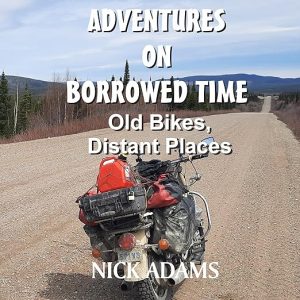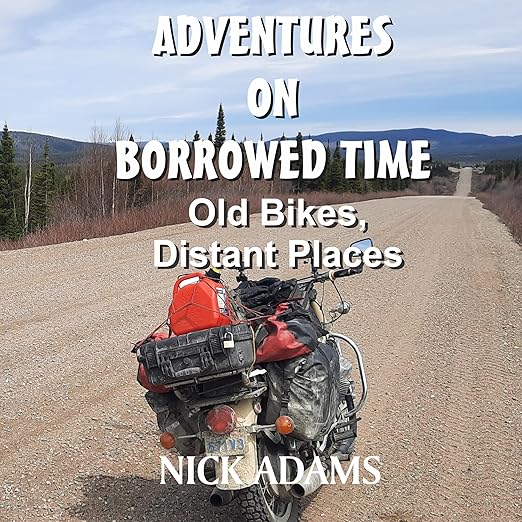
I came to Adventures on Borrowed Time by way of a recommendation from a reader who described it as "the book my dad would write if he could write." That description is both accurate and complimentary. Nick Adams is not a literary stylist in the conventional sense, but he is an exceptionally good storyteller in the way that specific people with specific experiences and genuine enthusiasm for sharing them tend to be. I listened to all five-plus hours on a long Saturday drive and found myself wishing my route were longer.
Adams is a Canadian motorcycle traveler and writer who has published several books about his rides on various aging machines through the wilder edges of North America. This one covers a series of journeys through the less-traveled parts of Eastern Canada: isolated communities on the Labrador coast, sixteenth-century Basque whaling settlements on Newfoundland's Avalon peninsula, gravel roads to Cree villages in the Quebec wilderness, unpaved back roads in Eastern Ontario. The bikes are elderly, a 1972 Moto Guzzi Eldorado figures prominently, and the mechanical difficulties are frequent, which is, in a sense, the point.
Where This One Lands
The title is a philosophical position as much as a description of the journeys. Adams is candid about age, he's in his seventies during these trips, and about the way that awareness of mortality changes how you experience motion and landscape. The opening of the book is essentially a meditation on all the reasons a person might talk themselves out of going: What if my bike breaks down? What if my joints hurt? What if it rains? He works through these objections not by dismissing them but by deciding, systematically, that they are insufficient reasons to stop moving. That's not a dramatic conclusion, but it's an honest one, and it gives the whole book a kind of philosophical ballast.
The destinations Adams chooses are genuinely interesting. He has an eye for the historically obscure and the geographically remote that keeps the travelogue sections from feeling interchangeable. The Basque whaling settlements in Newfoundland, the Cree villages accessible only by gravel roads, the communities on the Labrador coast that most Canadians have never visited, these feel like real discoveries rather than well-worn tourist territory. Adams describes them with the precision of someone who has done the research to understand what he's looking at.
Why Listen to Adventures on Borrowed Time
Adams narrates his own book, and this is the right choice. His voice has the comfortable, unhurried quality of a man who has spent a great deal of time moving through landscapes he finds beautiful and is in no particular rush to get anywhere. The conversational delivery suits the memoir form, these feel like stories being told in real time rather than polished accounts composed after the fact. One reviewer described the writing as feeling "more like listening to a good friend's stories than reading," and the audio format amplifies that quality considerably.
At five hours and twenty-three minutes, this is a short listen by audiobook standards. It won't exhaust a long drive or a weekend, but it fills one session extremely well. The pacing matches the subject: unhurried, specific, pleasurably digressive about mechanical details that non-motorcyclists might skim in print but that Adams makes feel consequential.
What Gives Us Pause
One reviewer noted a 1-star rating because the Kindle version wouldn't load on an old Mac, an entirely irrelevant consideration for the audio edition, but worth noting as a signal that this book attracts readers who are already fans of Adams' work rather than casual browsers. If you're coming to this cold, without prior motorcycle travel experience or interest in rural Canada specifically, the specificity that makes the book work for its core audience may feel like narrowness.
The book is also, by design, unhurried. There are no dramatic peaks, no moments of genuine peril (though the mechanical breakdowns provide mild narrative tension). If you need external conflict to sustain your attention, this isn't the book. But if you're the kind of listener who finds that the best travel writing is about attention rather than adventure, Adams delivers that reliably.
The Right Listener for Adventures on Borrowed Time
Motorcyclists, especially those who ride older machines or favor remote routes over tourist highways, will find this book deeply recognizable. Readers who enjoy quiet, observational travel memoir in the tradition of writers like Robert Pirsig or Eric Newby, books where the philosophy is embedded in the riding rather than declared, will also be at home here.
Listeners looking for dramatic adventure, survival stakes, or literary ambition beyond solid storytelling should look elsewhere. This is a book about a man on a motorcycle in rural Canada, told with warmth and specificity and occasional humor about things going wrong. That is enough, and for the right listener it is more than enough.