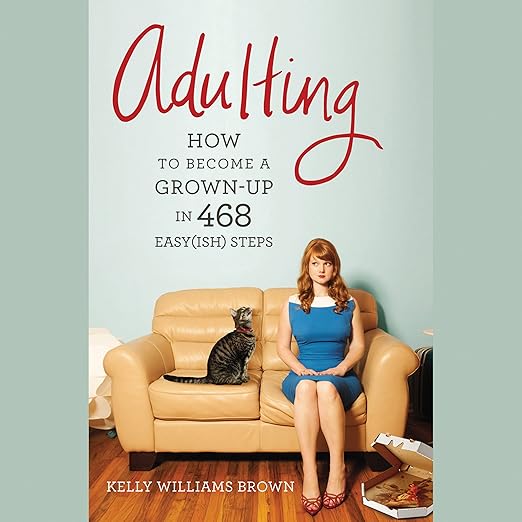
Competence is the promise, and this audiobook mostly keeps it, in the register of somebody who has already broken the toilet and then worked out how to fix it. Kelly Williams Brown built Adulting out of a blog, and the book keeps a blog's virtues intact: short units, a joke every few lines, and advice specific enough to act on before the section ends. It also keeps a blog's shelf life, which is the thing to weigh before buying.
Nine Hours, and Nobody Reviews Pal's Delivery
Humor carries the instruction here, and that is a structural decision rather than a coat of paint. One July 2017 account, graded five stars, lands the comparison precisely, describing an irreverent modern take on an etiquette manual that covers a great deal more than etiquette: thank-you notes, difficult neighbors, getting stains out of clothing, the groceries a functioning kitchen should always hold. That same account calls it a pep talk from the home-economics teacher nobody got, which is the tone in a single line.
Nine hours and fifty-seven minutes is a long stretch for a reference book, and nobody in the pool says a word about how Anjili Pal handles it. That silence costs more here than it usually would, because the material is built as a numbered sequence of steps rather than as a continuous argument. Print lets you jump straight to a numbered step and double back to an earlier one. Audio asks you to remember which one you wanted, and the comedy depends on timing in a way a checklist never does.
Ratings number two on this record, and the displayed average is 4.5, which two whole votes produce exactly: one four and one five, with no other combination available to them. Everything else on the page then contradicts it. Five written responses sit here, one of them a four and the rest fives, each carrying its own grade, and those five average 4.8. The counter therefore records fewer votes than the page displays opinions, and the figure it shows is not the one the visible grades produce.
Toilet Paper Gets Its Own Bay on the Map
Specificity is what makes this useful, and it is exactly where most books in the category give up. Checking the faucets and the stove rather than the nearby bars when you view an apartment is a real instruction with a real consequence. So is the guidance on finding a mechanic who will not rob you blind, and the frank suggestion for how to stop yourself flirting at work. The book commits to concrete cases instead of retreating into principles, and that is why it kept selling.
Renting, cooking, cleaning, neighbors, mechanics, frenemies, thank-you notes and the toilet: the coverage is genuinely wide, and the organizing joke is nautical, a Sea of Adulthood containing a Not Running Out of Toilet Paper Bay. That framing gets funnier the more mundane the subject underneath it becomes. The book understands the difference between a life problem and an admin problem, treats both as worth solving properly, and never suggests that one of them is beneath the reader's attention.
Professional recommendation is what February 2014 brings, in a five-star account from somebody who recommends the book to twenty-somethings and to their parents as part of their working practice, and who has given it away as a gift because it says the things a parent wants said by anybody other than a parent. The line that account quotes first is blunt: do not be hurt when the world does not care about you. That is the register throughout, funny and unsentimental at once.
Filed Under Home and Garden, Written for Life
House and Home is where this sits on the shelf, tagged under home and garden, and the placement is simply wrong. A handbook covering job interviews, office romance, friendship breakups, car maintenance and personal finance is a life-skills book with a comic spine. Anybody filtering for home and garden will be baffled by it, and anybody who genuinely needs it will never come across it, which is the more expensive half of a misfiled category.
Subtitles are missing here, and this one costs you real information. The listing carries a single word and nothing else. The December 2013 four-star quotes step eight by number, which tells you the book runs as a numbered sequence that the title never mentions anywhere. From this page a buyer cannot work out whether the purchase is an essay collection, a memoir or a checklist, and the honest answer is much closer to the third.
Thirteen years separate this recording from the present, and the age shows in places. The suggestion for keeping up with the world routes through public radio and a hair straightener. The money and housing material belongs to the rental market and the job market of its own moment rather than to this one. None of that breaks the book, since faucets and thank-you notes do not change, but a listener in their twenties now will be translating a few sections as they go.
Graduates and Their Parents Share This Gift
Graduates in a first apartment are the target, and the book knows precisely what that person does not yet know. It also works as a gift, which is how one December 2014 account, five stars, arrived at it, buying a copy for a twenty-year-old, reading the entire thing first, and laughing out loud several times before handing it over. Parents of new graduates are therefore a second audience, and the writing is calibrated to be survivable by both of them.
Newcomers expecting current advice on rent, credit or job hunting should treat the particulars with caution and keep the attitude. Anybody already running a household will find most of this obvious, which is no criticism of a book written for people who are not. And listeners wanting a structured curriculum rather than a numbered miscellany will find the organization loose on purpose. Grown-up is a verb in this book, and it conjugates it patiently, one small competence at a time.
How much of this audiobook is humor and how much is instruction?
Closer to half and half, with the two inseparable. Every practical unit arrives wrapped in a joke, and the jokes function as the delivery mechanism rather than as decoration, which means a listener who dislikes the comic voice never reaches the advice underneath it. Sample a few minutes before committing to the full run.
Do you need to have read the blog first?
No. The description says the book grew out of the blog, and the material has been reorganized rather than reprinted from it. Nothing assumes prior reading, and the numbered structure means every listener starts in the same place regardless. The blog is context for where the voice came from, not a prerequisite.
Does the audiobook cover money and work as well as housework?
Yes, and considerably more widely than the shelf label suggests. Job interviews, office relationships, finding a mechanic, ending friendships and personal finance all appear alongside cleaning and cooking. The organizing principle is competence in general rather than domestic skill in particular, which is precisely what makes the category tag so misleading.