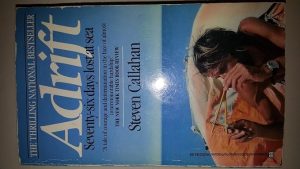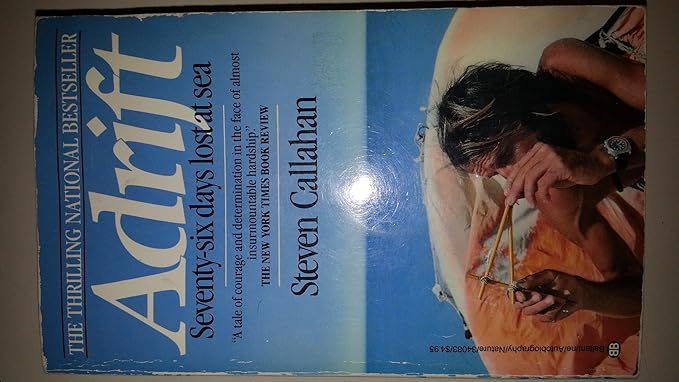
There is a very short list of survival memoirs that belong in a different category from the rest, books where the experience is so singular and so thoroughly examined that they become something more than adventure narrative. Adrift belongs on that list. Steven Callahan spent seventy-six days alone on a five-foot inflatable life raft in the Atlantic Ocean after his sloop Napoleon Solo sank in a storm west of the Canaries in February 1982. He survived by catching fish with a spear, collecting rainwater, and applying a self-taught engineering intelligence to keep his raft functional as it slowly deteriorated around him. He was eventually rescued off the coast of Guadeloupe, having drifted nearly eighteen hundred miles.
I came to this audiobook having read the print edition years earlier, and the experience of hearing Callahan tell his own story is fundamentally different from reading it. The distance that prose provides between the reader and the events narrows considerably when the voice doing the telling is the one that was there. There is a specific quality to Callahan's narration that is difficult to name precisely. It is not dramatic. It is careful in the way that a person is careful when they have had a long time to think about what happened to them and why, and what they want to say about it.
A Closer Look at Adrift
Survival literature as a genre has a structural challenge that Adrift navigates better than almost any other entry: how do you write about waiting? Callahan spent the vast majority of his time at sea in a state of active but repetitive labor: checking the raft's integrity, catching fish, rationing water, scanning the horizon for ships that mostly did not stop. The psychological dimension of this, the way time distorts under extreme stress and deprivation, the negotiations the mind makes to keep functioning, is where Callahan's account goes deepest. He is not simply narrating what happened. He is examining what it did to his thinking, to his sense of himself, to his relationship with fear and hope and the specific cruelty of almost-rescues.
Several ships passed without stopping. That detail is among the most haunting in the book, and Callahan's accounting of his response to each one, the surge of hope, the effort not to read meaning into the disappointment, the recalibration required to keep functioning, is a study in the psychology of sustained endurance that has no real equivalent elsewhere. Sebastian Junger's The Perfect Storm comes to mind as a comparison in the ocean survival subgenre, but Junger is reconstructing events from the outside. Callahan was there and has had decades to think about what being there meant, and the difference between those two modes of telling is audible throughout.
One of the elements that distinguishes Adrift from more purely experiential survival memoirs is Callahan's analytical intelligence. He was a boat designer before the sinking, and that training runs through every decision he made on the raft. His improvised repairs, his fishing techniques, his management of freshwater: all of these are described with a precision that is both practically interesting and psychologically revealing. The engineering mind that kept him alive also gave him a framework for examining what was happening rather than simply reacting to it, and that framework is part of why the account is so unusually coherent as narrative. He could think about his situation even when he could barely function physically, and that capacity becomes one of the memoir's central subjects.
This also means that the audiobook has significant technical content that may not be to every listener's taste. Callahan describes equipment, improvised tools, and survival techniques with the specificity of someone who believes the details matter, and they do matter, but listeners who want pure psychological narrative may find the technical passages denser than they expected. They are never dry, because the context is always life and death, but they require active attention rather than passive absorption.
Things to Know Before Starting Adrift
At just under seven hours, the audio runtime is appropriately proportioned for the material. Callahan reads with a measured, almost deliberate quality that suits the memoir's reflective stance. He does not perform urgency or distress; he recounts, which is the right register for a story this long in retrospect. There are moments of genuine emotion, particularly in the passages dealing with the ships that passed him and with the physical deterioration of his last weeks on the raft, that land with more force in his own voice than any interpretation could provide. The authenticity of having lived this is audible throughout, not as a performance of authenticity but as the actual thing.
This is one of those audiobooks where recommending the author narration over a professional alternative is not a hesitation. Callahan is the right reader for Callahan. The slight roughness in the delivery, the occasional hesitation, the sense of someone choosing his words carefully because the words matter: all of these add rather than subtract from the experience.
Who Steven Callahan Is Writing For
Readers drawn to survival literature, maritime adventure, and the psychology of extreme endurance will find Adrift essential. It belongs alongside accounts like Into Thin Air and Touching the Void in the canon of survival writing, and arguably exceeds both in the depth of its psychological examination simply by virtue of the duration involved. The author's narration makes the audiobook format particularly appropriate for this title. Those who prefer their adventure writing with faster pacing or less technical detail may find the middle sections demanding, but patience is rewarded by the specificity and honesty of Callahan's account.