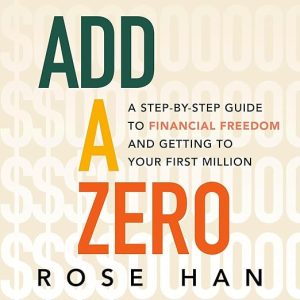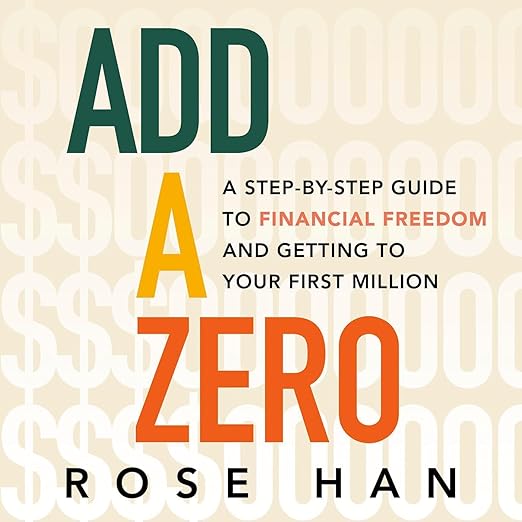
I came across Add a Zero at a time when I had been reviewing a stretch of personal finance audiobooks that all seemed to be talking to the same imagined reader: someone with a stable salary, an emergency fund already in progress, and just enough disposable income to feel guilty about lattes. Rose Han is writing for different people, and you can feel that difference from the first chapter.
Han built her platform on YouTube, documenting her journey from $100,000 in debt to financial independence and eventually millionaire status. That origin story is embedded in the book's DNA in a useful way: the advice is tested against her actual experience rather than constructed for a generic aspirational reader. She narrates the audiobook herself, which adds a dimension that the printed page cannot provide.
The organizing metaphor of the title is the book's most useful structural choice. Growing net worth one zero at a time, from $0 to $10,000, then to $100,000, then to $1,000,000, breaks wealth-building into psychologically manageable stages. Han's framework acknowledges that the mindset required to reach the first threshold is genuinely different from what is needed to cross subsequent ones. This is more intellectually honest than most wealth-building books, which tend to present the same strategy regardless of starting point. The Financial Waterfall, her system for prioritizing debt repayment alongside savings and investment, received specific praise from multiple reviewers. One listener who is self-employed and earns irregularly described it as the most practically useful framework they had encountered in the genre precisely because it accounts for variable income rather than assuming a steady paycheck. That specific validation matters. Very few personal finance books address the irregular income reality directly, and Han addresses it with real specificity rather than a note that results may vary.
Han's Own Voice Feels Like a Friend
The narration is the primary reason to choose the audio version. Reviewers who followed Han on YouTube consistently noted that listening to the audiobook felt like having a conversation with someone they already knew and trusted. That familiarity is earned through her years of public documentation of the same journey the book describes. Han's voice carries warmth and specificity rather than the polished distance of a professional narrator reading someone else's work. She also integrates QR codes and supplementary tools throughout, which are accessible via the companion PDF included with the Audible version. At six hours and twelve minutes, the pacing is tight enough that the book does not overstay its welcome, which is its own kind of discipline in a genre prone to substantial padding.
Strongest Early, Thinner Once Investing Begins
Han's book is strongest on mindset and on the early stages of debt elimination and initial wealth-building. Listeners who are already well into the investment phase of their financial lives may find the later sections thinner than they hoped. The book is also firmly optimistic in register, which is appropriate for its intended audience but occasionally tips into cheerleading rather than analysis. The psychoemotional framing, described by one reviewer as a powerful current flowing through the required mindset, is present throughout and may feel abstract to listeners who want purely tactical advice. Han balances both dimensions reasonably well, but if you come to this specifically for sophisticated investment strategy, you will want to supplement it with something more technically detailed than this foundation-level guide.
Right for Irregular Income and Early Debt Payoff
This is for anyone carrying debt they cannot seem to get ahead of, anyone in an irregular income situation that most finance books pretend does not exist, and anyone who learns best by hearing someone talk through their real experience rather than reading theory. It is also a strong choice for people who already follow Han on YouTube and want a structured version of the advice she distributes across individual videos. Skip it if you are specifically looking for advanced investment strategy or tax planning. This is the starting framework, not the advanced course, and it is genuinely excellent at what it sets out to do.
Good to Know
What is the Financial Waterfall system Rose Han describes in Add a Zero?
It is a prioritization framework for allocating money across competing demands: debt repayment, emergency savings, and investment, in a specific sequence. Han's version is designed to work for variable as well as fixed monthly income, which is its distinguishing feature over standard debt snowball or avalanche methods.
Does Add a Zero work as an audiobook if you also need the companion PDF tools?
Han designed the book with audio listeners in mind. The companion PDF referenced via QR codes is available in the Audible library and supplements the audio rather than replacing it. You can follow the core concepts without the PDF, but the tools add significant practical value.
How does Add a Zero compare to other popular personal finance audiobooks?
Han's approach is less rigid and more psychologically nuanced than most standard personal finance frameworks. She does not prescribe a single universal sequence but adapts the strategy to the listener's starting point. The tone is also less moralistic and more collaborative in character.