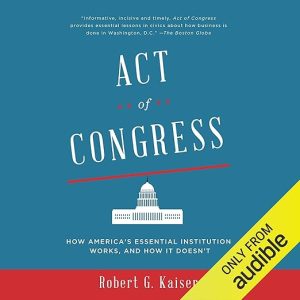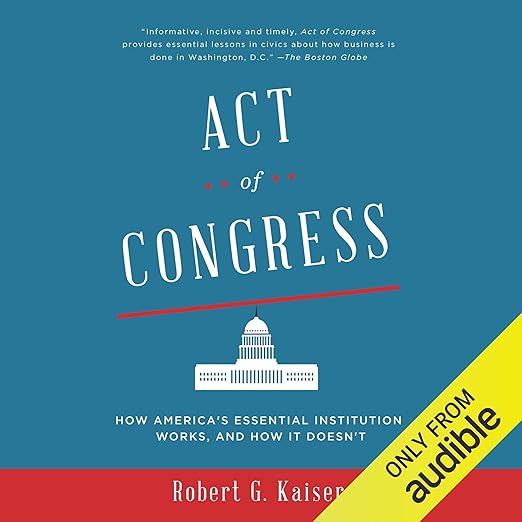
Robert G. Kaiser was given something rare: collaborative access to Barney Frank and Chris Dodd throughout the drafting and negotiation of a major piece of financial legislation, beginning before the 2008 crisis was fully resolved and continuing through the bill's passage. Act of Congress as an audiobook - narrated by Matthew Josdal across nineteen hours and nine minutes - is the documentary account that access produced. It is one of the most unflattering portraits of the American legislative system ever published by someone who clearly respects it and has spent a career trying to understand it, which is precisely what makes it so valuable.
The Dodd-Frank Act is the specific vehicle here, but Kaiser uses it as what multiple reviewers accurately describe as a mechanism to illustrate what really goes on in Congress. One reviewer noted that he could have written the same structural account using the Affordable Care Act, and the conclusion would have been substantially identical: ferocious partisanship regularly overwhelms all other considerations, congressional staff members are more influential than most senators or representatives realize or acknowledge, and individual integrity occasionally prevails against significant institutional pressure to abandon it. The Dodd-Frank case study makes these observations concrete rather than abstract.
Frank and Dodd Gave Kaiser the Whole Process
Kaiser's behind-the-scenes access is the book's foundational asset, and it is more extensive than almost any comparable legislative account. Both Frank and Dodd collaborated throughout the process and allowed their staffs to share every step of the drafting. This is not a reconstructed account built from later interviews and document requests; it is a contemporaneous record of how a major piece of legislation was argued, negotiated, lobbied, and ultimately passed. The level of detail about the role of financial industry lobbying - both where it succeeded and where it surprisingly failed to shape the bill - is specific enough to permanently alter how you think about the relationship between capital and legislation.
The character portraits are where Kaiser's long career as a Washington Post reporter shows most clearly. Barney Frank - brilliant, sometimes abrasive, who mastered the financial reform details to a degree unusual among legislators who typically delegate that work to staff - and Chris Dodd - patient, relationship-driven, committed to a vision of bipartisan Senate process that the institution was actively working to destroy around him - are rendered as fully human actors with real complexity rather than as ideological symbols or simplified heroes. One reviewer described the book as among the best they had read about US politics and policy, specifically citing the detailed account of how the bill was actually created as its distinguishing strength.
Nineteen Hours Because Kaiser Refused to Abbreviate
That level of detail is both the book's greatest asset and the reason it requires the commitment of a nearly nineteen-hour audiobook rather than fitting into a shorter format. Kaiser does not abbreviate the process to make it more palatable. He renders it at the length it actually took, which is part of the portrait.
Josdal Keeps Frank and Dodd's Voices Apart
Josdal's narration earns its place in a dense and demanding text. Legislative process writing has a specific challenge: the cast of characters is large, the procedural steps are granular, and the stakes can feel abstract even when they are economically consequential for millions of people. Josdal differentiates the major players consistently - Frank's combative intelligence sounds different from Dodd's patient pragmatism, and the various staff members and lobbyists who move through the account are held distinct from each other. The transitions between floor action, committee markup, backroom negotiation, and public positioning are managed with the pacing that keeps procedural content readable without sacrificing the detail that is the book's purpose.
The financial regulation subject is the lens rather than the limit. Listeners who followed the 2008 crisis and its regulatory aftermath will find the behind-the-scenes account of Dodd-Frank valuable regardless of their position on the legislation's specific provisions. Kaiser is not an advocate for the bill. He is a reporter following a process. The honest portrait he produces includes both the genuine achievements of the legislation and the places where institutional dysfunction produced outcomes that had more to do with political survival than with sound financial regulation.
Already Knowing Congress Changes How This Lands
Nineteen hours is a meaningful commitment, and the book earns that length by being genuinely informative rather than artificially extended. But listeners who want a brisk narrative will find the procedural detail demanding of sustained attention. This is a document-level account of legislative history, and the density is part of what makes it definitive. One reviewer who already knew a great deal about Congress found it confirming rather than revelatory - which is the right response from someone who came in informed. For listeners encountering the full picture for the first time, the same content will land with considerably more force.
Dodd-Frank has been modified multiple times since the book was published, and some of the specific regulatory provisions Kaiser describes have since been altered or repealed. The book is not a current guide to financial regulation. It is a historical account of how a specific reform was built in a specific political moment. That distinction matters for listeners who come to it looking for current regulatory analysis rather than legislative history.
Readers of the 2008 Aftermath Will Want This
This audiobook is for listeners who want to understand how the American legislative process actually functions at the level of specific decisions, specific personalities, and specific institutional pressures rather than in the abstract language of civics education. It is for listeners who followed the 2008 financial crisis and its aftermath, for students of American government and political science, and for anyone who has wondered what the distance between democratic theory and legislative reality actually looks like from close range. Listeners wanting a short overview of Congress or a current regulatory analysis should look elsewhere. For those willing to invest in the full account, Kaiser's portrait of Dodd-Frank in the making is one of the most substantive pieces of political journalism available in audio form.
A Few Questions About Act of Congress
Does this audiobook require prior knowledge of the Dodd-Frank Act or financial regulation to follow the narrative?
No. Kaiser builds the financial context as he goes, explaining reforms and regulatory provisions as they become relevant to the legislative story. Listeners without a finance or regulatory background can follow the account through the political and procedural narrative.
Does the audiobook cover the role of financial industry lobbying in the Dodd-Frank process in specific detail?
Yes. Kaiser examines where financial industry lobbying shaped the legislation, where it surprisingly failed, and how both Frank and Dodd navigated that pressure throughout the drafting process. This is among the most illuminating sections in the book.