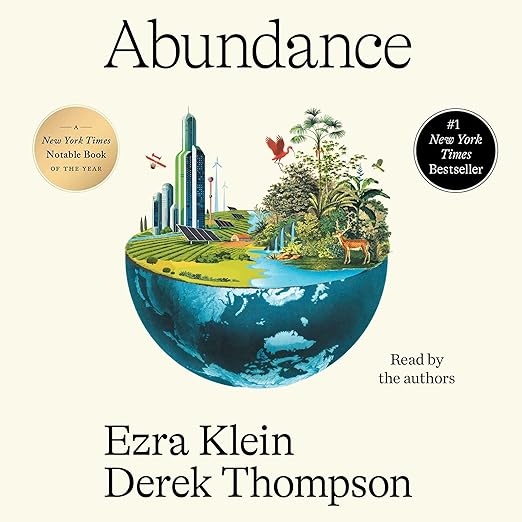
Housing, clean energy and immigration do not usually share a diagnosis. Abundance insists that they share exactly one, and that the shortage running through all three was chosen rather than suffered. Seven hours and fourteen minutes is a lean runtime for a book with this much political ambition, and Simon and Schuster Audio released it in March 2025 with Ezra Klein credited as the reader. Start with that credit, because the audiobook has two authors and the listing acknowledges only one.
Yesterday's Rules Block Today's Urgent Needs
Klein and Thompson make a generational argument rather than a partisan one. One generation's solutions, the argument runs, become the next generation's problems: rules written to stop the abuses of the 1970s now block the urban density and green energy the 2020s need, and laws designed to make government consider the consequences of its actions have made it too slow to act consequentially. The formulation that stuck with me is the one about capacity, that our ability to see problems has sharpened while our ability to solve them has withered. The five-star from early September 2025 supplies the sharpest one-line summary anyone has managed, proposing Supply Side Economics For Liberals as an alternative title. That is not a dismissal. It is close to the thesis.
Where the book is weaker is in its claim to symmetry. The framing asks liberals to admit when government is failing and conservatives to admit when government is needed, which sounds evenhanded until you notice how the chapters are weighted. The audience being addressed, corrected and organized already believes in public capacity. Conservative readers are invited to observe rather than to change, and the honest version of this book would say so on the cover rather than in the last third.
Seven Hours That Turn Policy Into Story
Compression is the underrated virtue here. Seven hours is short for a policy book with this scope, and the argument stays legible from beginning to end: what was built, what stopped being built, which rules did the stopping, what a politics of plenty would require instead. Klein and Thompson write for people who are not in the room where these decisions get made, and the housing chapters in particular do something rare, turning permitting and environmental review into a story with stakes rather than a procedural complaint.
The five-star filed in February 2026 gets at why the tone works. Parts of the book are described there as genuinely depressing, since the material is a catalogue of what could have existed and does not, and yet the same response reports coming away hopeful about housing specifically, and credits the authors with calling out obstruction from any political direction. That combination, dispiriting evidence and a usable conclusion, is difficult to sustain across seven hours and mostly holds.
One Credited Voice for Two Different Reporters
Audio raises a question the argument itself cannot settle. This is a co-written book with one credited voice, and audio removes the visual cues that would tell you whose reporting you are hearing. A print reader can check a byline on an essay adapted into a chapter; a listener gets a continuous first-person plural instead, a we that never resolves into two people with different beats and different priors. For a book whose authority rests on two journalists having covered different territory, that flattening costs something real.
Thompson's Name Missing From His Own Byline
The most useful skeptical read comes from a four-star posted in July 2025, which grants that the authors are informative while arguing that they break little new ground, describing them as loquacious, too often unfocused and rarely practical about problems that are not in dispute. That is a fair characterization of the middle hours. The diagnosis is repeated more often than it is deepened, and a listener who already accepts the premise will feel the book circling.
Sharper criticism comes from the three-star posted later in September 2025, written by an engineer who came to the title expecting sustainable abundance and a set of workable solutions, and found instead a selection of illustrative situations chosen to support the argument, with the opening and closing sections rated far above the middle. Note what that entry measures the book in: pages, not hours. Every written response on this record describes reading a printed copy, which is worth holding in mind on a listing whose badge is meant to describe a recording.
Metadata on this record carries two real defects. Derek Thompson is named repeatedly in the description, appears in the blurbs and is referred to by the reviewers, yet the byline shows Ezra Klein alone, so half the authorship is invisible to anyone browsing by name. And the rating counter reads four while five written responses sit underneath it, which means the number a buyer uses to judge confidence is smaller than the column it supposedly summarizes. A 4.5 built from four whole-star votes is arithmetically possible, but it is describing a much thinner base than the accolade stack at the top of the page implies.
Required Listening for Housing Policy Circles
Anyone who follows housing policy, energy buildout or the mechanics of why American infrastructure takes so long should treat this as required listening, and the five-star from January 2026 makes that case more expansively than I would, naming candidates for office, think tank leaders, policy advocates, students of government and ordinary citizens across the political spectrum. The book is at its best as a shared vocabulary. It gives a name to a frustration a lot of people have been circling for a decade.
Listeners hunting for implementation detail will be frustrated, and so will anyone who wants the opposing case argued at full strength rather than summarized. Seven hours buys you a diagnosis, a set of illustrative failures and a direction, not a program. Come to it as the opening statement in an argument that is still running, and the compact runtime becomes a feature: this is the book you listen to before the debate rather than the one that settles it.
- Narration: The reading credit goes to one of the book's two authors, so a co-written argument arrives in a single voice and the collaborative we never gets a face attached to it.
- Themes: Chosen scarcity, housing and clean-energy construction, regulatory sclerosis, supply-side liberalism
- Mood: Argumentative, briskly diagnostic, more impatient than angry
- Verdict: A clear and unusually compact policy argument that names the problem far better than it solves it.