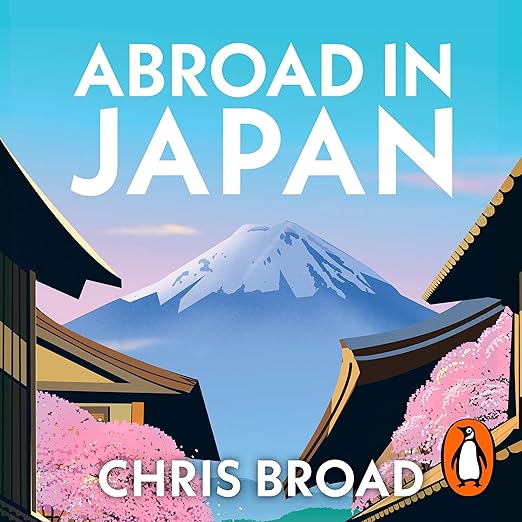
Forty-seven prefectures and ten years of living in them supply the raw material for this audiobook, and Chris Broad performs it himself, which for someone whose working life is spent talking to a camera is the only arrangement that makes sense. The book opens with an Englishman landing in a village in the rural north with no Japanese and no teaching experience, convinced he is about to be dismissed faster than anyone in the country's history, and it covers, across a little over eight hours, the summit of Mount Fuji, a missile passing overhead, and a week spent alongside Ken Watanabe.
The Verdict, Briefly
Comedy carries most of the weight, and the culture writing arrives underneath it rather than alongside. That is the correct order for this material. Broad is not a scholar of Japan and the book never pretends otherwise; what he has instead is a decade of accumulated embarrassment, a good ear for the moment a social rule reveals itself, and enough distance from his younger self to let the early chapters be genuinely humiliating. Memoirs written by people who arrived somewhere unqualified tend to age well.
One response in the pool is worth more than the other four combined, and it comes from somebody who begins by admitting to never having finished a book before, picked this one up because of the author's channel and podcast, and came away feeling like a friend had told them a story. That is the exact effect this kind of memoir is aiming for, and hearing it confirmed by a self-described non-reader says more about the accessibility of the prose than any measured praise could.
Broad's on-page personality is inseparable from the appeal, and the written responses keep circling that without quite naming it. People describe recognizing a person rather than a prose style, which tends to happen when a writer has spent years saying similar things aloud to an audience. The obvious risk in that arrangement is a book that reads like a transcript of the videos, and the decade-long span is what saves it, since no single episode could carry an arc that long.
Why Abroad in Japan Works as an Audiobook
Inventory is what the May 21, 2025 response offers, and it is a useful one: Japanese people, food, customs, and history, the experience of teaching as a young foreigner, then documenting life across different regions, through earthquakes, a missile flying overhead, heavy snow, and the slow business of learning the language. Four stars from that entry, not five, and the difference reads like somebody who enjoyed the tour without being transformed by it. That is a fair place to set expectations.
Ten years is the unit of measurement, and the length is doing something structural. A twelve-month expat account gives you culture shock and little else; a decade gives you the far more interesting arc where the strangeness stops registering and Broad has to work to remember what confused him. The best passages in the book sit on that boundary, where a rule he once found baffling is now simply how things are done.
Set pieces earn their placement too. A terrifying North Korean missile incident, a national television appearance that went badly wrong, a week in the company of the country's biggest movie star: the description names these up front, and they arrive as promised rather than as a bait-and-switch. For a memoir assembled from a decade of small observations, having three genuine anchors keeps the middle from drifting.
Points to Consider
Publishers do not line up on this listing. The credited house is Transworld Digital, while the description opens by announcing Penguin and the copyright line names Penguin Audio for the 2023 recording. Neither claim contradicts the other outright, but a buyer comparing editions has three house names to reconcile, and the same copy carries a doubled verb and a dropped word inside two sentences of the opening paragraph. It is not the tidiest storefront entry I have read this year.
Impenetrable is the word the description reaches for, promising to unravel one of the world's most mysterious cultures, and that is a claim no comic memoir can meet. What the book actually delivers is one foreigner's decade, filtered through the specific accidents of teaching placement and video production. That is plenty. Anyone arriving because the copy promised explanation rather than anecdote should adjust before pressing play, because the pleasures here are personal rather than analytical.
Names and places come at you steadily, and one September 2024 response confirms this works by ear: that listener moved between the recording and a printed copy, and reports finding the names and cities easy to recognize even while mostly listening. Worth knowing, because eight hours of Japanese place names read by a non-native speaker is exactly the scenario where audio versions of travel memoirs come apart. This one appears to hold together.
Who Should Pick Up Abroad in Japan
Viewers of the channel are the obvious constituency, and the October 23, 2025 response makes the case for them: engaging enough to finish quickly, good stories, and a useful look at living and working in Japan as a foreigner. The same entry recommends it to anyone curious about Japanese culture from an unusual angle, which is the wider audience. You do not need to have watched a single video for the book to work.
Anyone wanting a practical guide should look elsewhere entirely. No itineraries, no phrasebook, no advice on where to stay, and the classification of this as travel writing is generous: it is a memoir that happens to be set across a country. Listeners after cultural analysis with citations attached will find the register too light, and readers who dislike self-deprecating comedy will find a great deal of it.
Whatever else this is, it is unusually good company. The stories are properly told, the author knows precisely when a joke has run its course, and the decade of distance keeps the whole thing from curdling into the kind of expat writing that mistakes bafflement for insight. Start it if you want a country explained through one person's mistakes rather than through its statistics.
In Brief
- Performance: Read by the author, a creator whose whole practice is spoken delivery, and the material was clearly written to be said out loud.
- What it covers: Expat life in Japan, culture shock worn down over a decade, teaching abroad, comic humiliation
- Feel: Warm, self-deprecating, quietly informative
- Our call: A very good decade-long expat memoir that is funnier than it is analytical, and never claims otherwise inside the book itself.
Do you need to know Chris Broad's channel before starting this audiobook?
No. Two of the five written responses come from people who follow his videos and a third mentions the channel only through a partner, which explains the warmth of the pool. The book introduces its own premise from scratch, two responses never raise the videos at all, and nothing in the opening chapters rewards prior familiarity.
How much of the audiobook is about teaching English in Japan?
Teaching is the entry point rather than the subject. The opening stretch covers arriving in a northern village with no language and no classroom experience, but the book spans a decade and forty-seven prefectures, so the job recedes once the travel and video work take over the narrative.