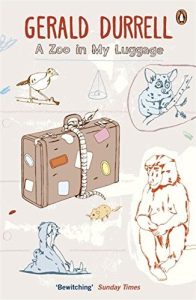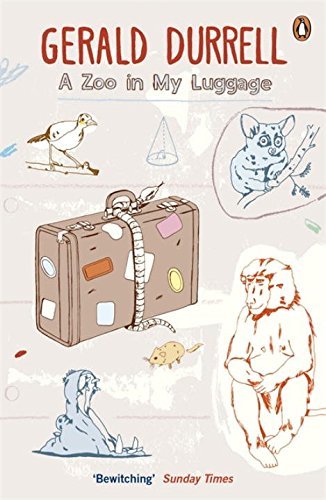
Where exactly do you keep a chimpanzee while you look for premises? That is the practical crisis running through the back half of A Zoo in My Luggage, and it is why this short audiobook is a good deal funnier than its travel shelving implies. Gerald Durrell's account opens on a third trip to the British Cameroons in West Africa, where he and his wife collect animals for a zoo they do not yet own, then follows them home to England, where the animals arrive and the zoo still does not exist. Rupert Degas reads just under five and a half hours of it. Penguin is the publisher of record, and the record itself has problems worth walking through first.
A Closer Look at A Zoo in My Luggage
Two fields on this listing begin with an invisible left-to-right control character, the kind that gets carried along when somebody copies a block of text out of a printed product-details table and pastes it into a catalog form. The publisher field and the language field both carry it. The running time appears in a clipped abbreviated form rather than the fuller phrasing catalog entries normally carry, which is a second sign of a paste rather than a keyed field. The release date is January 1, 2012, and a first-of-January date is what a database shows when the year is known and the day is not. None of this touches the recording, but it does tell you the metadata was assembled quickly from somewhere else.
The publisher line deserves its own note. It reads simply Penguin, with no audio imprint attached, on a product that exists only as audio. Between that, the placeholder date and the pasted fields, a buyer comparing editions has very little to work with. What is solid: a named reader, a running time, and a description that sets out the book clearly.
The structure is the joke. Half the book is the expedition, which behaves the way expedition writing is supposed to, and half is the aftermath, which does not. Durrell comes back to England with Cholmondeley the chimpanzee, Bug-eye the bush baby and a quantity of other creatures the copy declines to itemize, and no site for the zoo he collected them for. The description is quite clear that managing the menagerie in a succession of unsuitable places around England supplies as much adventure as catching them did, which is a promising sentence in a book about catching things.
That structure sets the reading a specific task. Comic prose of this kind builds long sentences and puts the payoff in the final clause, so the timing of a single voice decides whether a paragraph lands or simply passes. The other job is population control: a bush baby, a chimpanzee and a rotating cast of officials, neighbors and animals need to stay separable across five hours without a cast list to help. Sample a stretch where an animal is arriving somewhere it should not be, rather than the framing chapter, and you will hear immediately whether the timing is there.
Things to Know Before Starting A Zoo in My Luggage
The entire written column on this listing is two words long. One response, headed Five Stars, filed in August 2015, consisting of the phrase fun story. The badge of 5.0 is perfectly legitimate over a single vote, since one person choosing five stars produces exactly that, but it means the number tells you nothing beyond the fact that one buyer was pleased. A record with no reception is not a record with bad reception, and the two get confused constantly. Judge this one on the author, the reader and the sample, because the page offers no third-party evidence at all.
The genre placement is only half right. Filed under travel with a tag reading Africa, this record describes a book that leaves Africa around its midpoint and spends the remainder in England solving a housing problem. Anyone shopping specifically for West African travel writing will get a partial serving of it. Anyone shopping for a book about founding a zoo will get more than the shelf label suggests.
Worth knowing what the expedition actually involves, too. The premise is capturing wild animals and transporting them back to England to stock a private collection, described throughout in a thoroughly cheerful register. That practice sits very differently in current conservation thinking than it did when the book was written, and the copy makes no acknowledgment of the distance. Some listeners will read it as the historical document it is; others will find the good humor around it harder to share.
Who Gerald Durrell Is Writing For
Good company if you enjoy comic memoir where the author is the least competent creature in the room, if animals behaving badly in domestic settings is a genre you would happily hear more of, or if you want something short and buoyant between heavier books. The description positions it for readers who already know My Family and Other Animals, and that is fair, though nothing here depends on having read it. Families should note the copy's own promise of animal lovers of all ages, which the content supports.
Look elsewhere if you want natural history rather than anecdote, since the animals are characters here rather than subjects. Look elsewhere too if a thin listing bothers you, because with one rating, two words of reception and a publisher field that was clearly pasted from a print catalog, you are buying on reputation. Five hours is a small enough bet that the reputation will probably do.
How much of the audiobook actually takes place in Africa?
Roughly the first half. The trip to the British Cameroons occupies the collecting section, after which the book relocates to England for the considerably more chaotic business of housing everything that was collected. The description treats the second half as equally eventful, which is why the travel label undersells it.
Is this audiobook suitable for younger listeners?
The copy pitches it at animal lovers of all ages and the material supports that. Expect comic misadventure, animals turning up in unsuitable places and a great deal of exasperation rather than danger. Older children who already enjoy funny nonfiction are the natural audience for it.
Which animals actually make it home?
The description names two of them: Cholmondeley the chimpanzee and Bug-eye the bush baby, describing both as additions to the family rather than to a collection. Others travel with them without being itemized, which is part of the joke, since the household has no idea how many are coming.